

Signals: S10 Migration & Demographic Shift · S7 Water Stress & Allocation · S11 Public Finance & Infrastructure Capacity
The premise is that social infrastructure, the habits and institutions a place builds together, helps make an asset durable. On Thursday, we asked whether heat is really pushing European hotel guests north, and found that measured demand didn’t match what travelers told surveys. Today we move from guests to residents, and to an official population forecast.
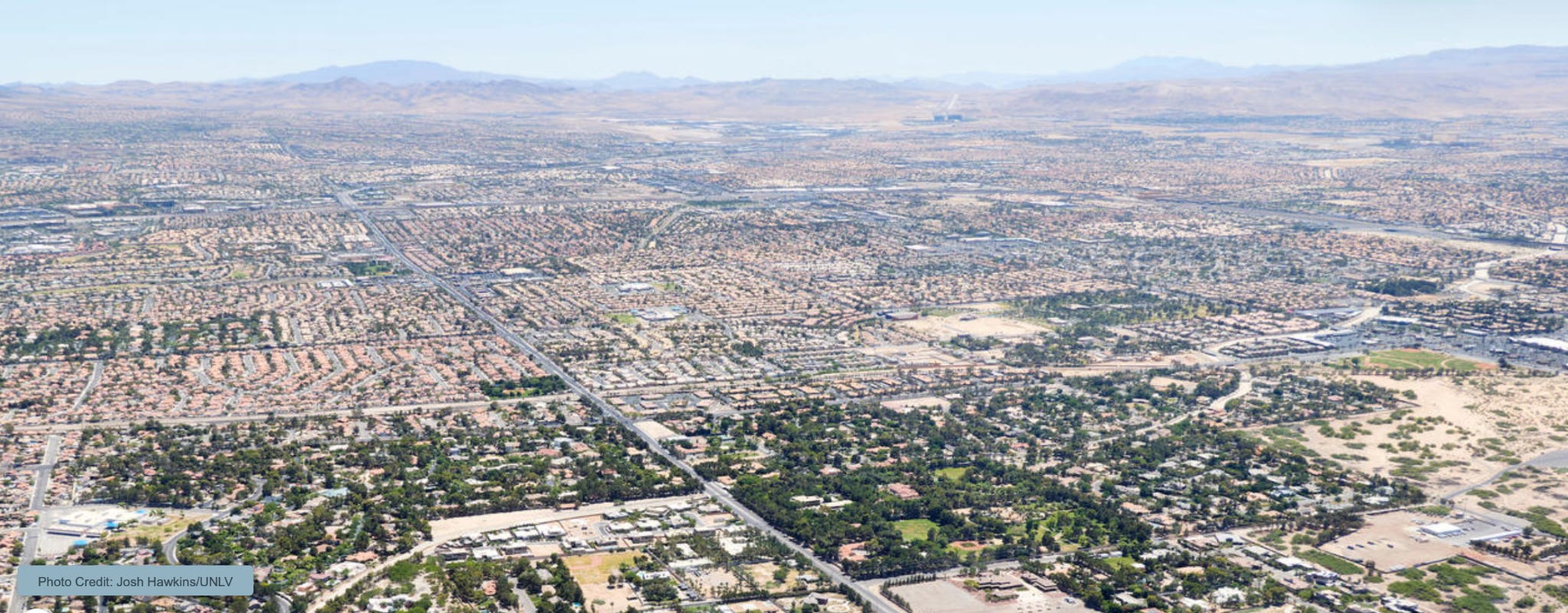
In July 2026, the growth forecast for Las Vegas lost a decade. Is water the reason, and how much growth can the valley’s water actually carry?
Market Signal
On July 22, 2026, the University of Nevada, Las Vegas (UNLV) released the annual population forecast for Clark County, home to Las Vegas, from its Center for Business and Economic Research (CBER). A year earlier, CBER projected the county would reach 3 million residents by 2045. Its 2026 forecast moves that milestone to 2055.
CBER now expects the county to add about 204,000 residents between 2026 and 2036. Last year’s forecast had about 347,000 over the same period. That’s about 143,000 fewer people, a 41% cut in the decade’s expected growth. In other words, it’s a cut in a forecast, not a loss of people.
CBER projects the county’s annual growth rate to fall from 1.6 percent in 2026 to about 0.6 percent in 2029, then hold relatively steady through 2060. CBER also expects natural change, meaning births minus deaths, to turn negative around 2032. All of it is modeled, not observed.
Why the slowdown? CBER gives three reasons. Birth rates in Clark County run below the national average. Net migration, both domestic and international, is expected to be lower than past forecasts. And a higher share of the migrants who do arrive are retirees, which CBER calls a change from previous decades.
Water isn’t on that list. Despite the headlines, I couldn’t find hard data showing that water, heat, or the new Colorado River rules are causing the slowdown.
Where does the county stand today? The Census Bureau estimates Clark County’s population at 2,407,226 on July 1, 2025. USAFacts, relaying the Census Bureau’s estimates, puts the county’s growth from 2024 to 2025 at about 21,500 people, or 0.9%. Roughly 8,900 came directly from another country, about 8,500 came from elsewhere in the US, and births exceeded deaths by about 4,000.
That mix matters. The Census Bureau reported in January 2026 that net international migration to the US was 1.3 million in the year to June 30, 2025, down from 2.7 million the year before, a decline of 53.8%. In March, it reported that the 50 counties with 1 million or more people, including Clark County, had a combined net domestic migration loss of 637,634.
While the Census Bureau does not make this point, it seems reasonable to me that a county leaning this much on international arrivals will feel that drop.
Case Study
In five weeks this past summer, Clark County got a slower forecast, a new federal rulebook for its main water source, and a lawsuit.
The Las Vegas Valley runs on the Colorado River. In a complaint filed on August 24, 2026, Nevada says its share is 300,000 acre-feet per year, or a relatively meager 3.3% of the water apportioned to the Lower Basin states and Mexico. The Lower Basin states are Arizona, California, and Nevada. An acre-foot is enough water to cover one acre of land one foot deep. The complaint also says the river supplies 90% of the valley’s water.
On August 21, 2026, the Bureau of Reclamation, the Interior Department agency that runs Lake Mead and Lake Powell, released its Record of Decision, the formal decision on how the two reservoirs run from 2027 through 2036. For 2027 and 2028, it cuts Lower Basin deliveries by 1.25 million acre-feet in each year. Arizona takes 760,000 acre-feet of that, California 440,000, and Nevada 50,000.
The operating guidelines for 2027 and 2028 apportion 250,000 acre-feet to Nevada, a 16.7% cut to Nevada’s share. According to Alex Hager at KJZZ, the new rules officially took effect on October 1, 2026, and the Lower Basin states are still finalizing an implementing agreement.
Does a 50,000 acre-foot cut bind today’s taps? No. Headroom is the gap between what you’re allowed to use and what you actually use. Nevada’s complaint puts the state’s 2025 consumption at 198,570 acre-feet. The Southern Nevada Water Authority (SNWA), the valley’s wholesale water agency, says on its own site that Nevada’s consumptive Colorado River use was 212,400 acre-feet at the end of 2024.
Set against the 250,000 acre-foot allocation, that leaves a margin of about 37,600 to 51,430 acre-feet, depending on which year you use. In other words, the adopted cut lands inside the cushion.
Where did that cushion come from? Decades of conservation by the people who live there. But each source counts it differently.
Nevada’s complaint says consumption fell from 325,000 acre-feet in 2002 to 198,570 acre-feet in 2025, despite an increase of 875,000 new residents.
Separately, SNWA says Southern Nevada reduced its per capita water use by 58 percent between 2002 and 2025. Both come from parties to the lawsuit, and they measure different things—the former looks at total use and the latter at per-person use.
So what is Nevada suing over? The complaint alleges the decision would let the Interior Secretary impose an annual reduction on Nevada of 213,556 acre-feet, based on a 3.6 million acre-foot shortage, which it says is about 71% of Nevada’s entitlement.
That number isn’t invented. Reclamation’s own Final Environmental Impact Statement (EIS), the analysis behind the decision, gives Nevada 5.93% of shortages in its long-run modeling. 5.93% of the modeled 3.6 million acre-foot maximum matches the complaint’s number within rounding.
But the Record of Decision says the Department is not adopting the specific shortage volumes, shortage distributions, or conservation activities reflected in assumptions used to analyze the Preferred Alternative. It adopts a maximum potential shortage of up to 3 million acre-feet for the Lower Basin states for 2027 through 2036, allocated under applicable law. In other words, the 71% is Nevada’s description of the deepest modeled case, not a cut anyone has ordered.
And if that case did happen? Taking 213,556 from 300,000 leaves 86,444 acre-feet, which is 43.5% of 2025 use. The governor’s office puts it at less than 86,500 acre-feet per year.
That’s where the cushion runs out. The moat has a depth. The adopted cut sits inside it, and the deepest cut in Nevada’s complaint would go well past it.
Nevada, its Colorado River Commission, and SNWA filed suit in federal court in Nevada against Interior Secretary Doug Burgum and others. They ask the court to vacate the decision, the Final EIS, and the 2027 and 2028 guidelines. KJZZ reported on October 1, 2026, that the lawsuit is still working its way through the legal system, and as a reminder, every claim in the complaint is only an allegation at this point.
Strategic Implications
Driver one is that the base case should be the new forecast, not the old trend. The rental market this lands on is already soft. Lee and Associates, a commercial real estate brokerage working from CoStar data, reports Las Vegas multifamily vacancy at 10.8% in the second quarter of 2026. Asking rent was $1,473 per unit, down 2.25% from a year earlier, with 70% of properties offering generous concessions.
Net absorption, meaning units newly occupied minus units vacated, was only 1,327 over 12 months, against 3,366 units of new supply. That’s about 39% of what was delivered. Another 4,456 units are under construction, with an expected 3.4 years of absorption at that pace. These are a broker’s figures, but next to a forecast that cut a decade of growth by about 41%, lease-up and rent assumptions built on the 2010s growth path look too generous.
Driver two is that water is both a ceiling and a forecast input, not the cause of projected slower population growth for Las Vegas. Since 1996, CBER has produced the forecast with the Regional Transportation Commission of Southern Nevada, SNWA, and a group of regional forecasting partners. SNWA spokesperson Bronson Mack says the forecast supports Southern Nevada’s 50-year water resource plan. So water feeds the forecast as an input and sets the ceiling on how far growth can run. It isn’t what’s slowing growth down.
Driver three is that the water agency is a public-finance counterparty. Nevada Governor Joe Lombardo called this a matter of survival for a community that represents about two-thirds of our state’s citizens. On Census figures, Clark County is 73.3% of Nevada’s population, so the governor understates his case.
His office says the federal analysis skipped the impact of what it calls draconian curtailments on southern Nevada’s $180 billion economy, not a loss estimate. SNWA’s general manager, John Entsminger, said conservation has limits, and the reduced water volume Interior has proposed makes it impossible to meet even this community’s basic needs.
Driver four is the community itself. A valley that cut its total water use while adding hundreds of thousands of residents shows that shared habits can stretch a fixed supply. That record lets Nevada argue in court that it has already done its share, and it keeps the adopted 250,000 acre-feet above current use.
CBER director Andrew Woods says growth isn’t guaranteed; it’s earned through long-term planning and investment in jobs, education and workforce training, healthcare, and other quality-of-life improvements. In other words, the valley’s frugality built the cushion, and that cushion leaves room for growth.
Driver five is that an older inflow changes who rents. CBER says a higher share of new arrivals are retirees. For multifamily owners and build-to-rent developers building single-family homes to lease, that points to smaller, accessible units and away from the young-household renter pool many pro formas assume.
Future Signal
I don't expect the adopted cut to directly affect rents, because the allocation still sits above current use. It shows up at the exit. A 2030 buyer will face tighter market conditions than Las Vegas had in the 2010s. They will have to navigate a slow-growing county (0.6% annually), upcoming regulatory guidelines, and the court’s stance on the decision.
Watch five things.
First, the next guidelines process, which the Interior Secretary must begin no later than October 1, 2027.
Second, Nevada’s lawsuit, for an answer, an injunction motion, or a ruling.
Third, the Census Bureau’s next county estimates, which will show whether international arrivals held up.
Fourth, CBER’s next annual forecast, which will say whether 2055 holds.
And fifth, Nevada’s 2026 water use against the 250,000 acre-foot line. The narrower the gap, the shallower the moat.
Stakeholder Takeaway
If you own or develop multifamily or build-to-rent in Las Vegas, replace trend-based absorption with CBER’s July 2026 path. Model the adopted 250,000 acre-feet as today’s ceiling, and treat the complaint’s deepest case as a stress test, not a forecast.
If you lend in the valley, ask the sponsor which population forecast sits under the rent growth, and which year’s water use sits under any headroom claim. That choice alone moves the cushion by 13,830 acre-feet.
As always, KNOW YOUR SIGNALS and BE CLIMATE READY!
Jamie
Run this on your own deal
The CRDF Signal Tracker™ built for this brief lets you log what this brief turns on, CBER’s annual forecast, Clark County’s Census components, Nevada’s water use against its 250,000 acre-foot allocation, the guidelines process, the lawsuit, and quarterly vacancy, concessions, and absorption, with every entry dated and sourced. Free, no signup: Brief 49_CRDF Signal Tracker™ (xlsx)
New to the framework? The blank master CRDF Signal Tracker™ and Deal Stress Test™ workbooks are at climatereadyre.com/tools.
Related briefs
Same signal (S10 Migration & Demographic Shift):
Next in sequence:
Sources
Every figure above includes the data coverage date, the publication date, and the date I verified it.
The forecast — Clark County’s 3 million milestone moves from 2045 to 2055; about 204,000 residents added between 2026 and 2036 against about 347,000 in the prior forecast; annual growth from 1.6 percent in 2026 to about 0.6 percent in 2029; natural change negative around 2032.
UNLV Lee Business School, Center for Business and Economic Research, Population Forecast release (Jessica Soria) · Data as of Forecast to 2060 · Published Jul 22, 2026 · Accessed Oct 2026
A modeled forecast, not observed data. CBER cites birth rates, net migration, and the retiree share of arrivals.
Who makes the forecast — produced since 1996 with the Regional Transportation Commission of Southern Nevada, SNWA, and regional partners; it supports SNWA’s 50-year water resource plan; Andrew Woods on growth being earned.
UNLV Lee Business School, CBER release, quoting Bronson Mack (SNWA) and Andrew Woods (CBER) · Data as of Jul 2026 · Published Jul 22, 2026 · Accessed Oct 2026
Water is an input to the forecast and a ceiling on growth, not a stated cause of the slowdown.
Clark County today — population 2,407,226 on July 1, 2025.
US Census Bureau, QuickFacts, Clark County, Nevada (Vintage 2025) · Data as of Jul 1, 2025 · Published Vintage 2025 · Accessed Oct 2026
Estimates from different vintages are not comparable.
The county’s growth mix — about 21,500 people, or 0.9%, from 2024 to 2025: about 8,900 from abroad, about 8,500 from elsewhere in the US, and about 4,000 more births than deaths.
USAFacts, relaying US Census Bureau Vintage 2025 estimates · Data as of Jul 1, 2024 to Jul 1, 2025 · Published Updated Jul 7, 2026 · Accessed Oct 2026
Rounded figures relayed from the Census Bureau; the three components sum to about 21,400.
International arrivals — US net international migration was 1.3 million in the year to June 30, 2025, down from 2.7 million, a 53.8% decline.
US Census Bureau, U.S. Population Growth Slows Due to Historic Decline in Net International Migration · Data as of Jul 1, 2024 to Jun 30, 2025 · Published Jan 27, 2026 · Accessed Oct 2026
A national figure, not Clark County’s.
The largest counties — the 50 counties with 1 million or more people had a combined net domestic migration loss of 637,634.
US Census Bureau, Slow Growth Impacts Nation’s Largest Counties Hardest · Data as of Jul 1, 2024 to Jul 1, 2025 · Published Mar 26, 2026 · Accessed Oct 2026
The release does not name Clark County. It is one of the 50 on its own Census population.
Nevada’s complaint — a share of 300,000 acre-feet per year, 3.3% of the water apportioned to the Lower Basin states and Mexico; 90% of valley water from the river; consumption of 325,000 acre-feet in 2002 and 198,570 in 2025, with 875,000 new residents; an alleged annual reduction of 213,556 acre-feet at a 3.6 million acre-foot shortage, about 71% of Nevada’s entitlement.
Complaint, Nevada et al. v. Burgum et al., US District Court for the District of Nevada, No. 2:26-cv-02665 · Data as of As pleaded · Published Aug 24, 2026 · Accessed Oct 2026
A party’s allegations, not findings of the court. The 213,556 acre-feet describes the deepest modeled case, which the Record of Decision did not adopt.
The adopted cut — Lower Basin deliveries cut by 1.25 million acre-feet in each of 2027 and 2028: Arizona 760,000, California 440,000, and Nevada 50,000.
US Bureau of Reclamation, Interior Department Finalizes Plans for 2027-2028 Colorado River Operations · Data as of Operating years 2027 and 2028 · Published Aug 21, 2026 · Accessed Oct 2026
Adopted operating rules for two years, not a forecast.
Nevada’s allocation — 250,000 acre-feet apportioned to Nevada for 2027 and 2028; the next guidelines process to begin no later than October 1, 2027.
US Bureau of Reclamation, Colorado River Guidelines for Coordinated Operations of Lake Powell and Lake Mead, Operating Years 2027 and 2028 · Data as of Operating years 2027 and 2028 · Published Aug 2026 · Accessed Oct 2026
The guidelines take effect with an implementing agreement among the Lower Basin states, which was still being finalized.
The Record of Decision — a maximum potential Lower Basin shortage of up to 3 million acre-feet for 2027 through 2036, allocated under applicable law; the modeled shortage volumes and distributions are not adopted.
US Bureau of Reclamation, Record of Decision, Post-2026 Colorado River Reservoir Operations · Data as of 2027 to 2036 · Published Aug 21, 2026 · Accessed Oct 2026
Under federal court challenge in Nevada.
The modeled shortage share — Nevada takes 5.93% of shortages in the long-run modeled distribution.
US Bureau of Reclamation, Post-2026 Colorado River Reservoir Operations Final Environmental Impact Statement, Chapter 2 (California Water Library copy) · Data as of Modeled, 2029 to 2060 · Published Jul 2026 · Accessed Oct 2026
A representative modeled distribution that the Record of Decision did not adopt.
The water authority’s figures — Nevada’s consumptive Colorado River use of 212,400 acre-feet at the end of 2024; per capita use down 58 percent between 2002 and 2025.
Southern Nevada Water Authority, Drought and Shortage · Data as of 2002 to 2025 · Published Undated · Accessed Oct 2026
SNWA is a plaintiff in the lawsuit: Per-person use and total use measure different things.
The state’s case — less than 86,500 acre-feet per year left in the deepest case; a $180 billion economy in southern Nevada; Governor Joe Lombardo on a matter of survival; John Entsminger on the limits of conservation.
Office of the Governor of Nevada, press release on the Colorado River lawsuit · Data as of Aug 2026 · Published Aug 24, 2026 · Accessed Oct 2026
A party’s statements. The $180 billion is the size of the economy, not a loss estimate.
The rules and the lawsuit today — the new rules took effect on October 1, 2026, with an implementing agreement still being finalized; the lawsuit is still working its way through the legal system.
KJZZ (Alex Hager), New Colorado River rules start today, but questions linger about Arizona water cutbacks · Data as of Oct 1, 2026 · Published Oct 1, 2026 · Accessed Oct 2026
No ruling had been reported as of that date. Court status can change quickly.
The rental market — Las Vegas multifamily vacancy of 10.8% in the second quarter of 2026; asking rent of $1,473 per unit, down 2.25% from a year earlier; concessions in 70% of properties; net absorption of 1,327 units over 12 months against 3,366 delivered; 4,456 units under construction.
Lee & Associates, Las Vegas Multifamily Market Report Q2 2026 (CoStar data) · Data as of Q2 2026 · Published Jul 2026 · Accessed Oct 2026
A broker’s report on CoStar data.
The cushion and the deepest case — a 16.7% cut to Nevada’s share; headroom of 37,600 to 51,430 acre-feet against the 250,000 acre-foot allocation, a band of 13,830 acre-feet; 86,444 acre-feet left after the alleged 213,556 acre-foot reduction, 43.5% of 2025 use; 5.93% of 3.6 million acre-feet reproducing the complaint’s figure within rounding.
CRREI modeled scenario · Method: CRREI arithmetic on the Operating Guidelines, the complaint, SNWA’s page, and the Final EIS. Headroom is the allocation less 2025 use (198,570) or 2024 use (212,400). The remainder is 300,000 less 213,556, divided by 2025 use. · Modeled — not a specific asset
The deepest case is a modeled tier Nevada describes in its complaint, not a cut anyone has ordered.
The forecast cut, absorption, and the county’s share — about 143,000 fewer forecast residents, a cut of about 41% in the decade’s expected growth; about 39% of new supply absorbed and about 3.4 years of absorption under construction; Clark County at 73.3% of Nevada’s population.
CRREI modeled scenario · Method: CRREI arithmetic. The forecast cut is (347,000 minus 204,000) divided by 347,000. Absorption is 1,327 divided by 3,366, and the pipeline is 4,456 divided by 1,327. The county share is 2,407,226 divided by Nevada’s 2025 Census estimate of 3,282,188. · Modeled — not a specific asset
Absorption ratios rest on a broker’s trailing 12 months and move with each quarter’s report.
Commentary and analysis only. Not investment, financial, legal, tax, or professional advice. CRDF tools are illustrative; examples are composites drawn from public data. Do your own due diligence and consult qualified professionals.
I run this analysis on specific deals if you are underwriting multifamily or build-to-rent in Las Vegas; book 20 minutes.
Jamie Wolf, MBA — Founder & Publisher, Climate-Ready Real Estate Investing, © 2026, CR REI Holdings LLC