

Signals: S9 Zoning, Codes & Land Use · S11 Public Finance & Infrastructure Capacity · S12 Resilience Economics & Retrofit
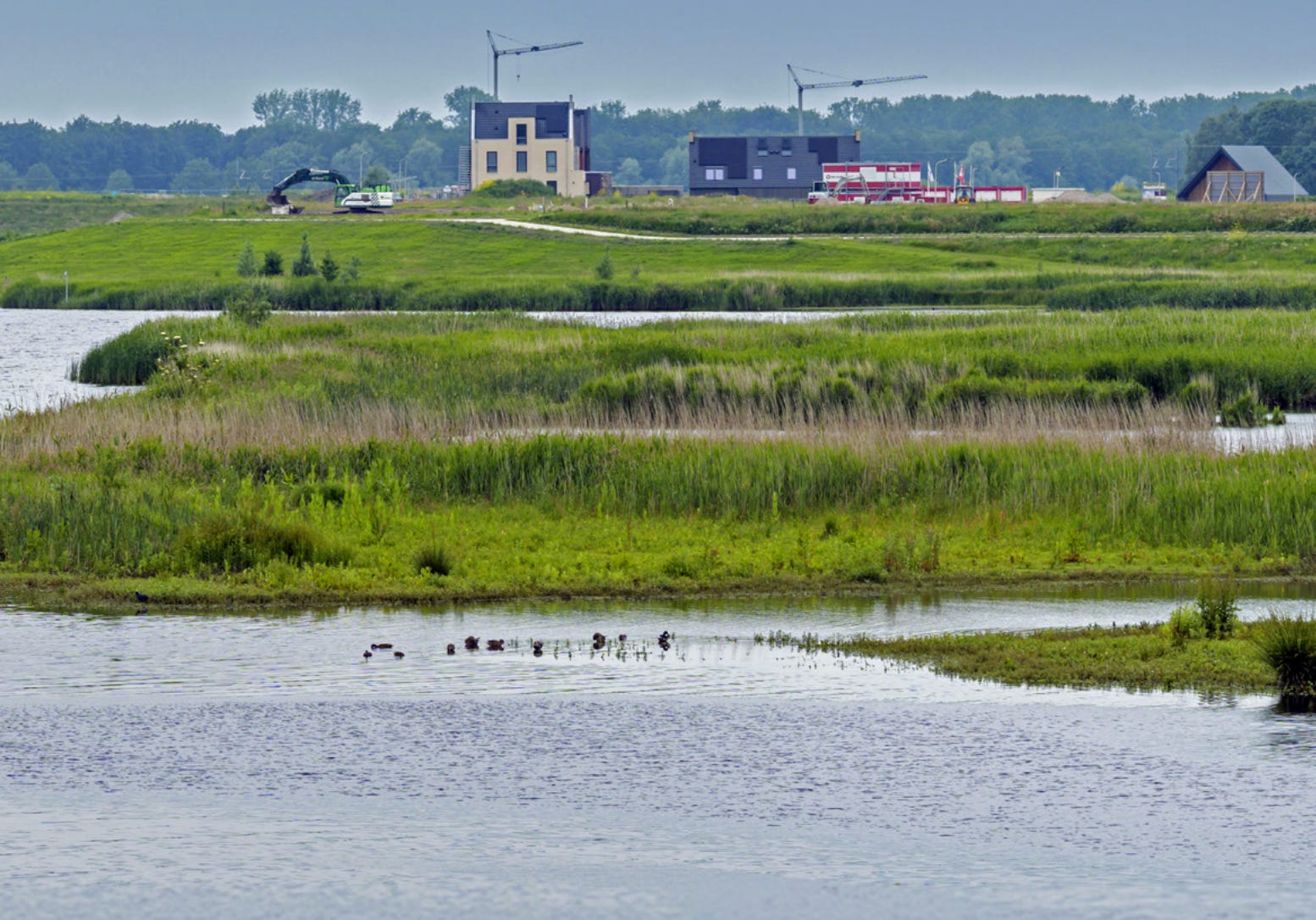
The Tolhek project in Heemskerk, Netherlands.
The Netherlands runs the most admired flood-resilience program on earth, with a statutory commissioner, a dedicated fund, and a 2050 target with an outlook to 2100.
Its own 2026 program document puts the cost of the measures it has projected at about €38 billion against roughly €29.3 billion of budget. It names the difference: “een budgettaire spanning van circa € 9 miljard.“ A budgetary tension of about nine billion euros.
That is the gold standard, admitting it is roughly a quarter short.
The Moment
Picture Benthemplein, a public square in central Rotterdam. On a dry day, it is a skateboard bowl and a basketball court. In a downpour, it becomes a basin, filling on purpose with stormwater the city chose to store in plain sight rather than pipe away.
It opened on December 4, 2013. Its three basins hold about 1.7 million liters, roughly 1,700 cubic meters (just under 450k gallons), and they take not only the rain that falls on the square but runoff from the paving and roofs around it.
Everywhere else, the default is to wall the water out with higher levees, bigger pumps, and deeper drains, all designed to move it away as fast as possible. Rotterdam holds it, visibly, and releases it slowly once the storm passes.
The reframe is what matters, and it is harder than the engineering. We are trained to read standing water as failure: a flooded basement, a washed-out site, or a claim to file. Rotterdam treats designed, temporary flooding as success. The square did its job precisely because it filled.
That lets a city justify public money on space that looks like recreation for most of the year and infrastructure for the rest.
Two things about Benthemplein are worth noting. First, the city doesn’t publish figures. And second, 1,700 cubic meters is roughly two-thirds of one Olympic swimming pool, meaning one isn’t big enough to be a real city-wide defense. One wonders how many basins are actually needed, what that might cost, and who pays?
The Story
Rotterdam’s resilience is not a post-disaster rebuild. It is a standing public program, and the governance is the part that cannot be copied quickly.
The visible layer runs from the very small to the frankly enormous. Water plazas, permeable paving and rooftop storage each absorb a little. At the other end sits the Maeslant barrier. It comprises two gates, each 210 meters long, 22 meters high, and 15 meters deep, carried on truss arms about 237 meters long, pivoting on ball joints ten meters across and weighing 680 tons apiece.
And the national Room for the River program, which ran to early 2019 at 34 locations along the IJssel, Waal, Nederrijn and Lek, cost €2.3 billion and improved safety for roughly four million people by giving rivers their floodplain back rather than squeezing them between ever-higher banks.
Here is a number that complicates the story in a useful way. The Maeslant barrier has only closed against storm or high water three times in twenty-nine years of service: November 2007, January 2018, and December 2023. It closes once each September for a functional test.
Three closures in twenty-nine years is either a triumph of over-engineering or evidence that the design event has not yet arrived. But sitting beneath the design is the institution. Rotterdam works inside a national ‘Delta Programme’ coordinated by a statutory Delta Commissioner, alongside regional water authorities and the national government. The Deltawet of 2011 inserted the position into the Water Act by naming a government commissioner for the Delta Programme, reporting directly to the Minister. The same act also establishes a Delta Fund.
The oldest surviving water board, Rijnland, was first recorded in 1255, so the Netherlands has roughly 770 years of water institutions. It does not have 770 years of democratic ones. Until the Water Boards Act of 1992, only landowners chose who governed a water board. The first direct elections residents could vote in weren’t held until 1995.
Eight centuries of treating water as a shared existential responsibility is real. Per PBL Netherlands Environmental Assessment Agency, 26% of the Netherlands’ land area lies below sea level, and 59% is flood-prone.
Structural Forces
Three forces explain who actually builds the resilient city, and the first one is not the size of the fund.
First, public finance. The Delta Fund holds about €29.1 billion for 2025 through 2039, which the program describes as an average annual budget of “ruim € 1,9 miljard,” or just over €1.9 billion per year.
Of the €1,924.1 million appropriated for 2026, the investment articles covering flood safety, freshwater supply, and water quality total €687.7 million, or 35.7%. Sustaining and managing existing water infrastructure assets costs €1,236.4 million, or 64.3%.
The flagship resilience fund is roughly two-thirds a maintenance budget. Across the full 2025 to 2039 window, the measures budget is €12.7 billion of €29.1 billion, about 44%. That is what a mature defense system costs to keep standing, and it is the line item every city copying this model will discover.
Second, what “ring-fenced” actually secures. The Water Act fixes that a fund exists and what it may be spent on. The Delta Fund is a budget fund established annually by a separate budget act. Its horizon rolls forward one year at each budget round. Currently, it ends in 2039, and the Delta Commissioner’s own 2026 headline request is a review of long-term financing.
The exportable feature is the mandate and the purpose. Any jurisdiction can legislate that an adaptation fund exists and may be spent only on adaptation. None of them can legislate that a future parliament will fill it.
Third, land use does hydrological work, and this is the portable piece. You do not need a Delta Commissioner to require that a new development hold its own stormwater on site, stop a floodplain being paved, or write water storage into the zoning code. These are ordinary land-use decisions within the reach of any local government, which makes Signal 9 the part of the Rotterdam model a US or Asian city could adopt without rewriting its constitution.
The economic logic underneath is defensible from every angle. The Netherlands can afford the defenses precisely because it cannot afford to be without them. Rotterdam is the largest seaport in the European Union, handling 99.0 million tons in the third quarter of 2025 alone on Eurostat’s measure. If the city floods, the tax base, the port revenue, and the insurability of every asset behind the defenses go with it.
The Next Chapter
In 2008, the Second Delta Committee recommended raising legal flood protection standards at least tenfold, which would have required dike investments estimated at €11.5 billion. A research group was asked to derive efficient standards more objectively. Using cost-benefit analysis and mixed-integer nonlinear programming, they concentrated the investment on three critical regions where two-thirds of the benefits accrued, and banked approximately €7.8 billion in cost savings.
An independent analysis was allowed to overrule and then cut an expert commission’s headline recommendation. The paper was published in a peer-reviewed operations research journal, and its last author was the sitting Delta Commissioner.
The result was then written into law as a per-person risk ceiling. By 2050, for anyone living behind the dikes, the probability of dying in a flood must be no greater than one in one hundred thousand per year. That language has been in force since January 1, 2017.
The transferable concept is a statutory risk ceiling with a date attached, plus an analytical process that lets the government say it is proposing to spend too much.
Contrast that with the reactive model on which most of the world runs. In the US, recovery is funded after the disaster, in lump sums, through emergency appropriations that arrive once the damage is done. This model is politically easier, because it is simpler to write a relief check than to tax for a levee nobody has needed yet. It is also more expensive, because you pay to rebuild what you could have protected for less. And this model causes real suffering when there is either no money or no political will left, especially in the face of increasingly frequent and large disasters.
The physical playbook is already traveling, from New York to Jakarta, and new financing tools are arriving, including municipal resilience bonds, catastrophe bonds that pay for prevention, and blended public-private adaptation funds. What remains unsolved is the long-term thinking that the Delta Fund only partly solves. How is money allocated and committed for decades inside a political system that budgets one year at a time?
As an investor, before you price a single asset’s resilience, price the public balance sheet around it. Is there a dedicated adaptation budget, a credible long-horizon plan, and an institution that outlives the next election? Because the most expensive upgrade you can buy for one building is worthless if the levee behind it is only funded one emergency at a time.
And when you find a market that does have all three, ask the second question, too. Ask what share of that budget is going to new protection, and what share is going to keeping the last generation’s protection standing. In the Netherlands, the answer is roughly one-third and two-thirds, and that ratio is coming for everyone.
As always, KNOW YOUR SIGNALS and BE CLIMATE READY!
Jamie
Go Deeper
This is a Story & Future Thinking brief, so there is no companion workbook. The blank master CRDF Signal Tracker™ and Deal Stress Test™ are free and available at climatereadyre.com/tools.
Related briefs
Same signal (S11 Public Finance & Infrastructure Capacity):
Next in sequence:
Brief 31 · FORTIFIED Roof Savings: How 73% Fewer Claims Cut Insurance Costs - coming soon
Sources
Every figure above, with the date the data covers, the date it was published, and the date I verified it.
Delta Fund scale and shortfall — about €29.1 billion available for 2025 to 2039, an average of just over €1.9 billion per year; a total cost estimate of about €38 billion against roughly €29.3 billion of budget for Delta Programme measures through 2050, leaving a gap of about €9 billion
Staf deltacommissaris and the Ministry of Infrastructure and Water Management, Nationaal Deltaprogramma 2026, Achtergronddocument G: Deltafonds · Data as of 2025 price level · Published Sep 16, 2025 · Accessed Aug 2026
The 2026 spending split — of €1,924.1 million appropriated, €687.7 million, or 35.7%, goes to investment in flood safety, freshwater and water quality, and €1,236.4 million, or 64.3%, to exploitation, maintenance, renewal and network costs.
Ministry of Finance, Deltafonds budget 2026, memorie van toelichting · Data as of budget year 2026 · Published Sep 2025 · Accessed Aug 2026
Computed from the appropriations by article. Across 2025 to 2039, the measures budget is €12.7 billion of €29.1 billion, about 44%.
The statutory commissioner and fund — the Deltawet of 2011 inserted a government commissioner for the Delta Programme reporting directly to the Minister, and established a Delta Fund; the fund’s purpose is fixed in law, its annual amount is not, and its horizon currently runs to 2039
Deltawet waterveiligheid en zoetwatervoorziening, Staatsblad 2011, 604 · Data as of 2011 · Published Dec 20, 2011 · Accessed Aug 2026
The Water Act contains no statutory minimum annual contribution and no protection to 2050. A separate budget act establishes the fund annually with a rolling horizon.
Benthemplein — opened December 4, 2013; three basins storing approximately 1.7 million liters, taking runoff from surrounding paving and roofs.
Gemeente Rotterdam, Benthemplein · Data as of 2013 · Published current · Accessed Aug 2026
The city publishes no construction cost for the square.
Maeslant barrier — two gates 210 meters long, 22 meters high and 15 meters deep, on ball joints ten meters across weighing 680 tons; built 1991 to 1997; designed against a surge five meters above datum
Rijkswaterstaat, Maeslantkering · Data as of 1997 · Published current · Accessed Aug 2026
Truss arm length of about 237 meters and mass of about 6,800 tons are not published by Rijkswaterstaat and are carried here at lower confidence.
Barrier closures — three closures against storm or high water since entry into service in 1997: November 2007, January 2018 and December 2023, with only December 2023 meeting the unmodified three-meter criterion
Rijkswaterstaat, storm Pia, December 2023 · Data as of Dec 2023 · Published Dec 2023 · Accessed Aug 2026
The 2007 and 2018 closures were made at a temporarily lowered threshold of 2.60 meters. The barrier is also closed annually in September for a functional test.
Room for the River — measures at 34 locations along the IJssel, Waal, Nederrijn and Lek, total cost €2.3 billion, completed in early 2019, improving safety for roughly four million people.
Rijkswaterstaat, Ruimte voor de rivieren · Data as of 2019 · Published current · Accessed Aug 2026
The program responded to the river floods of 1993 and 1995 and was crisis-funded rather than funded through steady-state budgeting. No start year is asserted here because sources differ: the Dutch Water Sector portal states the government began developing the program in 2007, while elsewhere the program is dated to the spatial planning decision that preceded implementation.
Water board democracy — the oldest surviving water board is first recorded in 1255; only landowners chose water board governance until the Water Boards Act of 1992, and the first direct elections were held in 1995
Land below sea level — 26% of the Netherlands’ land area lies below NAP, and 59% is flood-prone
Nationaal Archief, Waterschapsverkiezingen · Data as of 1255 to 1995 · Published current · Accessed Aug 2026
Netherlands Environmental Assessment Agency · This research was conducted in collaboration with Deltares, HKV Consultants and Blueland. Accessed Aug 2026
Planbureau voor de Leefomgeving, correction on flood risk formulation in the IPCC report · Data as of 2010 · Published currently · Accessed Aug 2026
Issued specifically to correct the widely repeated claim that 55% of the country lies below sea level, which conflates below sea level with floodable.
Port of Rotterdam scale — 99.0 million tons of goods handled in the third quarter of 2025, by far the highest of any EU port
Eurostat, maritime transport of goods at port level · Data as of Q3 2025 · Published Mar 2026 · Accessed Aug 2026
The cost-benefit result — a 2008 recommendation implying about €11.5 billion of dike investment was replaced by a targeted program concentrating on three regions carrying two-thirds of the benefits, saving approximately €7.8 billion
Eijgenraam, Kind, Bak, Brekelmans, den Hertog, Duits, Roos, Vermeer and Kuijken, Economically Efficient Standards to Protect the Netherlands Against Flooding, Interfaces 44(1) · Data as of 2008 to 2012 · Published 2014 · Accessed Aug 2026
Peer-reviewed. The last author was the sitting Delta Commissioner.
The statutory risk ceiling — by 2050, the probability of dying in a flood for anyone living behind the primary defenses must be no greater than one in one hundred thousand per year; in force since January 1, 2017
Deltaprogramma, Deltabeslissing Waterveiligheid · Data as of 2017 · Published current · Accessed Aug 2026
Commentary and analysis only. Not investment, financial, legal, tax, or professional advice. CRDF tools are illustrative; examples are composites drawn from public data. Do your own due diligence and consult qualified professionals.
I run this analysis on specific deals. If you are underwriting assets in a market whose public adaptation budget you have never read, book 20 minutes.
Jamie Wolf, MBA — Founder & Publisher, Climate-Ready Real Estate Investing, © 2026, CR REI Holdings LLC