

Signals: S4 Valuation & Appraisal Gap · S1 Insurance Repricing · S6 Chronic Climate Stress
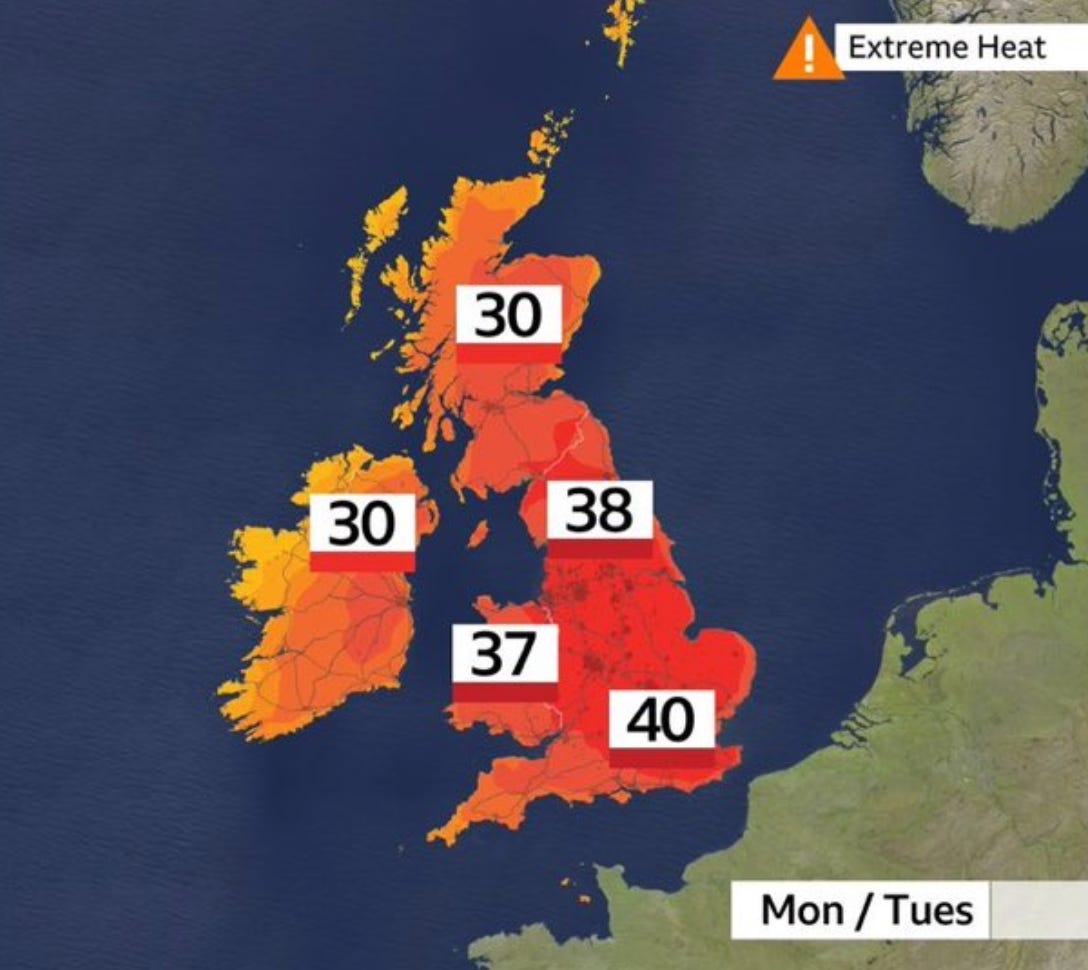
The UK recorded a temperature of 40.3°C for the first time in July 2022. In the London heatwave of late June 2025, roughly 260 excess heat-related deaths were estimated in the city, about 170 of which were attributed to climate change. The full data for the summer of 2026 is not yet compiled, but England’s interim count for May and June alone, 2,877 heat-associated deaths, is nearly double the whole of summer 2025.
Meanwhile, those numbers don’t appear in an office valuation model.
They should, because the mechanism that connects them to value runs through a building system most institutional buyers never examine during due diligence. Here is that mechanism, on a stabilized trophy asset that looks perfect on paper.
Market Signal
Chronic heat is a different underwriting problem from acute hazard, and the difference is what makes it easy to miss.
An acute event is legible. A storm arrives, damage occurs, a claim is filed, and everyone involved knows the date. Chronic stress produces no event at all. It slowly shifts the conditions a building was designed for, and the failure appears as an operating problem rather than a loss.
The UK data makes the drift measurable. The 40.3°C record set at Coningsby in July 2022 was the first time the country exceeded 40 degrees in the observational record.
The mortality analysis from Imperial College London and the London School of Hygiene and Tropical Medicine is more useful still for an underwriter, because it quantifies frequency rather than severity. Their rapid attribution study of the June 2025 European heatwave found roughly 2,300 heat-related deaths across 12 European cities, compared with an estimated 800 in a world without warming. In London specifically, about 260 excess deaths were estimated, roughly 170 of which were attributable to climate change.
This is the finding that should change a model. An event of that kind in London is now expected roughly every six summers. Without warming, it would have been expected at most once every sixty years. And as we have all observed, the event that occurred in 2025 has already been repeated just one year later, with Europe in its fifth heatwave of the 2026 summer season as of mid-August 2026 - and summer is not yet over.
A building commissioned against a once-in-sixty-years condition is now facing that condition roughly ten times as often. Nothing about the building changed. The recurrence interval did.
This is the same structural move NOAA made when it revised the Houston design storm after Harvey, covered in Brief 2. A number that governs engineering was quietly restated, and every asset designed against the old number inherited a deficiency it did not have the day before.
On the cost side, insurance consumes 2.4% of income receivable across MSCI’s US Quarterly Property Index as of the 12 months to Q3 2024, double its share five years earlier. That is the American figure, and I use it as an order-of-magnitude reference rather than a UK benchmark, because the UK commercial market is priced differently. The direction is what transfers, not the level.
Deal Scenario
The following is a modeled composite meant to illustrate a mechanism; it is not a specific building.
A City of London trophy office. Stabilized, high occupancy, blue-chip anchor tenant, and the sort of covenant strength that gets a deal through committee without argument.
The building was designed and commissioned in an era when British offices were engineered against a summer design condition well below 40 degrees. Most floors rely on comfort cooling sized to that condition. Several have no mechanical cooling at all, which was an ordinary specification decision for the London market at the time and remains common in older prime stock.
During an extended heat event, the plant runs at capacity and cannot hold setpoint. The MEP consultant flags it in the quarterly report. Nothing breaks. No claim is filed. No damage occurs.
Instead, the building stops delivering the product it leases.
A trophy office does not sell square footage. It sells an environment a professional firm can put clients and staff in. When it cannot hold that environment for several days a year, and those days are rising by a factor the tenant can look up, the asset has developed a defect no condition survey will find.
The financial consequence arrives through three channels, and only the first is obvious.
Operating cost. Running a plant at capacity during longer, more frequent heat events increases energy consumption and accelerates equipment wear, pulling forward the replacement cycle.
Capital expenditure. Bringing cooling capacity up to the revised condition requires plant replacement and, in older prime stock, often requires riser and floor-plate work. That is a disruptive, tenant-in-place program, not a maintenance line.
Lease economics. This is what decides the outcome. A tenant that has experienced the building failing to cool will price that into a renewal, and a tenant negotiating a new lease will price it into the incentive package.
Against that, note what happens at exit. The buyer in year five is underwriting the capex program you deferred, at the frequency numbers published after your acquisition, with a lender applying its own view. That is not a pessimistic assumption about exit yield. It is the same assumption you should be making about the seller today.
Underwriting Analysis
The failure of diligence in this scenario is not analytical. It is procedural. Cooling capacity against a forward design condition is nobody’s job.
The building survey covers condition, meaning whether the plant works. The valuation covers comparables, meaning what similar buildings traded for. The ESG assessment covers emissions, meaning what the building emits. None of the three asks whether the plant is sized for the climate the building will operate in for the rest of the hold.
So you have to add the question deliberately.
Ask for the design summer condition the cooling plant was sized against, and compare it to the current and projected design condition for the location. This is a single question to the MEP consultant, and it is the highest-value question in the entire diligence pack.
Ask how many hours in the last three summers the building failed to hold setpoint. Building management systems record this. Almost nobody requests it, and it is the closest thing to a direct measurement of the defect.
Ask what proportion of the net lettable area has no mechanical cooling. In older prime European stock, this is frequently non-trivial yet rarely surfaced.
Read the anchor tenant’s own climate disclosure. The CSRD Omnibus is now settled law. Directive (EU) 2026/470 entered into force on March 18, 2026, and raises the reporting threshold to companies with more than 1,000 employees and €450 million in turnover, taking roughly 80% of previously in-scope companies out of scope. Reporting applies to fiscal years beginning January 1, 2027, with first reports in 2028. A tenant already reporting on leased-asset climate risk is a tenant whose renewal decision has a documented rationale you can read in advance.
That last point deserves emphasis because it inverts the usual information asymmetry. Tenant disclosure is a diligence asset for the landlord. If your anchor tenant is publishing its exposure to leased real estate, it is telling you, in a filed document, what will drive its renewal.
The most sensitive input here is the recurrence interval, not the peak temperature. Peak temperature is what gets reported. Frequency is what determines whether a shortfall is an anomaly the tenant tolerates or a pattern the tenant reprices. A once-in-sixty-years event is a story. Once every six summers is a lease negotiation.
Strategic Implications
The general lesson is that chronic risk is repriced in terms of utility rather than damage, and utility is not something an insurance policy or a condition survey measures.
That makes chronic exposure systematically underpriced relative to acute exposure, because the entire diligence apparatus is built to find events. An asset in a market with no acute hazard at all can still have a design-condition problem that erodes its competitive position lease by lease.
For portfolio construction, it argues for a different question at the market level. Do not only ask what hazards a market faces. Ask what the local building stock was designed against, and how far the operating conditions have moved from it. A market where the stock was engineered generously has a buffer. A market engineered precisely to a historical norm does not, and prime European offices largely fall into the second category.
It also changes how you should justify a capex reserve.
Cooling capacity work reads like a discretionary building improvement competing against a lobby refurbishment or a lift upgrade. It is not. On a revised design condition, it is closer to a roof replacement, meaning it is a precondition for the asset to continue performing its function rather than an enhancement. Assets that clear the bar keep their tenant covenant and their institutional buyer pool. Assets that do not begin competing on price against buildings that can hold setpoint.
A flood layer also operates on a longer clock for this asset. The Environment Agency’s Thames Estuary 2100 plan is the long-term defense framework. Its monitoring reviews (the ten-year review in 2021, the plan update in 2023, and the fifteen-year review published in August 2026) revisit the adaptation pathway against measured sea-level rise, now running at 4.1 millimeters a year and matching the plan’s assumption.
For a five- to seven-year hold, that is background. For the buyer underwriting the hold after yours, it is not.
Brief 5 showed the same logic in a levered Sun Belt deal, where the covenant broke before the return did. Brief 34 separates acute and chronic physical risk directly and asks which one actually shows up in NOI.
As always, KNOW YOUR SIGNALS and BE CLIMATE READY!
Jamie
Run this on your own deal
The CRDF Deal Stress Test™ built for this brief takes a stabilized asset and tests it against revised design conditions, capex timing, and lease economics rather than a loss event. Free, no signup: Brief 8 · CRDF Deal Stress Test™ (xlsx)
New to the framework? The blank master Signal Tracker and Deal Stress Test workbooks are at climatereadyre.com/tools.
Related briefs
Same signal (S6 Chronic Climate Stress):
Brief 5 · Sun Belt Multifamily Insurance and IRR: Climate Risk Behind a 207% Rise
Brief 15 · The Netherlands Label C Rule: How a Deadline Moved a Market to 78% Compliance - coming soon
Brief 20 · NABERS 5.5-Star and Sydney Office Value: When a Rating Decides Your Tenant Pool - coming soon
Next in sequence:
Brief 9 · Valencia Flood 2024 and Property Risk Maps: 491mm in Eight Hours - coming soon
Sources
Every figure above, with the date the data covers, the date it was published, and the date I verified it.
UK temperature record — 40.3°C at Coningsby, the first UK reading above 40°C
UK Met Office — July 2022 heat review · Data as of Jul 19, 2022 · Published Jul 22, 2022 · Accessed Aug 2026
London heat mortality, June–July 2025 — ~260 ESTIMATED excess heat-related deaths (modeled)
Imperial College London Grantham Institute and LSHTM — Climate change tripled heat-related deaths in early summer European heatwave · Data as of Jun 23 – Jul 2, 2025 · Published Jul 2025 · Accessed Aug 2026
European heat mortality and recurrence interval — ~2,300 heat deaths across 12 European cities vs ~800 without warming; London events of this kind now expected roughly every 6 summers vs at most once in 60 years
Imperial College London Grantham Institute and LSHTM — Climate change tripled heat-related deaths in early summer European heatwave · Data as of Jun–Jul 2025 · Published Jul 2025 · Accessed Aug 2026
Rapid attribution study; treat the attribution split as modeled rather than observed. The ~260 London total and the 6-summers-versus-60-years recurrence figures are on the Imperial Grantham background briefing UK and European heatwave 2025, not on the tripled-deaths page linked above, which carries only the 171 London attribution and the 2,300 / 1,500 European totals.
Excessive heat waves 2026 — five European heat waves so far in the 2026 season, with summer not yet over
NPR — Europe swelters through its fifth heatwave of the summer · Data as of Aug 13, 2026 · Published Aug 13, 2026 · Accessed Sep 2026
Excessive heat waves 2026, event list — running compilation of the 2026 European heat wave events
Wikipedia — 2026 European heatwaves · Data as of 2026 season · Published date not stated · Accessed Sep 2026
Tertiary source, used only to locate the underlying events.
UK heat mortality monitoring, England 2025 — 1,504 heat-associated deaths in England, summer 2025 (95% confidence interval 936 to 2,072)
UK Health Security Agency (gov.uk) — Heat mortality monitoring report: England, 2025 · Data as of summer 2025 · Published Apr 2, 2026 · Accessed Sep 2026
UK heat mortality monitoring, England May–June 2026 — 2,877 heat-associated deaths in England across the May 24–27 and June 21–28, 2026 episodes, nearly double the whole of summer 2025
UK Health Security Agency (gov.uk) — Interim heat mortality monitoring report: England, May and June 2026 · Data as of May–Jun 2026 · Published Jul 30, 2026 · Accessed Sep 2026
The UK Health Security Agency (UKHSA) (which assumed the health-monitoring and surveillance functions previously held by Public Health England) tracks excess mortality by comparing death counts during high-temperature episodes to expected baseline levels at normal seasonal temperatures.
Insurance as a share of commercial property income — 2.4% of income receivable, double its share five years earlier.
MSCI — US Quarterly Property Index · Data as of 12 months to Q3 2024 · Published Dec 9, 2024 · Accessed Aug 2026
US data, used as an order-of-magnitude reference. The UK commercial market is priced differently; the direction transfers, the level does not. MSCI attributes the regional spread partly to regulation and rebuilding costs, not to climate alone.
CSRD scope after the Omnibus — threshold raised to 1,000+ employees and €450M turnover, removing roughly 80% of in-scope companies; applies to fiscal years from January 1, 2027, first reports 2028
Council of the EU — Directive (EU) 2026/470 · Data as of Feb 2026 · Published Feb 26, 2026 · Accessed Aug 2026
Directive (EU) 2026/470, Official Journal, 26 February 2026, in force 18 March 2026; the authoritative text is on EUR-Lex.
Thames Estuary 2100 — long-run London tidal flood defense framework, with ten- and fifteen-year monitoring reviews (2021, 2026) and a 2023 plan update tracking the adaptation pathway; measured rise 4.10 mm a year over 1993–2024, matching the plan assumption
UK Environment Agency — Thames Estuary 2100: 15-year monitoring review (2026) · Data as of 2024 tide data · Published Aug 6, 2026 · Accessed Aug 2026
TE2100 and its review are published. Any statement that a specific building footprint moved into a priority flood zone would be a modeled characterization, not an Environment Agency finding, and none is made here.
City of London trophy office scenario — cooling capacity shortfall against a revised design condition, with operating cost, capex and lease-economics consequences
CRREI modeled composite · Method: cooling-capacity failure modeled against the Met Office observation and the Imperial recurrence finding, with impairment described directionally rather than as a point estimate · Modeled — not a specific building
Commentary and analysis only. Not investment, financial, legal, tax, or professional advice. CRDF tools are illustrative; examples are composites drawn from public data. Do your own due diligence and consult qualified professionals.
I run this analysis on specific deals. If you are underwriting a stabilized office asset and want the design-condition, capex, and lease assumptions pressure-tested before you sign, book 20 minutes.
Jamie Wolf, MBA — Founder & Publisher, Climate-Ready Real Estate Investing, © 2026, CR REI Holdings LLC