

Signals: S6 Chronic Climate Stress · S1 Insurance Repricing · S8 Disclosure, Taxonomy & Regulatory Regimes
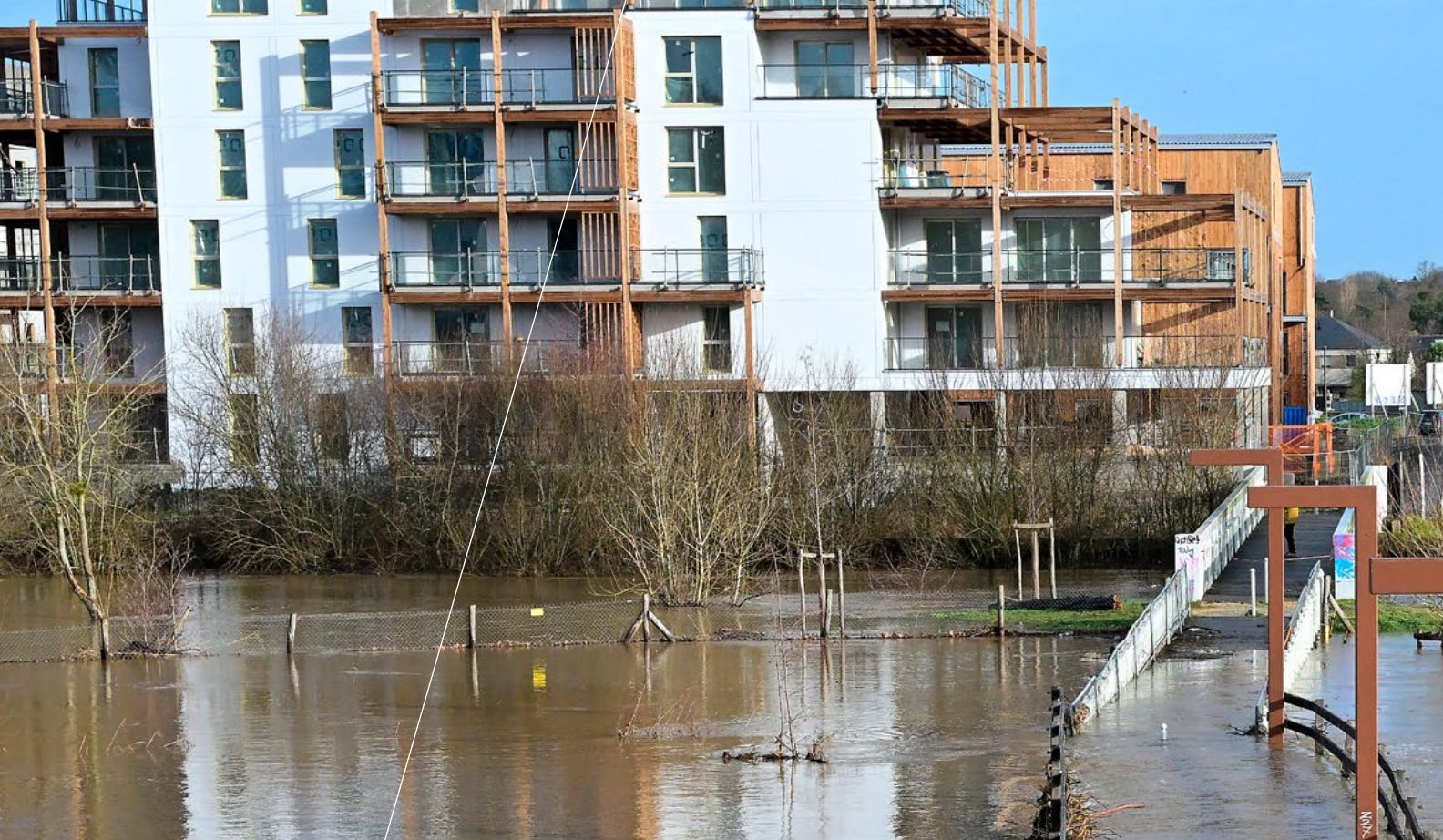
Photo Credit: www.ccr.fr
On Monday, the European Central Bank showed us Eurozone buyers marking down high-risk offices in the sale price itself. Today that repricing arrives as a bill. France charges every property policy a statutory natural catastrophe (CatNat) surcharge, and that surcharge went up. The question for an underwriter isn’t what it costs. It’s what the increase tells you.
Market Signal
Every French property damage policy, household and business alike, carries a compulsory CatNat surcharge based on article A125-2 of the insurance code.
The French Parliament officially established the compulsory CatNat surcharge (or national natural disaster compensation scheme) on July 13, 1982, following disastrous national floods the previous year.
On January 1, 2025, the rate for that mandatory coverage rose from 12 to 20 percent of the property damage premium, applying to all contracts concluded or renewed from that date. This added €1.2 billion per year of coverage capacity.
One rate exists for all perils, including droughts, floods, earthquakes, cyclones, and land movement. France has no subsidence-only surcharge. Because the same 20 percent lands on every policy in the country, it tells you nothing about your building.
But instead of floods, drought is now the primary driver of the bill. CCR, the state-backed reinsurer behind the regime, reports in its Bilan (balance sheets) for 1982 to 2025 that drought accounts for 41.2 percent of cumulative non-motor CatNat losses, second only to flood at 50.4 percent.
Banque des Territoires, reporting on CCR in June 2026, puts drought at 53.1 percent of losses over the last ten years, and records 2022 as the costliest year, close to €3.9 billion of claims, with more than 95 percent of it drought-related.
For 2025, CCR estimates insured drought damage of €770 million to €1 billion. Of €3.71 billion of Cat Nat premiums that year, €1.54 billion came from businesses, representing 44.3 percent once motor is stripped out.
The first strictly uniform, legally binding nationwide RGA (the French-language version of the clay shrink-swell abbreviation) exposure map was created on July 22, 2020. Almost exactly one year after the 20% surcharge increase took effect, the first major overhaul to that clay shrink-swell exposure map since 2020 was imposed on January 9, 2026. It took effect on July 1, 2026.
If you aren’t familiar with the soil type, clay-rich soil shrinks when it dries out. Conversely, when it gets wet, it swells. Think back to pottery class - or Silly Putty that you failed to put away. This weather-driven soil movement is a leading cause of structural damage to buildings in France.
Medium to strong exposure now covers 55 percent of mainland France, up from 48 percent on the 2020 map, based on 446,000 claims from 1989 to 2022. That’s 12.1 million houses in the exposed zones. Centre-Val de Loire went to 90 percent of its territory, up from 82 percent. Remember that data point because we’re about to buy a warehouse there.
Deal Scenario
Let’s look at a modeled scenario to show how you might run your own numbers on a deal.
A 40,000-square-meter single-let logistics warehouse near Orléans, in Centre-Val de Loire. Rent is €50 per square meter per year, anchored on CBRE, which puts new warehouses in the Orléans, Blois and Tours market at €50 to €56 for the fourth quarter of 2025.
BNP Paribas Real Estate’s first-quarter 2026 chart reads €40 prime for Orléans. Assume landlord non-recoverable costs are €100,000. That yields rental income of €2,000,000 and NOI of €1,900,000.
The exit yield in our modeled scenario is 5.50 percent, within the field bounds and not solved for. At 5.50 percent, the value is €34,545,455. Debt is €19 million, interest-only at 4.5 percent, so €855,000 of debt service per year. In our modeled scenario, that’s a 55.0 percent loan-to-value and a debt service coverage ratio of 2.22 times.
JLL puts prime French warehouse yields at 4.90 percent in the second quarter of 2026. Cushman and Wakefield says leased secondary assets trade above 6 percent. A regional box is neither.
The first shock, then, is the premium.
The base property damage premium is assumed at €60,000, since nobody publishes a rate for large warehouses. At the old 12 percent, the surcharge was €7,200. At 20 percent, it’s €12,000. So the statutory step is €4,800 per year, which, capitalized at 5.50 percent, is €87,273 of value, or 0.25 percent of the asset. Noise.
Shock two is the renewal.
Lift the base premium 25 percent after the asset lands in a strong zone, and you pay €90,000 against €67,200 before, up €22,800 per year. Almost all of it is market, not statute.
Shock three is the repair nobody else pays for.
Assume a slab and foundation repair of €1.5 million at a 2 percent annual probability. That 2 percent is a deliberately harsh stress. If a drought recognition order is issued, CatNat pays, but the owner keeps the professional deductible, 10 percent of the damage with a floor of €3,050. In this model, that’s €150,000.
With no order, the owner pays the whole €1.5 million. At a 60 percent chance of recognition, the expected cost is €13,800 per year. At a 0.5 percent probability, the worst-case scenario is 5.67 percent, not 6.19 percent.
The landlord covers that repair cost. Structural work under Article 606 of the Civil Code, such as frame, roof, load-bearing walls, and weatherproofing, can’t be recharged to the tenant, whatever the lease says.
Our model shows three possible outcomes for a warehouse that is remapped into a high-risk climate zone:
Case A. Insurance is recharged to the tenant and the landlord holds the repair reserve. Net operating income is €1,886,200, and value is €34,294,545, down 0.73 percent.
Case B. Insurance is not recharged because the lease is silent or the box is empty. NOI falls to €1,863,400 because the landlord can’t pass a €22,800 annual insurance premium increase on to the tenant. Consequently, the property’s asset value drops by 1.93 percent to €33,880,000 when capitalized at the standard 5.50 percent rate, erasing €665,455 in equity compared to the baseline scenario.
Case C: Case B plus a 25 basis point widening of the exit yield, because buyers have seen the same map. At 5.75 percent, it’s €32,406,957, down €2,138,498, or 6.19 percent, with coverage at 2.18 times and loan-to-value at 58.6 percent.
Summarizing, the statutory surcharge moved value by 0.25 percent. The yield widening moved it by 4.26 percent on its own, which is €1,473,043.
For an insurance bill to do that much damage, it would have to rise €81,017 per year.
The premium is not the cost.
The premium is the evidence you use to set the yield.
And the input that hurts most isn’t clay. Run it at BNP’s €40 of rent instead of CBRE’s €50, and Case C value is €25,450,435, coverage 1.71 times, loan-to-value 74.7 percent.
That’s the covenant conversation.
Underwriting Analysis
So here are five tests to run before you price the exit.
One. Recognition history. CatNat pays for drought damage only after an interministerial order recognizes the municipality, and since January 1, 2023, a professional has 30 days from publication to declare.
Over a long enough window, it is near universal. The brokers’ body PLANETE CSCA reports that 99 percent of local administrative districts, known in France as communes, have been recognized at least once since 1982, for some peril. So the question is how often, and how fast?
The answer? Slow!
For the 2025 drought, CCR counted 345 communes recognized as of May 26, 2026, with 22 percent of requests approved. For 2022, once the campaign had run its course, 5,010 communes were recognized, with 739 refused, representing about 87 percent.
Two. Map zone. Pull the parcel against the 2026 clay map, and be precise about what that map legally does. It binds promises of sale on buildable, undeveloped land and individual house-construction contracts. For a warehouse, it’s free public information. Centre-Val de Loire moved to 90 percent from 82 percent, Bourgogne-Franche-Comté to 74 percent from 58 percent. The state re-rated an asset that changed zone, whether or not its premium has caught up.
Three. Separate the statute from the market. The CatNat layer is fixed by law. The market layer is falling. Marsh reports global commercial rates down 6 percent in the second quarter of 2026, property down 12 percent, and Europe down 9 percent. The French brokers’ body, reporting AMRAE’s 2026 study, says cuts can reach up to 20 percent depending on the account. So if your base premium or deductible rises at renewal while the market is cutting, that is an underwriter telling you something specific about your building.
Four. Read the lease for who pays what. Insurance premiums pass to the tenant only where the lease expressly provides for it. Article 606 structural work never passes through.
Be aware that an anti-negligence penalty is designed to pressure local town halls into taking climate risks seriously. If a town repeatedly suffers natural disasters but its local government refuses to implement an official Risk Prevention Plan (Plan de Prévention des Risques or PPR), the state forces property owners to pay exponentially higher out-of-pocket deductibles for every subsequent disaster claim.
In a commune with no risk prevention plan, that 10 percent deductible doubles at the third order recognizing the catastrophe, triples at the fourth, quadruples after that. In our modeled scenario, 20 percent moves the Case C loss to 6.28 percent and 40 percent takes it to 6.46 percent. While that seems small, it wires Test One straight into cost.
Five. Watch the regime’s own balance sheet. The rate can move again. CCR says 2025 let it begin rebuilding reserves, aiming to withstand a one-in-forty-year event by 2035. Its own 2050 study projects geotechnical drought’s average annual cost rising 83 percent from the hazard alone, €606 million per year, and 103 percent with exposure growth. Those are CCR’s modeled numbers.
The Barusseau bill on adaptation passed the National Assembly at first reading on April 8, 2026. It is PROPOSED, not law, with Senate debate set for October 19, 2026. It would allow, by decree, premium modulation for professional property worth more than €20 million in risk prevention plan zones.
Our modeled warehouse is worth more than that.
Strategic Implications
On September 7, 2025, the reinsurance intermediary Howden Re partnered with the climate modeling firm Reask to combine climate data and subsidence modeling with local meteorological institute data for the United Kingdom and France. Jamie Rodney is Reask’s chief executive, and Tim Edwards is Howden Re’s head of international analytics. Reask’s co-founders, Thomas Loridan and Nicolas Bruneau, presented the work in Paris in December 2025.
The method is the part an investor can copy. They use the Soil Water Index from ERA5, a public monthly reanalysis dataset, which lets them project a drought year as early as October. Their preliminary read said about 11,500 municipalities could meet the drought criteria for 2025, and that recognitions would have run about 32 percent lower had the year followed the 2018 spatial pattern.
Those are their own preliminary modeled numbers. The data is free, monthly, and months ahead of the paperwork. The state hands you the rest for nothing. CCR publishes claims by peril and premiums by payer. Géorisques publishes the clay map.
Meanwhile, Descartes Underwriting, a Paris parametric insurer founded in 2019, writes drought but not subsidence. A parametric trigger on a soil moisture index could fund the deductible and the no-recognition case, independently of any order.
Know, however, that the costliest insured event, $1.3B insured, across Europe, the Middle East and Africa in 2025 wasn’t drought at all. It was a convective storm outbreak on June 25 and 26. French insurers carried that, and rates still fell.
Takeaway
Read the premium before you price the asset.
The 20 percent surcharge is not the risk. It’s the state telling you the drought bill is structural.
The risk sits in the deductible, in the recognition gap, and in article 606. And that risk shows up in the exit yield.
As always, KNOW YOUR SIGNALS and BE CLIMATE READY!
Jamie
Run this on your own deal
The CRDF Deal Stress Test™ built for this brief lets you run your own French box through the surcharge step, the renewal stress, the recognized and unrecognized repair cases, and the exit-yield widening, with every input flagged so you can replace it with your own numbers. Free, no signup: Brief 41_CRDF Deal Stress Test™ (xlsx)
New to the framework? The blank master CRDF Signal Tracker™ and Deal Stress Test™ workbooks are at climatereadyre.com/tools.
Related briefs
Same signal (S6 Chronic Climate Stress):
Brief 36 · Land Subsidence & Real Estate: Understanding the Property Appraisal Gap
Brief 34 · Real Estate Climate Risk: Acute vs. Chronic Threats
Next in sequence:
Sources
Every figure above includes the data coverage date, the publication date, and the date I verified it.
The surcharge step — the CatNat rate on property damage contracts raised from 12 to 20 percent, and on motor theft and fire premiums from 6 to 9 percent, from January 1, 2025, adding about €1.2 billion per year of capacity. Article A125-2 of the insurance code (Légifrance) carries the rates.
Ministère de l’Économie et des Finances, arrêtés renforçant le régime des catastrophes naturelles · Data as of applies from Jan 1, 2025 · Published Dec 28, 2023 · Accessed Sep 2026
One rate for all perils. It is the same on every policy and says nothing about any single building.
The regime’s origin — Loi n° 82-600 of July 13, 1982, created the regime after the winter 1981 floods in the Saône, Rhône and Garonne valleys.
Légifrance, Loi n° 82-600; Cohignac & Bidan, Variances (ENSAE Alumni) · Data as of 1981 to 1982 · Published Jul 13, 1982; Variances Nov 30, 2017 · Accessed Sep 2026
The link between the floods and the law comes from secondary histories, not the statute. Drought and subsidence entered the regime in 1989.
The motor line — every property damage contract, for individuals and companies, includes mandatory natural disaster cover, motor vehicles included.
Charpentier, James & Ali, arXiv:2107.07668 · Data as of 2021 · Published Jul 16, 2021 · Accessed Sep 2026
A preprint; used for the scope of the regime, not for loss figures.
Drought’s share of the bill — drought 41.2 percent and flood 50.4 percent of cumulative non-motor CatNat losses 1982 to 2025; 2025 insured drought damage €770 million to €1 billion; 2025 premiums €3.71 billion, €1.54 billion from businesses; 345 communes recognized for the 2025 drought as of May 26, 2026, 22 percent of requests; reserves aimed at a one-in-forty-year event by 2035.
CCR, Les catastrophes naturelles en France, Bilan 1982-2025 · Data as of 1982 to 2025 · Published Jun 2026 · Accessed Sep 2026
The 2025 drought figures are estimates; the recognition campaign was still open.
Over the last ten years, drought accounted for 53.1 percent of losses; 2022 was the costliest year at close to €3.9 billion, with more than 95 percent of losses due to drought.
Banque des Territoires (Anne Lenormand), reporting CCR · Data as of 2016 to 2025 · Published Jun 25, 2026 · Accessed Sep 2026
Secondary report of CCR data.
The clay map — the 2020 map was the first legally binding nationwide shrink-swell map; the 2026 revision, ordered January 9, 2026 and applying from July 1, 2026, puts 55 percent of mainland France in medium to strong exposure against 48 percent, built on 446,000 claims, covering 12.1 million houses; Centre-Val de Loire 90 percent from 82, Bourgogne-Franche-Comté 74 from 58.
Géorisques (BRGM); Banque des Territoires · Data as of 2026 map · Published Feb 2, 2026 (Banque des Territoires) · Accessed Sep 2026
The map binds land sales and house construction contracts, not commercial property.
The deal scenario — 40,000 square meters near Orléans at €50 per square meter per year, €100,000 non-recoverable costs, NOI €1,900,000, 5.50 percent exit yield, value €34,545,455, €19 million interest-only at 4.5 percent; €60,000 base premium; +25 percent renewal; €1.5 million repair at 2 percent with 60 percent recognition; Cases A, B and C, and Case C at €40 rent.
CRREI modeled scenario · Method: three shocks applied in sequence to one asset’s net operating income and exit yield, holding rent, debt, and every other line constant · Modeled — not a specific asset
The base premium is an assumption because no rate for large warehouses is published. The 2 percent repair probability is a deliberately harsh stress, not an observed frequency.
The rent and yield anchors — new warehouse rents of €50 to €56 in Orléans, Blois and Tours; Orléans prime rent of €40; prime French warehouse yields of 4.90 percent in Q2 2026; leased secondary assets above 6 percent.
CBRE; BNP Paribas Real Estate, REview Logistique T1 2026; JLL; Cushman & Wakefield, MarketBeat Logistique France S1 2026 · Data as of Q4 2025 to Q2 2026 · Published Feb 3, 2026 (CBRE) · Accessed Sep 2026
Broker figures. The €40 BNP reading was taken from a chart.
Deductibles and declaration — professional drought deductible of 10 percent with a floor of €3,050, doubled, tripled, and quadrupled at the third, fourth, and later orders where no risk prevention plan exists; 30 days to declare.
France Assureurs · Data as of 2024 · Published Jan 23, 2024 · Accessed Sep 2026
Industry body’s summary of the rules.
Who pays — building insurance premiums pass to a commercial tenant only where the lease expressly provides; Article 606 structural work cannot be recharged.
CG Legal (Grégory Calas) · Data as of leases from Nov 5, 2014 · Published Apr 29, 2026 · Accessed Sep 2026
A law firm’s summary, not legal advice for any specific lease.
Recognition rates — 99 percent of communes recognized at least once since 1982, for some peril.
PLANETE CSCA (Timothée Decaudin) · Data as of 1982 to 2025 · Published Jun 29, 2026 · Accessed Sep 2026
The 99 percent covers any peril, not drought alone.
The 2022 campaign — 5,010 communes recognized for the 2022 drought and 739 refused, about 87 percent.
La Gazette des communes (Lamine Ighil Ameur) · Data as of 2022 campaign · Published Sep 8, 2023 · Accessed Sep 2026
Counts at the close of the 2022 campaign.
The market layer — global commercial insurance rates down 6 percent in Q2 2026, property down 12 percent, Europe down 9 percent; AMRAE 2026 cuts of up to 20 percent.
Marsh, Global Insurance Market Index Q2 2026; PLANETE CSCA, reporting AMRAE · Data as of Q2 2026 · Published Jul 23, 2026 · Accessed Sep 2026
Marsh’s index covers its own placements across all perils.
The regime’s future cost — geotechnical drought average annual cost projected up 83 percent (€606 million per year) from hazard alone and 103 percent with exposure growth by 2050.
CCR, étude impact du changement climatique sur le coût des catastrophes naturelles à horizon 2050 · Data as of 2050 projection · Published Oct 17, 2023 · Accessed Sep 2026
CCR’s own modeled figures.
The flat rate in question — the Barusseau bill would allow, by decree, premium modulation for professional property worth more than €20 million in risk prevention plan zones; passed the National Assembly at first reading on April 8, 2026.
Sénat, dossier législatif ppl25-530 · Data as of 2026 · Published Sep 21, 2026 (page updated) · Accessed Sep 2026
Proposed, not law. Senate debate set for October 19, 2026.
The early read — Howden Re and Reask partnership for UK and France subsidence modeling; about 11,500 municipalities could meet the 2025 criteria; about 32 percent fewer recognitions on the 2018 pattern.
Howden Re · Data as of 2025 season · Published Dec 11, 2025 · Accessed Sep 2026
Preliminary modeled figures from the firms’ own webinar.
The other 2025 bill — the June 25-26, 2025 convective storm outbreak, about $1.3 billion insured, primarily in France, the costliest EMEA event of the year.
Aon, 2026 Climate and Catastrophe Insight · Data as of 2025 · Published Jan 2026 · Accessed Sep 2026
Aon’s own loss estimate.
Commentary and analysis only. Not investment, financial, legal, tax, or professional advice. CRDF tools are illustrative; examples are composites drawn from public data. Do your own due diligence and consult qualified professionals.
I run this analysis on specific deals. If you are pricing a French asset that the 2026 map has just re-rated, book 20 minutes.
Jamie Wolf, MBA — Founder & Publisher, Climate-Ready Real Estate Investing, © 2026, CR REI Holdings LLC