

Signals: S3 Capital Allocation Flows · S8 Disclosure, Taxonomy & Regulatory Regimes · S2 Credit & Mortgage Markets
The European Union has legislated that roughly 80% of the companies that were going to report under its sustainability rules are now out of scope, with the new scope taking effect from financial year 2027.
California is holding its thresholds but cannot currently enforce half of its package.
If you concluded from those two facts that climate disclosure is receding, you’re reading the regulation and missing the capital. Here is what actually changed in 2026, and why allocators haven’t moved at all.
The Moment
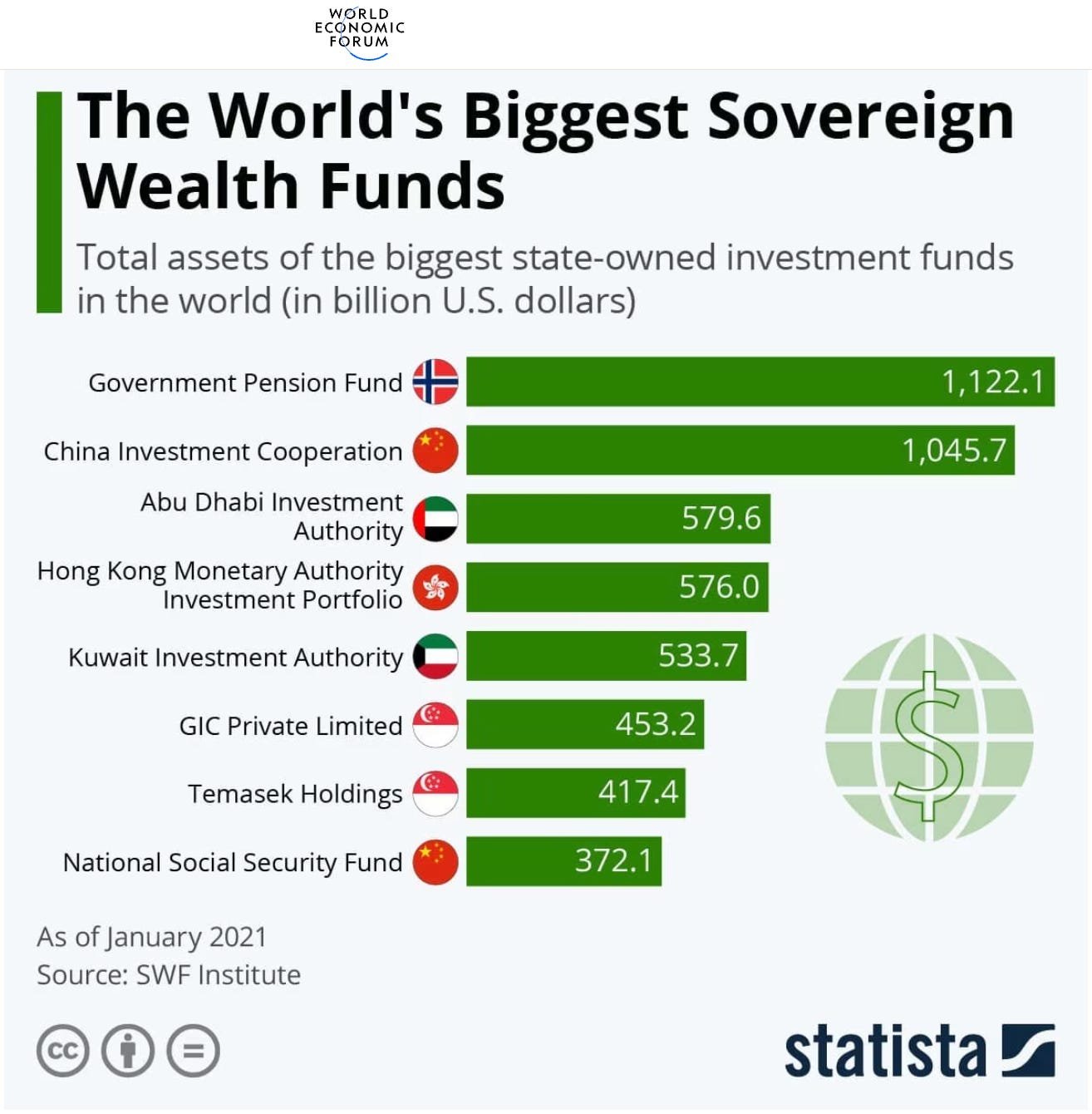
Norway’s Government Pension Fund Global holds NOK 22,683 billion, as of June 30, 2026. Spread that across the 5,636,904 people Statistics Norway counted at the end of Q2 2026, and it works out to about NOK 4.02 million per citizen. It owns stakes in something like 1.5% of every publicly listed share on the planet.
A fund that size cannot pick its way around a systemic risk. It is too large to sell exposure to anyone because, at that scale, it effectively owns the market. Its only options are to change what the market does or to absorb what the market produces.
That is what makes it a useful signal for a real estate investor who will never take its capital. It is a forced long-term owner, and forced long-term owners are the first to treat a slow risk as real.
The fund’s mandate allows up to 7% of assets in unlisted real estate. Its actual allocation has run well below that: 1.64% as of June 30, 2026. A patient owner with room to buy property, choosing not to, is telling you something about how the asset class is priced.
The Story
The regulatory picture in 2026 is genuinely two-directional, and most commentary conflates the two directions.
Europe narrowed the scope and kept the substance. The Omnibus package is no longer a proposal or an agreement. It is Directive (EU) 2026/470, approved by Parliament on December 16, 2025, and by the Council on February 24, 2026, published on February 26, and in force since March 18, 2026.
It replaces the old two-of-three test with a conjunctive one. An EU undertaking is in scope only if it has an average of more than 1,000 employees AND net turnover above €450 million. The balance-sheet route into scope is gone. The previous test was met by exceeding any two of three thresholds: €50 million in turnover, €25 million in balance sheet total, and 250 employees.
The change will remove roughly 80% of previously in-scope companies when it takes effect. Third-country parent companies are captured if the consolidated group generates net turnover exceeding €450 million in the EU and meets the criteria for having an in-scope large EU subsidiary or a qualifying EU branch presence.
Reporting now applies to fiscal years beginning January 1, 2027, with first reports in 2028. For those groups, the subsidiary test is €200 million of EU turnover.
What survived is as important as what was cut. The companies still in scope are the largest, those that occupy institutional real estate as tenants and whose disclosures a landlord can actually read.
California kept the thresholds and lost the timing. SB 253 applies to companies with more than $1 billion in revenue doing business in the state, with Scope 1 and Scope 2 emissions due November 10, 2026 under modified regulatory text that is still contingent on Office of Administrative Law approval, and a limited five-category Scope 3 beginning in 2027. SB 261 applies to companies with revenue above $500 million and requires biennial reporting on climate-related financial risk.
On November 18, 2025, the Ninth Circuit issued a temporary injunction blocking enforcement of SB 261 pending appeal. The court heard oral argument on January 9, 2026, and the stay has remained in place. The California Air Resources Board did not enforce the January 1, 2026 deadline. SB 253 was not enjoined, and CARB has moved to formal rulemaking. Depending on when you are reading this, the needle may have moved again.
The United States withdrew its banking guidance. The interagency Principles for Climate-Related Financial Risk Management, issued in October 2023 for institutions with more than $100 billion in assets, were rescinded, effective November 18, 2025.
Three jurisdictions, three directions, one calendar year. The effect is that the burden shifts from a compliance department to an underwriter, because the disclosure that used to be mandatory and comparable is now partial and voluntary.
Structural Forces
Under the regulatory noise, three forces are moving in only one direction.
The first is that capital allocators kept their frameworks. GRESB’s 2025 Real Estate Assessment drew 1,002 fund managers submitting 2,382 assessments, of which 81.5% held formal net-zero policies, up from 78.8% in 2024. That measures a self-selecting population of managers who chose to be assessed, not a market-wide share, and it rose the same year the EU narrowed its rules.
A manager raising capital is not audited by a regulator. An investment committee audits it, and the committee’s checklist has not shrunk.
The second is litigation. The Urgenda case in the Netherlands established that a government could be held to a legal duty on climate policy. It binds the Dutch state rather than private companies, and it should not be described as corporate liability precedent. It established that climate obligations are justiciable, and that door remains open.
For a fiduciary, the relevant question is not whether a lawsuit succeeds. It is whether a plaintiff can construct a claim that a reasonable manager would have priced a foreseeable risk and did not. Disclosure regimes create the documentary record on which that question is answered, which is why weakening disclosure does not reduce exposure so much as shift where it is made.
The third is that the tenant is now a data source. This is the practical one for a landlord.
A tenant in scope for CSRD is reporting on the climate risk of its leased real estate. That means your building appears in someone else’s regulatory filing, assessed by someone else’s methodology, with conclusions you did not write. A large corporate tenant that publishes its leased portfolio’s physical risk rationale has documented that rationale publicly years before renewal.
Read those filings the way you read a rent roll. They tell you what your anchor tenant will do.
Landlords should think through a second-order effect of the narrowed scope. A tenant that falls out of CSRD scope stops publishing, but that doesn’t mean it stops assessing. Mid-market corporate tenants will continue to run the same internal analyses their auditors and lenders require. What disappears is your ability to read it.
So the transparency you gain sits at the top of the tenant market, and the opacity sits in the middle, which is where a great deal of institutional real estate income actually comes from. If you own assets leased to companies in the €50 million to €450 million turnover band, you have just lost a forward indicator you were about to be given.
The workaround is old-fashioned. Ask during the lease negotiation. A tenant who has done the work will tell you, because a tenant who has done the work is usually looking for a landlord who has, too.
Next Chapter
The fiduciary standard is shifting from what you disclose to what you priced.
For most of the last decade, the compliance question was whether a manager reported the right things in the right format. Reporting was the product. With scope narrowing in Europe and half the California package enjoined, that framing is losing force, and the replacement question is harder to answer.
Did you underwrite the risk? Not - did you disclose it? Did the pro forma carry an insurance escalator that matched the market? Did the hold period assume a refinance in a market that will still finance? Did the exit assume a buyer pool that will still exist?
Those questions don’t depend on a directive, and they don’t go away when a court issues a stay. A model answers them, and the model is discoverable.
Three things to watch.
Whether the narrowed European scope reduces data availability enough to matter. With 80% of previously in-scope companies exiting, the comparable tenant-level data a landlord could have relied on has shrunk considerably. The largest tenants remain in scope, so the top of the market keeps its transparency, and the middle loses it.
Whether the Ninth Circuit resolves SB 261 in 2026. Either ruling sets the template for the state-level disclosure regimes that follow, and several states are waiting to see it.
Whether allocator requirements diverge further from regulatory requirements they already have. If GRESB participation and net-zero policy adoption continue to rise while statutory scope falls, then the binding constraint on a real estate manager is the LP, not the regulator, and it has been for some time.
Notice that the fund at the top of this brief has already answered the question that regulators are still debating. It did not wait for a directive, and no directive will change what it does next.
The through-line across this month of briefs is that climate risk reaches real estate through price before it reaches it through policy. Insurance repriced first. Credit followed. Valuation is following credit. Disclosure was always the slowest of the four, and it is the only one that can be repealed.
Brief 11 showed the cost of an unpriced hazard at the asset level. Brief 13 shows where institutional capital is actually going in 2026.
As always, KNOW YOUR SIGNALS and BE CLIMATE READY!
Jamie
Go deeper
This is a Story & Future Thinking brief, so there is no companion workbook. The blank master CRDF Signal Tracker and Deal Stress Test are free and available at climatereadyre.com/tools.
Related briefs
Same signal (S8 Disclosure, Taxonomy & Regulatory Regimes):
Brief 18 · SFDR Article 8 and 9 Enforcement for Real Estate Funds: 1 of 28 Acted - coming soon
Brief 15 · The Netherlands Label C Rule: How a Deadline Moved a Market to 78% Compliance - coming soon
Brief 8 · Office Overheating Risk and Valuation: What 40.3C Does to a Cap Rate
Next in sequence:
Brief 13 · GRESB Participation and Real Estate Returns: What $9 Trillion in Capital Screens For - coming soon
Sources
Every figure above, with the date the data covers, the date it was published, and the date I verified it.
Government Pension Fund Global scale — NOK 22,683 billion in assets, which, across Norway’s 5,636,904 people at the end of Q2 202,6 is about NOK 4.02 million per citizen; strategic ceiling of 7% of the fund for unlisted real estate against an actual allocation of 1.64% as of June 30, 2026
Norges Bank Investment Management · Data as of Jun 30, 2026 · Published Aug 12, 2026 · Accessed Aug 2026
Norwegian Petroleum Directorate · Data as of 2026 · Published 2026 · Accessed Aug 2026
CSRD Omnibus, final form — Directive (EU) 2026/470; threshold raised to 1,000+ employees and €450M turnover, removing roughly 80% of in-scope companies; applies to fiscal years from January 1, 2027, with first reports in 2028; third-country parents above €450M EU turnover, subsidiaries above €200M
Council of the European Union · Data as of Feb 2026 · Published Feb 26, 2026 · Accessed Aug 2026
Parliament approved on December 16, 2025; Council on February 24, 2026; in force on March 18, 2026. Previous thresholds were €50M turnover, €25M balance sheet, 250 employees.
CSRD Omnibus, scope thresholds — supporting commentary on the raised reporting threshold under Directive (EU) 2026/470
PwC Viewpoint — In brief INT2025-27 · Accessed Sep 2026
Non-EU companies in CSRD scope — an EFRAG estimate that Omnibus cuts non-EU companies in CSRD scope from 10,000 to 1,200 — reference only, not the basis of any figure in this brief
ESG Today · Accessed Sep 2026
California SB 253 and SB 261 — SB 253 applies above $1B revenue with Scope 1 and 2 due November 10, 2026, and Scope 3 from 2027; SB 261 applies above $500M with biennial climate financial risk reporting
California Air Resources Board · Data as of 2026 · Published 2026 · Accessed Aug 2026
CARB moved the Scope 1 and 2 deadline to November 10, 2026 in modified regulatory text made public on July 27, 2026. The Ninth Circuit issued a temporary injunction on November 18, 2025, blocking enforcement of SB 261 pending appeal; CARB has said it will not enforce the January 1, 2026 deadline. SB 253 is not enjoined.
US interagency principles rescinded — 88 FR 74183 (October 30, 2023) rescinded, effective November 18, 2025; applied to institutions above $100 billion in assets.
Federal Register · Data as of Nov 2025 · Published Nov 18, 2025 · Accessed Aug 2026
GRESB net-zero policy adoption — roughly $9 trillion benchmark; 81.5% of real estate participants hold formal net-zero policies in 2025, up from 78.8% in 2024, a rise of 2.7 percentage points
GRESB — 2025 Real Estate Assessment Results · Data as of 2025 · Published Oct 15, 2025 · Accessed Aug 2026
Both figures are from the Real Estate Assessment. Do not confuse the 78.8% real estate baseline with GRESB’s 2024 Infrastructure figure of 76.89%, often rounded to roughly 77%; the real estate and infrastructure series are separate benchmarks and are not interchangeable.
Urgenda — Dutch courts upheld a state duty on climate policy
Urgenda Foundation — Climate Case · Data as of 2019 · Published 2019 · Accessed Aug 2026
The ruling binds the Dutch state, not private companies. It is not a direct precedent on corporate liability.
Commentary and analysis only. Not investment, financial, legal, tax, or professional advice. CRDF tools are illustrative; examples are composites drawn from public data. Do your own due diligence and consult qualified professionals.
I run this analysis on specific deals. If you are positioning an asset for an institutional exit and want the disclosure and tenant-covenant assumptions pressure-tested before you commit, book 20 minutes.
Jamie Wolf, MBA — Founder & Publisher, Climate-Ready Real Estate Investing, © 2026, CR REI Holdings LLC