

Signals: S12 Resilience Economics & Retrofit · S1 Insurance Repricing · S9 Zoning, Codes & Land Use
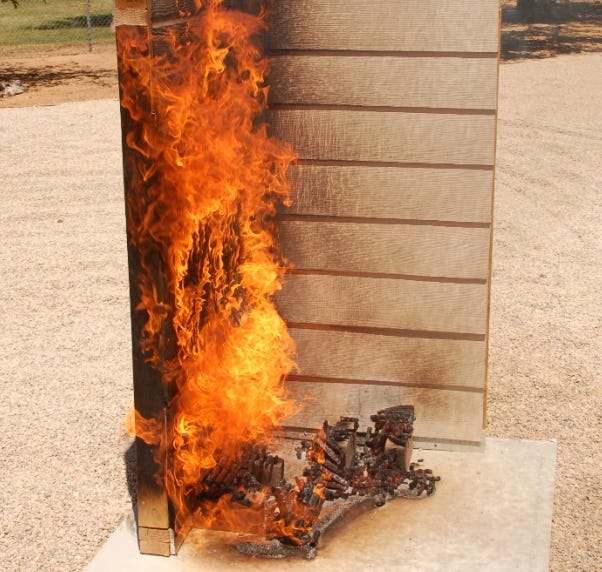
The National Institute of Building Sciences publishes a benefit-cost ratio for retrofitting buildings in the wildland-urban interface. It is $2 saved per $1 invested.
On a wildfire deal, the retrofit still pencils because the return was neither the premium discount nor the avoided loss.
Market Signal
Wildfire has stopped being an event that damages an asset and has become a test of whether the asset can be insured at all.
California’s regulation on mitigation in rating plans took effect October 14, 2022, with insurer filings due by April 12, 2023. It required that “an insurance company’s rating plan must contain a separate, individual discount or credit for each mandatory mitigation factor identified in the regulation.”
The Department of Insurance also stated what that meant. “The Department expects that consumers will receive at least $1 in premium reduction for each mandatory factor.”
The regulation also had a door. It applied only to insurers that already use wildfire risk in rating, so a carrier could comply by removing wildfire risk from its rating plan entirely. Resources for the Future found that among the top twenty-five property and casualty groups, discounts were either in place or carriers had removed wildfire from their rating procedures.
On the standards side, the Insurance Institute for Business and Home Safety’s Wildfire Prepared Home designation expanded to ten additional states on April 14, 2026, adding roughly 1.8 million eligible homes and bringing the program to fourteen states. IBHS launched a separate Wildfire Prepared Multifamily standard on June 9, 2026, at Essential and Enhanced levels.
The expansion made 1.8 million homes eligible for a designation. Whether any of those homes can obtain a discount depends on state-by-state carrier filings, and only California mandates that mitigation appear in rating at all.
Deal Scenario
Model a portfolio of 40 detached single-family rental homes in a California wildland-urban interface market, at a $16 million basis, or $400,000 per home. The carrier has issued a non-renewal notice on the portfolio. This is a modeled scenario, and the asset class is chosen deliberately. The retrofit cost research measures detached single-family houses, so the numbers actually transfer to a portfolio of them.
The choice is to complete an IBHS Wildfire Prepared Home retrofit across the portfolio, or to do nothing and go to the residual market.
Headwaters Economics prices a complete retrofit of a two-story, 2,000-square-foot detached home to a “good” level at $23,000 to $40,000, rising to $40,000 to $60,000 for “better” and $60,000 to more than $100,000 for “best.” Targeted measures alone, covering vents, deck flashing, gutter guards, and gravel mulch, run $10,000 to $15,000.
Take the midpoint of the good band, $30,000 per home, across forty homes. That is $1.2 million, or 7.5% of basis.
Assume a fire-exposed premium of $4,000 per home per year, so $160,000 across the portfolio, with the wildfire portion at 60%.
Now apply the measured discount. Resources for the Future examined the rating plans of the top twenty-five property and casualty groups, covering about 90.7% of the California homeowners market. A Class A roof earns an average discount of 1.88%, or $31.38 per year. The average maximum property-level discount, across carriers that discount the full premium, is 5.65%, or $98.33 a year. Stacking community-level Firewise credits on top reaches 13.15%.
At the property-level ceiling of 5.65%, the portfolio saves about $9,000 per year, against $1.2 million of spend, for a payback of roughly 130 years! That doesn’t sound very plausible.
In this scenario, “the costs of property retrofits are orders of magnitude greater than the insurance savings.”
So stop underwriting this as a discount play. It has never been one.
Underwriting Analysis
The return sits in three places, and only one of them is decisive.
First, avoided loss. NIBS puts wildland-urban interface retrofit at $2 per $1, and its own full report gives the band as “as high as 8:1 or conservatively 2:1” before selecting 2:1 as the published figure. On $1.2 million of spend, that is roughly $2.4 million of expected avoided losses across the measures’ life. Real, modeled, and spread over decades rather than over a seven-year hold.
Second, downtime. A destroyed rental home produces no income while it is rebuilt, and in a market where a whole neighborhood burns at once, rebuild queues run years, not months.
Third, insurability, and this is the one that decides the deal.
Follow what happens to the portfolio that does nothing.
It leaves the admitted market. California’s FAIR Plan, the residual market, settles a partial dwelling loss on actual cash value unless the policyholder has elected the optional Dwelling Replacement Cost addendum, meaning the payout is depreciated. Alternatively, the portfolio moves to surplus lines, where forms are not rate- or form-regulated. California surplus lines personal-lines policy counts grew from roughly 50,000 in 2023 to 320,000 in 2025, and personal lines have gone from 1.5% of surplus lines policies to 10% over the past thirteen years, per the association’s chief executive.
Either route trips a coverage covenant written against admitted, replacement-cost coverage. The lender’s remedy follows. The refinancing assumption fails, and the exit either disappears or reprices to a buyer who can self-insure.
The retrofit did not buy a cheaper premium.
It bought the portfolio’s continued right to carry a loan and trade at a normal cap rate. Measured against a $31 discount, the spend is indefensible. Measured against losing admitted coverage on a $16 million basis, it is trivial.
That inverts the capital sequence most owners run. Triage by insurability status first, not by cost to fix. The assets already carrying a non-renewal notice are where a retrofit dollar flips the deal from frozen to financeable, and those dollars earn their return long before any discount appears on a declarations page.
As always, when researching your options and numbers, check your current policy status.
For instance, HUD’s Green and Resilient Retrofit Program had its unobligated balances rescinded in July 2025, and its surviving awards were converted from grants to surplus cash loans effective March 1, 2026.
Meanwhile, FEMA’s Building Resilient Infrastructure and Communities program was terminated in April 2025, held unlawfully terminated by a federal court in December 2025, and reconstituted under court order in March 2026 with $1 billion across two fiscal years. Neither can be described today the way it was described two years ago.
Strategic Implications
Underwrite hardening as insurability insurance. The discount is a rounding error. Access to admitted, replacement-cost coverage is the whole return, and it is binary.
Use the right benefit-cost ratio for the right hazard. $2 per $1 for wildland-urban interface retrofit, $4 per $1 for above-code design generally, $11 per $1 for adopting current codes.
Ask the carrier what it credits, in writing, before the model. California requires mitigation to appear in a rating plan and does not set a size, and a carrier may exit the requirement by dropping wildfire from rating altogether. The published average maximums are 5.65% at the property level and 13.15% with stacked community credits.
Check the policy form, not just the premium. A FAIR Plan dwelling policy pays actual cash value on a partial loss unless the replacement-cost addendum was elected. That single line changes the recovery on every model in the portfolio, and it does not appear on a premium comparison.
Re-verify every grant assumption dated before 2026. Both major federal programs in this space changed status within eighteen months, one by rescission and one by litigation.
The exercise is urgent. The International Energy Agency estimates that “approximately two-thirds of the global building floor area that exists today will still be in use in 2040.” The retrofit question is not a subset of the construction question. It is most of it.
As always, KNOW YOUR SIGNALS and BE CLIMATE READY!
Jamie
Run this on your own deal
The CRDF Deal Stress Test™ built for this brief lets you run your own asset against insurability rather than a discount, with the premium savings, the avoided-loss ratio, and the coverage-covenant trigger all exposed as inputs. Free, no signup: Brief 29_CRDF Deal Stress Test™ (xlsx)
New to the framework? The blank master CRDF Signal Tracker™ and Deal Stress Test™ workbooks are at climatereadyre.com/tools.
Related briefs
Same signal (S1 Insurance Repricing):
Brief 26 · The True Cost of a FORTIFIED Roof: Insurance Savings & Storm Resilience
Brief 11 · Hurricane Helene Aftermath: Western North Carolina Home Insurance Rates Rise 4.4%
Next in sequence:
Brief 30 · Rotterdam Flood Resilience Funding: The Delta Programme Is EUR 9 Billion Short - coming soon
Sources
Every figure above, with the date the data covers, the date it was published, and the date I verified it.
Wildfire retrofit benefit-cost — $2 saved per $1 invested for retrofitting buildings in the wildland-urban interface; $4 per $1 for above-code design; $11 per $1 for adopting current codes; $6 per $1 for federal mitigation grants
National Institute of Building Sciences, Natural Hazard Mitigation Saves: 2019 Report · Data as of 2019 · Published Dec 1, 2019 · Accessed Aug 2026
Benefit-cost modeling. NIBS’s full report gives the wildland-urban interface band as “as high as 8:1 or conservatively 2:1” and publishes 2:1. The separate “$13 per $1” sheet is titled “Seismic Retrofit of Buildings” and does not apply to wildfire.
Measured wildfire mitigation discounts — a Class A roof earns 1.88% on average, or $31.38 per year; the average maximum property-level discount is 5.65% of full premium, or $98.33 a year; 13.15%, or $215.78, including community-level credits
Ludington, Liao and Walls, From Risk to Reward: Insurance Discounts for Wildfire Mitigation, Resources for the Future Working Paper 25-30 · Data as of 2025 · Published Dec 10, 2025 · Accessed Aug 2026
A working paper rather than peer-reviewed work. It covers the top twenty-five property and casualty groups, about 90.7% of the California homeowners multi-peril market. It finds that retrofit costs are orders of magnitude greater than the savings.
California’s mitigation-in-rating regulation — effective October 14, 2022, with filings due April 12, 2023; a separate discount or credit for each mandatory mitigation factor; the Department expects at least $1 of premium reduction per factor
California Department of Insurance, FAQ on Mitigation in Rating Plans and Wildfire Risk Models and 10 CCR 2644.9 · Data as of 2022 · Published Feb 16, 2023, revised Apr 10, 2025 · Accessed Sep 2026
The requirement applies only to insurers that use wildfire risk in rating. A carrier may comply by removing wildfire risk from its rating plan.
Retrofit cost — $23,000 to $40,000 to retrofit a two-story, 2,000 square foot detached home to a good level; $40,000 to $60,000 for better; $60,000 to more than $100,000 for best; $10,000 to $15,000 for targeted measures
Barrett and Quarles, Retrofitting a Home for Wildfire Resistance, Headwaters Economics · Data as of 2024 · Published Jun 2024 · Accessed Aug 2026
Contractor-priced for Northern California and scoped to one detached house with a 1,000 square foot footprint. Cost drivers scale with envelope and site geometry rather than unit count, so the figure does not transfer to a shared-envelope multifamily building.
IBHS program expansion — Wildfire Prepared Home extended to ten additional states on April 14, 2026, adding roughly 1.8 million eligible homes; Wildfire Prepared Multifamily launched June 9, 2026 at Essential and Enhanced levels
Insurance Institute for Business and Home Safety · Data as of Apr 2026 · Published Apr 14, 2026 · Accessed Aug 2026
IBHS’s own release names all fourteen states: Arizona, California, Colorado, Florida, Idaho, Montana, Nevada, New Mexico, Oklahoma, Oregon, Texas, Utah, Washington, and Wyoming, and states no home count; the 1.8 million figure comes from Digital Insurance’s report of Apr 28, 2026, where the headline rounds to 2 million and the body gives 1.8 million. Eligibility is for a designation, not for a discount. That report says only that qualifying homeowners may qualify for discounts.
California FAIR Plan settlement basis — a partial dwelling loss is paid at actual cash value, less depreciation, unless the optional Dwelling Replacement Cost addendum has been elected
California FAIR Plan Association, Dwelling Property Policy form CFP 00 01 · Data as of 2017 · Published Jul 2017 · Accessed Aug 2026
Surplus lines migration — California surplus lines personal-lines policies grew from roughly 50,000 in 2023 to 320,000 in 2025, and personal lines rose from 1.5% to 10% of surplus lines policies over thirteen years
‘Structural Shift Occurring in California Surplus Lines’ Surplus Line Association of California, reported via Claims Journal · Data as of 2023-2025 · Published Feb 17, 2026 · Accessed Sep 2026
An association statement about its own market, not a regulator’s count.
Federal program status — HUD’s Green and Resilient Retrofit Program had unobligated balances rescinded in July 2025 and surviving awards converted to surplus cash loans effective March 1, 2026; FEMA’s BRIC program was terminated in April 2025, held unlawfully terminated in December 2025, and reconstituted under court order in March 2026 with $1 billion across two fiscal years
Congressional Research Service, IN12609 on BRIC and P.L. 119-21 section 30002 · Data as of Apr 2026 · Published Apr 9, 2026 · Accessed Sep 2026
A revised BRIC notice of funding opportunity dated July 2026 supersedes the March version. Confirm current deadlines before relying on them.
Existing building stock — approximately two-thirds of the global building floor area that exists today will still be in use in 2040
International Energy Agency, Technology and Innovation Pathways for Zero-carbon-ready Buildings by 2030 · Data as of 2022 · Published Sep 2022 · Accessed Aug 2026
The measure is floor area, and the denominator is today’s stock rather than the 2040 stock.
The portfolio scenario — 40 detached single-family rentals at a $16 million basis, $30,000 per home retrofit across 40 homes, a $160,000 portfolio premium with the wildfire portion at 60%, and the 5.65% property-level discount ceiling applied
CRREI modeled scenario · Method: Headwaters’ good-retrofit midpoint applied per home to a detached single-family portfolio, against the RFF-measured maximum property-level discount; payback computed as spend divided by annual savings with no other pro forma input changed · Modeled — not a specific portfolio
The asset class was chosen so the retrofit cost research applies directly. The underlying study does not support applying a per-home figure to a shared-envelope multifamily building.
Commentary and analysis only. Not investment, financial, legal, tax, or professional advice. CRDF tools are illustrative; examples are composites drawn from public data. Do your own due diligence and consult qualified professionals.
I run this analysis on specific deals. If you hold wildland-urban interface assets carrying a non-renewal notice and want the insurability path priced before the covenant tests, book 20 minutes.
Jamie Wolf, MBA — Founder & Publisher, Climate-Ready Real Estate Investing, © 2026, CR REI Holdings LLC