

Signals: S8 Disclosure, Taxonomy & Regulatory Regimes | S3 Capital Allocation Flows | S4 Valuation & Appraisal Gap
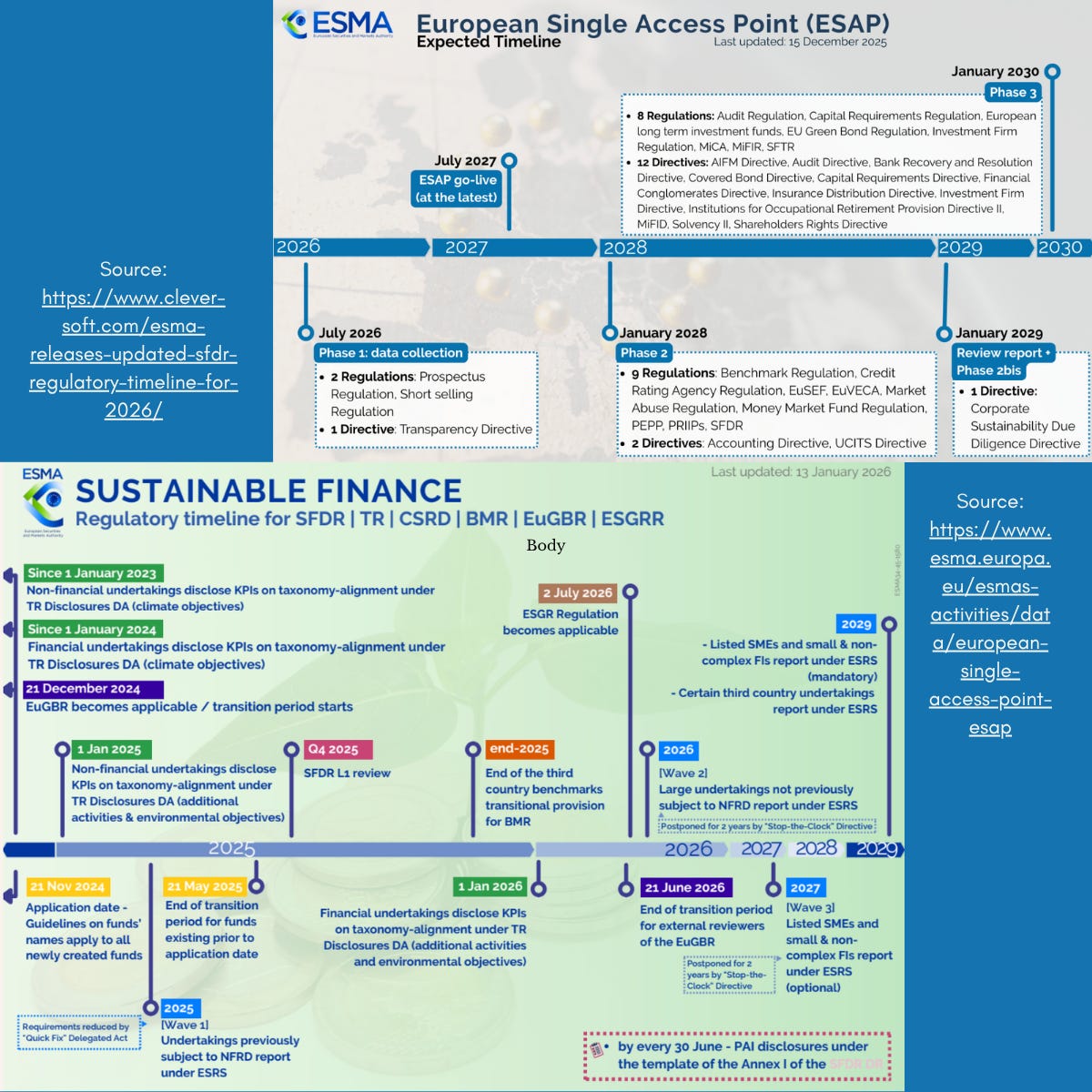
On Wednesday, we walked through how to win the LP conversation, the climate-skeptic, and the family office that does not do ESG, using returns, coverage ratios, and exit multiples rather than ideology. Today’s brief gives you the structural context for why that conversation is becoming unavoidable everywhere. The disclosure regime is closing in on every institutional real estate portfolio in the developed world. And once mandatory disclosure arrives, the line between ESG reporting and financial risk pricing disappears.
All month, we have been looking through the lens of Climate Risk as Capital Strategy because early recognition creates an investor advantage. With that as context…
The Moment
Let’s go to London. March 2025.
A mid-market European fund manager receives its first set of mandatory climate-related financial disclosures under CSRD, the EU’s Corporate Sustainability Reporting Directive. Wave 1 companies, which include large listed EU entities previously subject to non-financial reporting requirements, filed their first reports covering fiscal year 2024 data. The manager’s compliance team spent six months compiling the data. The numbers were not what anyone expected.
Three assets in the portfolio, two German office buildings and one Dutch logistics warehouse, carry physical risk scores that materially exceed the fund’s stated risk appetite. The German offices are rated as having above-average chronic heat-stress exposure and below-average energy performance under the EU Taxonomy thresholds for sustainable real estate. The Dutch warehouse sits in a secondary flood-risk zone that was not flagged at acquisition.
None of this was in the 2022 investor presentation. The fund manager now faces a choice. Either they must disclose the gap to LPs and lenders, quietly begin exiting, or retrofit at cost before the next report cycle. All three options carry consequences. The disclosure framework revealed a risk that the deal underwriting had missed, and it did so on a mandatory, audited, publicly accessible basis.
ESG reporting started as a compliance exercise. It is now the mechanism for surfacing embedded climate risk in capital markets. Once surfaced, it is repriced.
The Story
ESMA, the European Securities and Markets Authority, launched a Common Supervisory Action on SFDR fund disclosures in July 2023 and published its findings in June 2025, documenting material inconsistencies between the sustainability claims of several Article 8 and Article 9 funds and the underlying composition of their portfolios.
Some funds were classifying assets as sustainable investments without adequate documentation of how those assets met the EU Taxonomy criteria. No fines followed. National regulators issued bilateral letters, supervisory orders, and warning notices instead, and only one of twenty-eight said it had taken any enforcement action at all. In regulatory terms, that is the warning shot. The exercise covered the investment fund sector as a whole, including real estate AIFs, rather than real estate funds specifically.
ESG disclosure has evolved in three distinct stages, and understanding where we are in the sequence is key to anticipating what comes next.
Stage 1. Reporting Theatre, 2015 to 2021: ESG disclosures were voluntary, qualitative, and largely marketing-driven. Firms reported on what they chose to report. No standardization, verification, or enforcement existed. A property with a LEED Certified rating was treated the same as one with a LEED Platinum rating in most LP reports. The exercise was about optics.
Stage 2. Regulatory Architecture, 2021 to 2024: The frameworks arrived. SFDR in the EU. The UK, Australia, and New Zealand adopted TCFD. ISSB S1 and S2 were published in 2023. CSRD was enacted into EU law. California SB 253 was signed in October 2023. AASB S2 was finalized in Australia. The architecture was built before the data infrastructure existed to populate it cleanly. This gap, between mandatory disclosure and data quality, is what ESMA’s review documented.
Stage 3. Enforcement and Repricing, 2025 onward: Regulators are now testing disclosure quality against the frameworks. Auditors are treating climate disclosures like financial statements, with assurance requirements, materiality thresholds, and liability for misstatement. The CSRD mandates limited assurance in the first reporting cycle, with reasonable assurance over time. The Big Four accounting firms have built out sustainability assurance practices in anticipation. And institutional buyers, now priced by the same regulatory framework, are beginning to require that sellers prove alignment, not just assert it.
The mechanism through which reporting becomes repricing is direct.
When a CSRD-covered company discloses that 18 percent of its leased real estate cannot demonstrate alignment with the EU Taxonomy, that disclosure creates a paper trail. The auditor sees it. The LP sees it. The lender sees it. And the next valuation reflects it because the exit buyer pool for non-aligned assets has just structurally narrowed, and that narrowing is measurable in cap rate terms.
Structural Forces
Force 1: The Convergence of Global Disclosure Standards.
ISSB S2, the International Sustainability Standards Board’s climate disclosure standard, is now mandatory in Australia and Singapore, and adopted in Japan with application phased in from financial year 2027. In the United Kingdom, the equivalent standards, UK SRS S1 and S2, were published in February 2026 but remain voluntary while the FCA consults on making them mandatory for listed companies from the start of 2027. Canada is advancing.
The European Union took the opposite approach. The Omnibus I Directive, Directive (EU) 2026/470, entered into force on March 18, 2026, and cut the CSRD reporting population. Under the adopted thresholds, the exclusion is roughly 80 percent of previously covered companies, on Bird & Bird’s reading of the directive. The Commission has published no official post-adoption percentage.
The new threshold is the part with consequences for property. A company is in scope only if it exceeds 450 million euros of net turnover AND employs an average of 1,000 people. Both, not either. The previous test was two of three across turnover, balance sheet total, and headcount, which meant an asset-heavy company could land in scope on the strength of its balance sheet alone. That route is gone.
Real estate is the textbook capital-intensive, low-headcount industry. A fund manager or a listed owner can clear 450 million euros of turnover with a fraction of a thousand staff. So a large number of significant property owners are now outside CSRD, while their anchor tenants, who are retailers, logistics operators and corporates carrying real payrolls, are firmly inside it.
Your building’s energy performance and physical risk exposure may well be disclosed. It will be disclosed in your tenant’s audited filing rather than yours, and it will be characterized by someone whose interests are not yours.
The disclosure is happening. It is happening to fewer companies, about fewer data points, and increasingly to your counterparties rather than to you.
Force 2: The Physical Risk Scoring Gap.
The largest structural tension in today’s disclosure environment is the gap between what companies disclose at the portfolio level and what the underlying assets actually carry at the asset level.
Most TCFD-aligned disclosures rely on portfolio-level scenario analysis, running a transition- or physical-risk scenario across the entire book using broad geographic and sector assumptions. What they do not yet do consistently is score individual assets for their specific hazard exposure.
As tools such as CRREM (the Carbon Risk Real Estate Monitor), First Street Foundation’s commercial risk data, Munich Re’s Location Risk Intelligence platform, and MSCI’s Climate Value-at-Risk become more widely embedded in LP due diligence processes, the gap between portfolio-level and asset-level disclosure will narrow. When it does, the assets that have been carrying undisclosed physical risk will reprice, not gradually, but in the valuation cycle immediately following the disclosure.
Force 3: Auditor Liability Is Shifting the Game.
CSRD mandates limited assurance for the first reporting cycle and a trajectory toward reasonable assurance, the standard applied to financial statements, over time. When an auditor certifies climate data under the same liability framework they apply to revenue figures, the legal exposure for material misstatement shifts from a reputational cost to regulatory and litigation risks. This is the moment when ESG reporting shifts from a marketing function to a financial control function. The rigor, documentation, and audit trail that financial reporting now requires apply to every building’s energy performance certificate, every asset’s flood zone classification, and every portfolio’s physical risk score.
Force 4: The Taxonomy Alignment Gap as a Capital Markets Event.
Under the Sustainable Finance Disclosure Regulation as it stands today, an Article 9 fund must be able to demonstrate that what it holds meets the sustainable investment test. For real estate, that means specific energy performance thresholds, building code standards, and renovation milestones under the EU Taxonomy.
That gate is not theoretical. For example, in one non-compliance case in ESMA’s 2023 to 2024 Common Supervisory Action, reported on June 30, 2025, an Article 9 fund holding green and sustainability bonds could not perform a ‘Do No Significant Harm’ analysis at all, because the issuers would not share the underlying data, meaning the sustainable investment conditions were not satisfied.
For a sponsor, this is not a pricing question. An asset that cannot demonstrate alignment is not bid down by that fund. It is outside what the fund is permitted to hold.
Two things are now moving, and both run counter to what you would expect.
The first is visibility. Cutting roughly 80 percent of filers cuts the population reporting alignment data by roughly the same proportion. As a result, fewer counterparties will publish the data you would use to check your own position.
The second is the gate itself. The Commission’s SFDR review, published on November 20, 2025, proposed replacing the Article 8 and Article 9 classification with three categories and, in the process, converted Taxonomy alignment from a condition of entry into a safe harbor. A portfolio at 15 percent alignment is presumed to satisfy a 70 percent threshold that transition plans or engagement strategies can also satisfy.
That is a proposal, not a rule. The Council agreed its negotiating position on June 24, 2026. Parliament has not finalized its own. Trilogue is expected to begin at the end of 2026, with estimates for entry into force running from 2027 to 2028 and for application running to mid- or late 2029.
For a hold beginning today, the current gate governs the entire hold. The relief, if it survives trilogue at all, arrives after your exit, and the buyer who sets your exit price has to live with whatever replaces it.
Requirements can be withdrawn. Compliance can be scaled down. The underlying risk cannot be legislated out of the asset.
The Next Chapter
Asset-level physical risk certification will become standard deal documentation. Just as an environmental Phase I assessment is table stakes for commercial property acquisition today, expect institutional lenders in climate-sensitive markets to require climate risk certification, aligned to ASTM E3429-24 or a market-specific equivalent, within 36 months. A market of third-party providers is already forming around it, though the standard is not yet widely adopted and no lender has been shown to require it. It will propagate to EU markets, Canada, and Singapore through the same mechanism, that of institutional lender policy, not regulation. Lenders move first. The market follows.
The disclosure arbitrage window will close. Today, assets in markets with weaker disclosure requirements can be sold at prices that have not yet fully reflected their physical risk, because buyers have not yet been required to document that risk. As ISSB S2 and equivalent frameworks reach critical mass across the major institutional capital markets, and as institutional buyers carry those standards into cross-border transactions, the geography of non-disclosure shrinks. Within five years, a market without mandatory climate disclosure will be a market that institutional capital approaches with additional due diligence, not less. The arbitrage window is open. It will not stay open.
Litigation risk will concentrate on the disclosure gap. The pattern established by McVeigh v. REST in Australia, where a fiduciary’s failure to manage a material climate risk became the basis for a legal challenge, will be replicated in jurisdictions where the CSRD and the ISSB S2 create an explicit, documented standard of conduct. If a framework existed, and a fiduciary chose not to use it, the gap between the framework and the decision becomes the evidence. The disclosure trail created by mandatory reporting is also the litigation trail.
The Strategic Question
If the disclosure framework is going to surface every material climate risk in your portfolio, and it is, would you rather find it through your own assessment today, or through a mandatory disclosure to your LPs, your lenders, and your auditors at the worst possible moment in the credit cycle?
The disclosure regime is not the threat. The undisclosed risk is the threat. The disclosure regime is the mechanism that makes it visible. The question for your portfolio today is not whether you will disclose. It is whether you will know what you are disclosing before you have to.
As always, KNOW YOUR SIGNALS and BE CLIMATE READY!
Jamie
Go Deeper
This is a Story & Future Thinking brief, so there is no companion workbook. The blank master CRDF Signal Tracker™ and Deal Stress Test™ are free and available at climatereadyre.com/tools.
Related briefs
Same signal (S8 Disclosure, Taxonomy & Regulatory Regimes):
Brief 12 · Climate Disclosure Rules for Real Estate in 2026: CSRD, SB 253, and What Changed
Brief 13 · GRESB Participation and Real Estate Returns: What $9 Trillion in Capital Screens For
Brief 17 · Industrial Insurance Costs and Triple Net Recovery: 15% a Year in Dallas
Next in sequence:
Brief 19 · Rio Verde Water Cutoff and Scottsdale: 1,000 Residents on Hauled Water - coming soon
Sources
Every figure above, with the date the data covers, the date it was published, and the date I verified it.
ESMA supervisory action on SFDR disclosures — 2023–2024 Common Supervisory Action launched July 2023, final report June 30, 2025; national competent authorities issued bilateral letters, supervisory orders and warning notices, and only one of twenty-eight reported taking any enforcement action.
ESMA — Final Report, 2023-2024 CSA on the integration of sustainability risks and disclosures · Data as of 2023–2024 · Published Jun 30, 2025 · Accessed Aug 2026
ESMA reported an overall satisfactory level of compliance on sustainability risk integration under UCITS and AIFMD, but significant room for improvement on SFDR specifically. The two findings are separate and should not be merged. The exercise covered the investment fund sector, not real estate operators.
Article 9 fund unable to perform a DNSH analysis — Example 12, non-compliance: issuers of green and sustainability bonds withheld information, so the Article 2(17) sustainable investment conditions were not fulfilled.
ESMA — Final Report, 2023-2024 CSA, Example 12 · Data as of 2023–2024 · Published Jun 30, 2025 · Accessed Aug 2026
ESMA’s position is that a lack of information is not grounds for failing the DNSH principle. Note the shelf life: Article 2(17) and the DNSH principle are deleted in the SFDR 2.0 proposal, so this shows what the current regime caught, not where the rules are heading.
Omnibus I Directive and the size of the CSRD cut — Directive (EU) 2026/470, published in the Official Journal February 26, 2026, in force March 18, 2026; exclusion from CSRD reporting under the adopted thresholds is roughly 80 percent of previously covered companies on Bird & Bird’s reading; listed SMEs removed entirely.
Bird & Bird — Omnibus I Directive entered into force: a first overview of the amended CSRD and CSDDD · Data as of Mar 18, 2026 · Published 2026 · Accessed Aug 2026
The directive is adopted law and is cited by number. The adopted EUR 450 million turnover and 1,000-employee test is stricter than the thresholds behind the Commission’s February 2025 estimate, and company-count estimates for the before and after circulate widely without reconciling with each other.
Origin of the “roughly 80 percent” figure — the Commission’s February 2025 Omnibus package estimate of its own original proposal, produced under thresholds different from those finally adopted; Bird & Bird reports the adopted directive’s cut at roughly the same level.
European Commission — Omnibus package · Data as of Feb 2025 · Published date not stated · Accessed Sep 2026
The Commission’s estimate predates the final thresholds. Bird & Bird reports the adopted directive’s cut at roughly 80 percent.
Revised CSRD scope test — net turnover above EUR 450 million AND an average of 1,000 employees; the previous test was two of three across turnover, balance sheet total and headcount.
Bird & Bird — on revised Articles 19a and 29a of the Accounting Directive · Data as of Mar 18, 2026 · Published 2026 · Accessed Aug 2026
The test is conjunctive. The removal of the balance-sheet route is what makes this a real estate event: the industry is capital-intensive and low-headcount, so the operator may fall out of scope while the tenant stays in.
ESRS simplification — revised delegated act adopted July 3, 2026: mandatory data points reduced by more than 60 percent, total data points by more than 70 percent, reporting costs by more than 30 percent per company; mandatory from financial year 2027.
Bird & Bird — on the revised ESRS delegated act · Data as of Jul 3, 2026 · Published 2026 · Accessed Aug 2026
The delegated acts were still within a scrutiny period of up to four months at the time of writing. Confirm the period has run before treating these as final. Background to the “fewer data points” line in Force 1; no figure from this entry is quoted in the body.
Taxonomy reporting scope contracts with CSRD scope — the CSRD reporting obligation triggers the Article 8 disclosure duty; draft Delegated Act changes add a materiality threshold ending all-activity screening and simplify DNSH criteria.
Bird & Bird — Omnibus I overview, section 7 on Taxonomy · Data as of Mar 18, 2026 · Published 2026 · Accessed Aug 2026
Omnibus I does not amend the Taxonomy Regulation directly. The contraction is an indirect effect of the cut to the reporting scope, and it is already in force.
SFDR 2.0 proposal — COM(2025) 841 final, published November 20, 2025; replaces the Article 8 and Article 9 classification with three categories: Sustainable, Transition and ESG basics.
European Commission — Commission proposes improvements to the SFDR · Data as of Nov 20, 2025 · Published Nov 2025 · Accessed Aug 2026
A proposal, not a rule. The draft articles number the categories differently from the Commission’s plain-language announcement; the names used here follow the announcement.
Taxonomy alignment becomes a safe harbor, not a gate. Each category requires at least 70 percent of investments to meet the category’s objective, and a portfolio with at least 15 percent taxonomy-aligned investments is presumed to meet that 70 percent threshold; transition plans and engagement strategies can satisfy it instead.
European Commission — Commission proposes improvements to the SFDR · Data as of Nov 20, 2025 · Published Nov 21, 2025 · Accessed Aug 2026
Proposed, not adopted. The Commission’s announcement states the 70 percent portfolio threshold. The 15 percent taxonomy presumption sits in draft Articles 7 and 9 of COM(2025) 841, as read by Corporate Finance Lab, Paul Hastings, and CMS. The Council mandate of June 24, 2026 separately allows general-purpose EU public-sector bonds to count for up to 15 percentage points of the same 70 percent threshold: different instrument, same number. SFDR 1.0 remains in force unchanged.
SFDR 2.0 legislative status — Council negotiating position agreed June 24, 2026; Parliament position not finalized; trilogue expected to begin at the end of 2026; application estimates range from 2027 at the earliest to late 2029.
Council of the EU — Council agrees position on simpler transparency rules for sustainable financial products · Data as of Jun 24, 2026 · Published Jun 24, 2026 · Accessed Aug 2026
Proposed, not adopted. A negotiating mandate is not law. The mandate is indexed in the Council press release archive. The press release does not state the application window. Sources differ on the endpoint because they predate and postdate the Council position: Bird & Bird reads an 18-month transition and expects 2027 or 2028; Travers Smith reads 24 months and projects mid- to late-2029. Both readings are carried.
SFDR 2.0 removes the defined term “sustainable investment” — DNSH ceases to be a key assessment criterion and survives as category exclusion lists; PAI disclosure Articles 4 and 7 are deleted; disclosures capped at two pages.
Bird & Bird — SFDR 2.0: paradigm shift in European sustainability legislation, Part 2 · Data as of Nov 20, 2025 · Published May 13, 2026 · Accessed Aug 2026
Proposed only. SFDR 1.0 remains fully in force and unchanged, including Articles 8 and 9, Article 2(17), DNSH, and the PAI disclosure duties.
ASTM E3429-24, Standard Guide for Property Resilience Assessments — published 2024; positioned as a climate-risk analog to the Phase I environmental assessment.
National Law Review — Property Resilience Assessments and ASTM Standard E3429-24 · Data as of 2024 · Published 2024 · Accessed Aug 2026
It is a voluntary guide. This brief forecasts that institutional lenders will require it within thirty-six months, but it is not a documented requirement.
McVeigh v Retail Employees Superannuation Trust (REST), Australia — climate risk and fiduciary duty; settled November 2020.
Equity Generation Lawyers — McVeigh v REST · Data as of Nov 2020 · Published 2020–2022 · Accessed Aug 2026
The case settled with no judgment and therefore set no binding precedent. Its significance rests in the trustee’s undertakings rather than in any finding of law.
Revised CSDDD — scope now above 5,000 employees and EUR 1.5 billion worldwide turnover; obligations apply from July 26, 2029; the EU-wide civil liability scheme was removed, and the mandatory Climate Change Transition Plan was withdrawn.
Bird & Bird — Omnibus I overview, section 6 on CSDDD · Data as of Mar 18, 2026 · Published 2026 · Accessed Aug 2026
National liability regimes survive, with fines up to 3 percent of net worldwide turnover. Relevant to the forecast that litigation will concentrate on the disclosure gap; no figure from this entry is quoted in the body.
London fund manager scenario, the three-asset portfolio and the 18 percent Taxonomy figure — an illustrative composite, not a specific fund, filing or transaction.
CRREI — illustrative composite, no external source · Data as of not applicable · Published date not stated · Accessed Sep 2026
Built to show how a disclosure obligation converts an unmeasured risk into a documented one. The mechanism is real and sourced above; the fund, the assets, and the 18 percent are not drawn from any single disclosure and carry no evidentiary weight.
Commentary and analysis only. Not investment, financial, legal, tax, or professional advice. CRDF tools are illustrative; examples are composites drawn from public data. Do your own due diligence and consult qualified professionals.
I run this analysis on specific deals. If you are positioning an asset for an institutional or transition-capital exit and want the eligibility and physical risk assumptions pressure-tested before you commit, book 20 minutes.
Jamie Wolf, MBA — Founder & Publisher, Climate-Ready Real Estate Investing, © 2026, CR REI Holdings LLC