

Signals: S7 Water Stress & Allocation · S9 Zoning, Codes & Land Use · S4 Valuation & Appraisal Gap
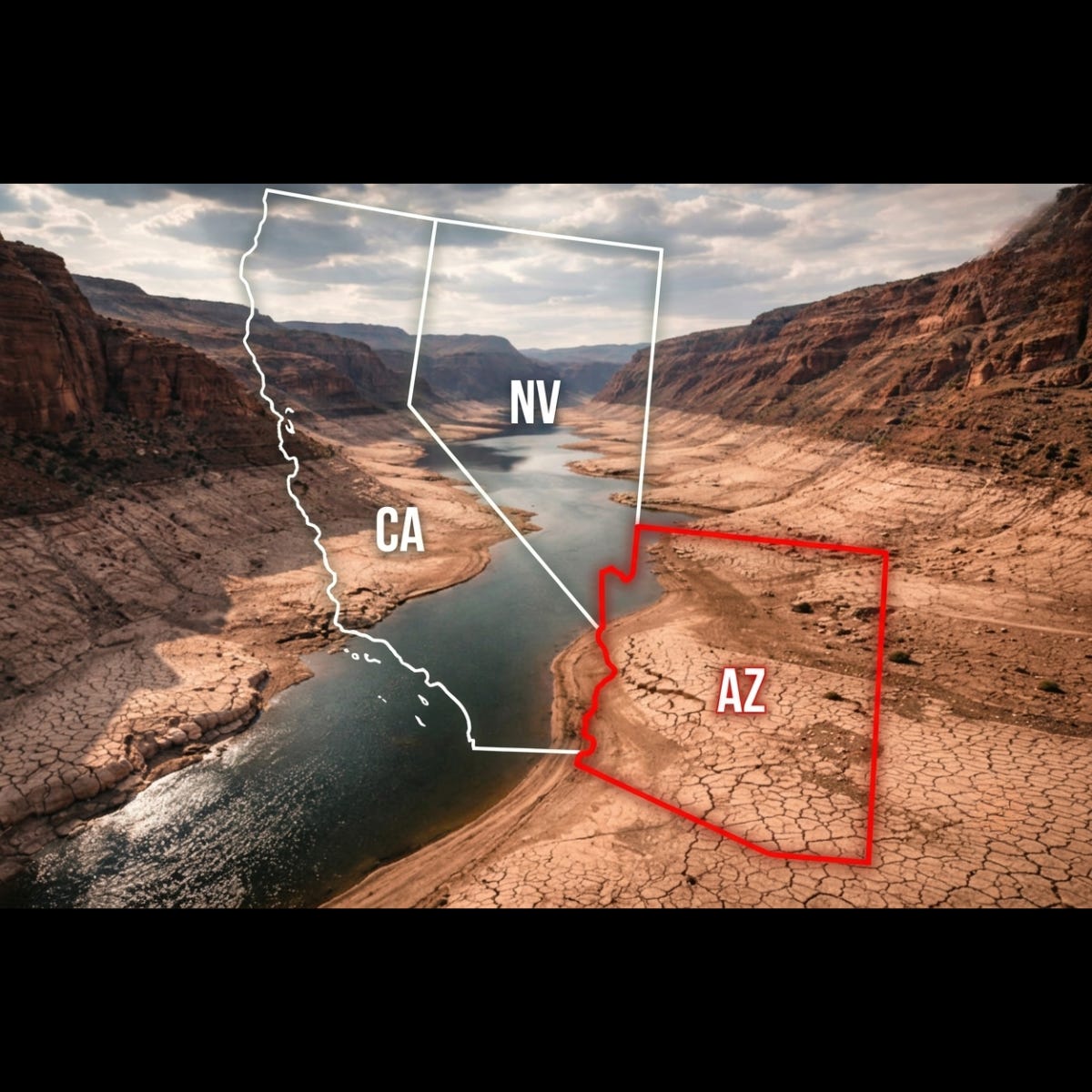
On June 1, 2023, Arizona stopped approving assured water supply determinations for new Phoenix-area subdivisions based on groundwater.
The model behind that decision projects 4.86 million acre-feet of unmet demand across the next hundred years.
No drought declaration, no emergency, and no disaster. A state agency ran a model, and a category of land stopped being developable.
Market Signal
Water touches real estate differently from every other climate signal in this publication, and the difference is worth understanding before the numbers.
Insurance reprices annually and reversibly. A carrier that withdraws can return. Water rights do not work that way. An aquifer that cannot support a hundred-year assured supply determination does not recover on a policy cycle, and the legal instrument that governs it is closer to a title condition than to an operating expense.
Arizona’s Assured Water Supply program requires a developer to demonstrate a hundred-year water supply before a subdivision can be platted. The 1980 Groundwater Management Act created that requirement, with the operative Assured Water Supply Rules effective in 1995, and for nearly three decades groundwater satisfied it.
In June 2023, the Arizona Department of Water Resources published a new Phoenix Active Management Area groundwater model and stopped approving new groundwater-based determinations. The projection behind it shows 4.86 million acre-feet of unmet demand by 2121.
This is not a building moratorium. Developments within existing Certificates and Designations of Assured Water Supply may continue to expand. What stopped is the approval of new groundwater-based determinations.
Arizona then created an alternative pathway. A developer could qualify by bringing non-groundwater supply to the project, through the Alternative Designation of Assured Water Supply route. In June 2026, the Maricopa County Superior Court voided the 25% supply-reduction provision at the center of that route, which is where Brief 28 picks up the story.
That combination is what makes this a repricing rather than a prohibition. Land with an existing certificate became more valuable. Land without one became worth the cost to serve it with water, plus the transaction cost to acquire it, minus the delay.
In other words, water moved from a utility-connection question to an acquisition line item in a single day.
The scale of the underlying depletion is not in dispute, which is what makes the administrative response predictable rather than surprising. Satellite gravimetry from NASA’s GRACE and GRACE-FO missions has documented sustained groundwater storage loss across the US Southwest and other major aquifer systems since 2002.
That data has been public for two decades. What changed in 2023 was not the hydrology. A regulator finally attached a permitting consequence to it.
For an investor, what’s perhaps most relevant is the sequence of events. Physical data usually precedes regulatory action by years, and regulatory action is what reprices the asset. Watching the hydrology tells you where to look. Watching the agency tells you when.
Case Study
The clearest illustration is not a subdivision. It is a community that already existed.
Rio Verde Foothills is an unincorporated area northeast of Scottsdale. About 1,000 residents, in roughly 500 to 700 homes, many of them expensive, relied on hauled water delivered from a Scottsdale standpipe. The community itself runs to some 2,000 homes.
On January 1, 2023, Scottsdale stopped supplying it.
The city had signaled the decision for eight years, beginning in 2015, to protect supply for its own residents. Rio Verde Foothills lies outside Scottsdale’s municipal boundary and service obligation. There was no contract to breach.
Hauled water prices nearly tripled for some households as tankers had to drive farther to find a source.
No well ran dry. No aquifer collapsed under those specific homes. What failed was an assumption embedded in the value of every one of those parcels, which was that a neighboring city would keep selling water to people it had no obligation to serve.
The physical resource was never the binding constraint. The legal and political arrangement around it was, and that arrangement was never written down anywhere a buyer would have looked.
Additionally, this was not marginal housing on marginal land. Expensive housing carries the same exposure when the entitlement is missing, and in some ways carries it worse, because the buyer pool for a high-value home with an unreliable water supply is considerably thinner than for a modest one. Buyer scarcity compounds water scarcity.
For anyone underwriting land or residential product in the Southwest, that is the transferable lesson. The question is not whether water exists. (Although…!) It is whether an enforceable right to it survives a policy change at an entity you do not control.
Strategic Implications
Water risk enters a real estate decision through three channels, and only the first is commonly subject to due diligence.
Physical supply. Whether the resource exists is the question everyone asks, and it is the least decisive, because in most Western markets the resource exists in some quantity at some depth at some cost.
Legal entitlement. Whether you have a right to it that runs with the land and survives a policy change. This is what Rio Verde lacked and what an Assured Water Supply certificate provides.
Administrative discretion. Whether an agency can change the rule that governs your entitlement, and how fast. Arizona demonstrated the answer is yes, and in a single announcement.
The practical consequence for underwriting is that water belongs in the diligence stack next to title, not next to utilities.
A certificate is an asset. Land inside an existing Designation of Assured Water Supply carries something land next to it does not, and the two parcels can look identical on a survey. That premium is real, legally documented, and rarely in a comp set.
The reverse also holds. A parcel whose development plan assumes a groundwater determination that can no longer be issued is not discounted. It is a parcel with an unpriced acquisition requirement attached, and the price of that requirement is set by whoever currently holds the alternative supply.
Then there is the question of what happens to the buildings already there. Rio Verde eventually reached an arrangement, but the interim taught the market something durable. A home whose water arrives by truck, at a price set by scarcity, along a route that lengthens as sources dry up, is not the same asset it was when the standpipe was open.
A financing consequence follows directly and is easy to miss. A lender underwriting a land loan on a parcel without an assured supply determination is lending against an entitlement that does not yet exist.
That is a different risk from construction risk or lease-up risk. It is closer to a permitting-risk model, and it is binary. The parcel either obtains an alternative designation or is not platted. In the latter case, the loan has no collateral.
Expect that to show up first as tighter land loan terms in affected submarkets rather than as a change in land prices, because credit reprices faster than comps do. It is also the earliest visible signal that the repricing has begun.
Future Signal
Track these four things -
Whether other states copy the Arizona mechanism. The Assured Water Supply framework is unusual in requiring a hundred-year demonstration at platting. Most Western states regulate water rights without explicitly tying them to subdivision approval. If the model spreads, the repricing spreads with it, and it arrives as a permitting change rather than as a shortage.
Whether water rights start appearing in institutional screens. Brief 13 noted sovereign and pension capital concentrating in water-secure Northern European markets while running data centers and logistics. That allocation pattern implies water is already inside proprietary models. When it appears in a published investment policy, entire Sun Belt submarkets reprice at once.
Whether the alternative supply market develops or seizes. Arizona’s alternative pathway only works if non-groundwater supply is actually purchasable at a price development can bear. If it is, this becomes a cost. If it is not, the alternative is theoretical, and the practical effect is closer to a moratorium.
Whether existing certificates start trading separately from the land. If a Designation of Assured Water Supply is the scarce asset, the market will eventually price it independently. Watch for land transactions in which the water entitlement is valued and disclosed as a separate line item rather than absorbed into the per-acre price. That is the moment water becomes a tradeable input rather than a site characteristic, and it changes how every parcel around it is underwritten.
The through-line is that water is the one climate variable where the legal instrument matters more than the physical resource. Insurance can be repriced. Heat can be engineered against. A parcel without an enforceable right to water cannot be developed at any price, and no amount of capital fixes that.
Brief 20 applies the same administrative-risk logic to an Australian office asset, where a rating threshold, rather than a water model, determines who can lease the building.
As always, KNOW YOUR SIGNALS and BE CLIMATE READY!
Jamie
Run this on your own deal
The CRDF Signal Tracker™ built for this brief lets you log water entitlement, allocation, and permitting signals in your markets, translate them into financial impact, and score which ones are moving your pricing. Free, no signup: Brief 19 CRDF Signal Tracker™ (xlsx)
New to the framework? The blank master Signal Tracker and Deal Stress Test workbooks are at climatereadyre.com/tools.
Related briefs
Same signal (S7 Water Stress & Allocation):
Brief 13 · GRESB Participation and Real Estate Returns: What $9 Trillion in Capital Screens For
Brief 28 · Arizona Assured Water Supply Certificate: Subdivisions and a 4.86M Acre-Foot Gap - coming soon
Brief 5 · Sun Belt Multifamily Insurance and IRR: Climate Risk Behind a 207% Rise
Next in sequence:
Brief 20 · NABERS 5.5-Star and Sydney Office Value: When a Rating Decides Your Tenant Pool - coming soon
Sources
Every figure above, with the date the data covers, the date it was published, and the date I verified it.
Arizona stopped approving groundwater-based determinations — from June 1, 2023, ADWR no longer approves new Assured Water Supply determinations based on groundwater in the Phoenix AMA; the model projects 4.86 million acre-feet of unmet demand by 2121.
Arizona Department of Water Resources — Phoenix AMA Groundwater Supply Updates · Data as of Jun 2023, projected to 2121 · Published 2023 · Accessed Aug 2026
Developments within existing Certificates and Designations may continue to expand. Only new groundwater-based determinations have stopped. This is not a building moratorium. ADWR’s wording is “will not approve,” not “will not process”; it does not state how pending applications were administratively handled after June 1, 2023.
Assured Water Supply program dates — created by the 1980 Groundwater Management Act; ADWR adopted the operative Assured Water Supply Rules in 1995, so groundwater satisfied the enforceable hundred-year test for roughly three decades.
Arizona Department of Water Resources — Arizona Groundwater Code · Data as of 1980–1995 · Published date not stated · Accessed Aug 2026
ADWR says it “adopted new” rules in 1995, which implies a predecessor rule set between 1980 and 1995. The 1995 rules are operative, not the first.
Alternative pathway — the Alternative Designation of Assured Water Supply allows qualification using non-groundwater supplies; the 25% reduction applied to each new alternative supply under R12-15-710(H) was voided by the Maricopa County Superior Court in June 2026 in HBACA v. ADWR.
Arizona Department of Water Resources — Alternative Designation of Assured Water Supply · Data as of 2023–2026 · Published 2024 · Accessed Aug 2026
Rio Verde Foothills water cutoff — Scottsdale ended standpipe deliveries on January 1, 2023; about 1,000 residents, in roughly 500 to 700 homes, relied on hauled water, in a community of some 2,000 homes.
High Country News — What happens when an affluent Arizona suburb’s main water supply is cut off · Data as of Jan 2023 · Published Feb 3, 2023 · Accessed Sep 2026
The 500 to 700 homes and ~1,000 residents pairing traces to High Country News. The ~1,000 figure is haul-water dependents, not the community’s population. Scottsdale had signaled the cutoff since 2015. The community is unincorporated and sits outside Scottsdale’s service obligation. No official population figure exists for Rio Verde Foothills; the census-designated place Rio Verde is a different, adjacent community.
Hauled water prices — prices nearly tripled for some households after the cutoff.
Washington Post — Arizona city cuts off a neighborhood’s water supply amid drought · Data as of Jan 2023 · Published Jan 16, 2023 · Accessed Aug 2026
Multi-decade groundwater depletion — satellite gravimetry documents sustained groundwater storage loss across the US Southwest and other major aquifer systems since 2002.
NASA JPL — GRACE and GRACE-FO · Data as of 2002–2024 · Published 2024 · Accessed Aug 2026
Commentary and analysis only. Not investment, financial, legal, tax, or professional advice. CRDF tools are illustrative; examples are composites drawn from public data. Do your own due diligence and consult qualified professionals.
I run this analysis on specific deals. If you are underwriting land or residential product in a water-constrained market and want the entitlement and supply assumptions pressure-tested before you commit, book 20 minutes.
Jamie Wolf, MBA — Founder & Publisher, Climate-Ready Real Estate Investing, © 2026, CR REI Holdings LLC