

Signals: S12 Resilience Economics & Retrofit · S3 Capital Allocation Flows · S4 Valuation & Appraisal Gap
The most carefully measured green premium in global real estate is a Tokyo office study covering ten years of leases. It finds a rent premium of about 6.5% for certified buildings.
Then it corrects for the fact that certified buildings tend to be newer, larger, and better located. The premium falls to 5.4% for medium-sized older buildings and 2.6% for large new ones.
That latter figure is the one to underwrite. Here is why the gap between 6.5% and 2.6% is the whole story of resilience-weighted investing.
The Moment
Institutional real estate has spent three years talking about scoring portfolios for climate resilience. The talk runs well ahead of the documents.
Start with the fund most often cited. Japan’s Government Pension Investment Fund is the largest in the world by assets, holding ¥293.6 trillion as of March 31, 2026, which is about 1.96 trillion US dollars at 150 yen to the dollar. It returned 16.47% in fiscal year 2025.
It is also barely a real estate investor. Alternatives are 1.74% of the total portfolio, against a 5% ceiling, and real estate sits within a combined infrastructure and real estate sleeve of that 1.74%. The fund’s own climate reporting is built on listed equities and corporate bonds, setting alternatives aside.
So when a headline links the world’s largest pension fund to a real estate resilience methodology, it is worth noting that the allocation behind the headline is a fraction of one percent of the balance sheet. That is worth knowing before borrowing the authority.
The framework that exists in a public document belongs to CalSTRS and is narrower and more useful than the version in circulation.
In 2023 and 2024, CalSTRS and its real estate consultant assessed physical climate risk across every separate account and joint venture asset in the portfolio. In fall 2024, it began a test case applying that analysis before any new acquisition, requiring investment partners to document mitigation measures and demonstrate how the additional risk was carried through the underwriting process.
It is a pre-acquisition screen with a documentation requirement. It is not quartile scoring, it is not systematic overweighting of a top quartile, and it is not a divestment review list for the bottom.
The distinction matters commercially. A screen changes what you have to prove at the buy. A divestment program changes who is selling and at what price. Those create different markets, and only one is documented.
The Story
Tokyo is the right place to look for what resilience is actually worth, because Japan has been pricing building performance longer than anywhere else and publishes enough transaction data to measure it.
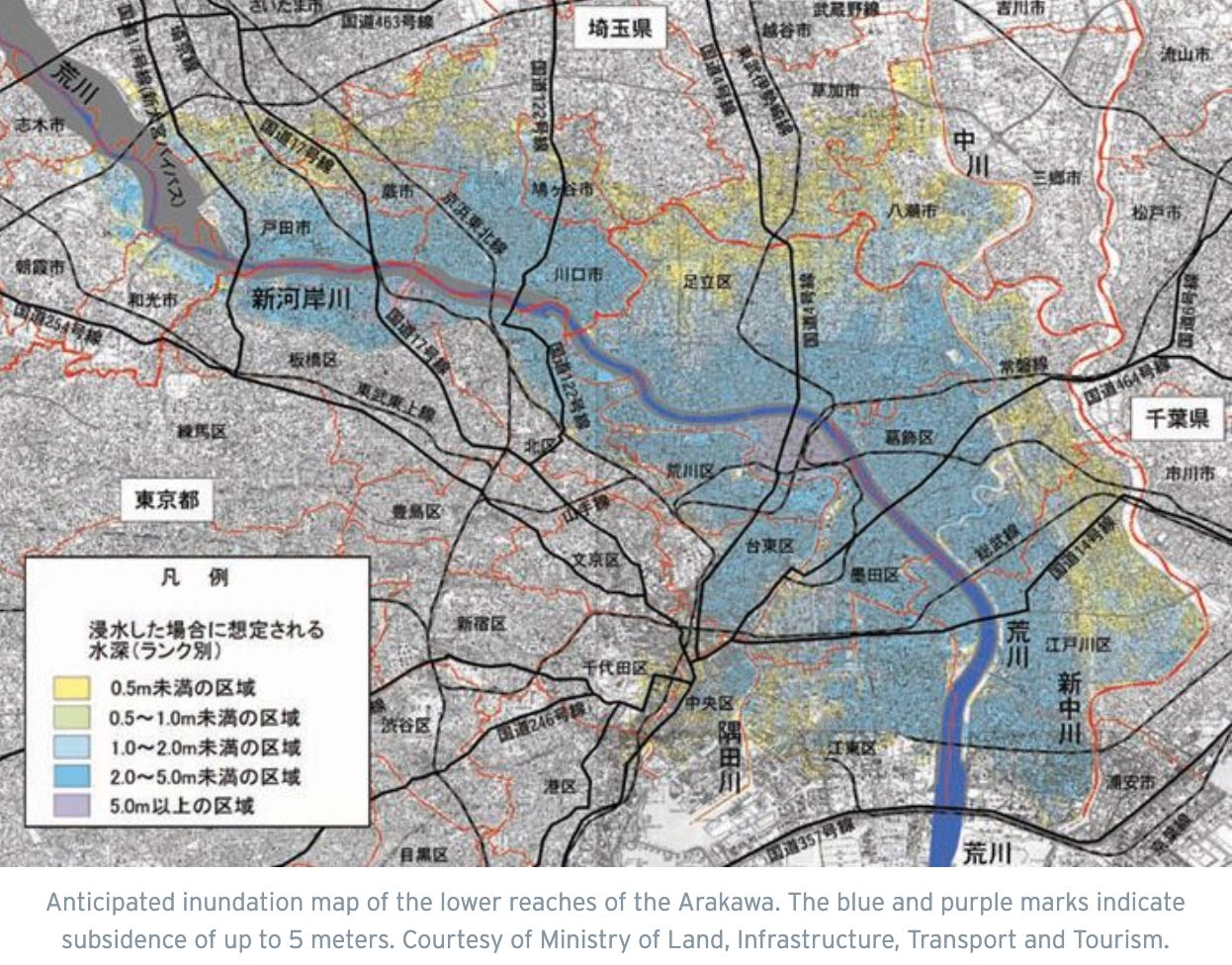
The physical layer is real and dated. The Metropolitan Area Outer Underground Discharge Channel, the flood tunnel usually photographed as an underground temple, was completed in 2006 after thirteen years of construction and can move up to 200 cubic meters per second into the Edogawa River. Its pressure-adjusting tank sits in Kasukabe City, Saitama Prefecture, north of the metropolis rather than inside it, and the Ministry of Land, Infrastructure, Transport and Tourism’s Edogawa River Office runs it. Over its first eighteen years of operation, the Tokyo Metropolitan Government puts the flood damage avoided at about ¥148.4 billion.
The regulatory layer is older still.
Japan’s Building Standards Act was revised in 1981 and again in 2000, and those two dates organize how institutional stock is screened in the country. Vintage relative to 1981 is the first question a Japanese acquisitions team asks.
The market layer is the Japanese listed real estate investment trust sector. The Tokyo Stock Exchange REIT Index had, at current exchange rates, a total market capitalization of ¥16.17 trillion across 58 constituents as of July 31, 2026, which converts to roughly 104 to 112 billion US dollars depending on the rate you use.
That market publishes asset-level environmental data under exchange governance requirements, which makes it one of the few places where the green-to-brown spread can be measured rather than asserted.
And when it is measured properly, it is smaller than the market believes.
The leading peer-reviewed study of the Japanese green premium, published in Sustainability in 2021, covers Tokyo office leases from 2009 to 2019 across both CASBEE and DBJ Green Building certification. The base model finds a premium of about 6.5% on contract rents.
The authors then address the obvious problem. Certified buildings are not a random sample. They skew newer, larger, better located, and better managed, and a naive comparison prices all of that as though it were the certificate.
After correcting for it, the premium falls to 5.4% for medium-sized older buildings and 2.6% for large new ones.
The uncontrolled number is roughly two and a half times the controlled one for the newer stock. It matters because this rationale underlies most green-premium claims circulating in Europe and North America, and most have never been corrected.
Remember that this example measures rent. It reports no effect of capitalization rate. Claims that certification compresses cap rates by a specific number of basis points in the Japanese market aren’t substantiated. If you are underwriting a certification decision, underwrite the rent line. The exit yield assumption has to be argued separately and on its own evidence.
Structural Forces
Force 1: The controlled number is the investable number. A performance premium measured without controls is mostly measuring building quality. This is not a technicality. It is the difference between a premise that survives an investment committee and one that does not, and it is why a 2.6% controlled rent premium can circulate as the 6.5% uncontrolled headline two citations later. When a broker quotes you a green premium, the first question is what it was compared against.
Instead, use these four questions to turn a quoted premium into an underwritable one.
What was the comparison group? Certified against uncertified, or certified against uncertified, matched on age, size, floor plate, and submarket? If the answer is the first, the number is mostly building quality.
Rent or yield? These are different claims with different evidence bases, and a rent study cannot support a capitalization rate assumption. Most quoted cap rate effects trace back to rent studies.
Contract rent or asking rent? Asking rents overstate because space that sits unlet at a premium ask never trades at that premium. The Tokyo study uses contract rents.
What period, and has the certification standard changed inside it? A ten-year window that spans a tightening of the certification threshold is measuring two different products under one label.
Force 2: Adoption is nearly universal and therefore no longer a differentiator. GRESB’s 2025 Real Estate Assessment drew 1,002 fund managers, including 84 first-time participants, submitting 2,382 assessments. Net-zero policies now sit at 81.5% of participating entities, up from 78.8% in 2024. When four in five participants have a policy, having one no longer signals anything. What separates entities is execution and measured performance, which is exactly where the Tokyo data points to.
Force 3: Screening at acquisition is where the constraint actually binds. The CalSTRS approach puts the test before the purchase and makes the sponsor carry the documentation burden. For an operator raising institutional capital, this is the practical change. You are not being asked to prove that your portfolio scores are good. You are being asked, deal by deal, to show the hazard analysis and the mitigation in a form that will survive an investment committee that did not visit the site.
Force 4: Japan measures what other markets estimate, and that is the transferable part. The value of the Japanese market to an investor in Dallas or Manchester is not that CASBEE will arrive there. It is that Japan demonstrates what happens to a premium when a market has enough disclosure to test it. The premium does not disappear. It shrinks to something defensible, and it becomes durable because it can be verified.
Next Chapter
The controlled and uncontrolled figures will separate in institutional reporting. Once one large allocator publishes a green premium net of building-quality controls, the uncontrolled figures become difficult to circulate in a diligence memo. Expect the gap to start being footnoted, and expect some current underwriting assumptions to move down when it is.
Certification value will migrate from rent to eligibility. Brief 20 traced this in Sydney, where a NABERS threshold decides which tenants may sign rather than what rent they pay. Brief 15 traced it in the Netherlands, where a national label prohibition moved the office market. A rent premium is a price. A threshold is a gate, and a gate is worth more than the premium it replaces because it cannot be competed away.
Physical hazard screening will become a condition precedent, rather than a report. The CalSTRS test case requires mitigation documentation inside the underwriting. When that becomes standard rather than a pilot, the sponsor who already produces it closes faster, and the one who does not discovers the requirement during exclusivity.
One near-term item is also worth noting. The NOAA Climate Prediction Center’s ENSO discussion of August 13, 2026 has an El Niño Advisory in effect, gives a greater than 90% chance of a very strong event through the Northern Hemisphere fall and winter of 2026-27, and puts a 69% probability on a three-month relative oceanic Niño index of +2.5°C or more during October to December 2026, a threshold no El Niño recorded since 1950 has reached. That set includes 1982-83.
A resilience premise is easy to hold in a quiet year. The next two are unlikely to be quiet, and the assets whose hazard exposure was documented at acquisition will be the ones whose insurance renewals and lender conversations go differently.
As always, KNOW YOUR SIGNALS and BE CLIMATE READY!
Jamie
Go Deeper
This is a Story & Future Thinking brief, so there is no companion workbook. The blank master CRDF Signal Tracker™ and Deal Stress Test™ are free and available at climatereadyre.com/tools.
Related briefs
Same signal (S12 Resilience Economics & Retrofit):
Brief 15 · The Netherlands Label C Rule: How a Deadline Moved a Market to 78% Compliance
Brief 13 · GRESB Participation and Real Estate Returns: What $9 Trillion in Capital Screens For
Next in sequence:
Brief 22 · CMBS Spreads & Climate Risk: 77bp and 56bp per Point of Exposure - coming soon
Sources
Every figure above, with the date the data covers, the date it was published, and the date I verified it.
Tokyo office green premium — about 6.5% on contract rents in the base model, falling to 5.4% for medium-sized older buildings and 2.6% for large new ones once building quality is controlled for, across CASBEE and DBJ Green Building certification.
MDPI, Sustainability — Onishi, Deng & Shimizu, 13(21):12227 · Data as of 2009–2019 · Published 2021 · Accessed Aug 2026
Controlled. The correction uses propensity score clustering, which is why the premium falls. The study measures rent and reports no capitalization rate effect.
GPIF assets and allocation — ¥293.6 trillion as of March 31, 2026, about 1.96 trillion US dollars at 150 yen to the dollar; fiscal 2025 return of 16.47%; alternatives 1.74% of the total portfolio.
Government Pension Investment Fund — Annual Report FY2025 summary · Data as of Mar 31, 2026 · Published 2026 · Accessed Aug 2026
Real estate sits inside a combined infrastructure and real estate sleeve within the 1.74% alternatives allocation. The dollar figure moves with the exchange rate; the yen figure does not.
CalSTRS physical climate risk process — assessment of all separate account and joint venture real estate assets across 2023 and 2024, followed by a fall 2024 test case applying physical climate risk analysis before acquisition with required mitigation documentation.
CalSTRS — Net Zero Strategy, Annual Branch-Wide Updates, Investment Committee item 3b · Data as of 2023–2024 · Published May 7, 2025 · Accessed Aug 2026
A pre-acquisition screen with a documentation requirement. The document describes no quartile scoring, no systematic overweighting, and no divestment review. By early 2025, CalSTRS extended the pre-acquisition analysis to all new investments.
GRESB 2025 participation and net-zero adoption — 1,002 fund managers including 84 first-time participants, submitting 2,382 assessments; net-zero policies 81.5%, up from 78.8% in 2024; net-zero targets 66.4%, up from 65.5%.
GRESB — 2025 Real Estate Assessment Results · Data as of 2025 · Published Oct 15, 2025 · Accessed Aug 2026
Japanese listed real estate market size — ¥16.17 trillion across 58 constituents, roughly 104 to 112 billion US dollars.
Japan Exchange Group — Tokyo Stock Exchange REIT Index factsheet · Data as of Jul 31, 2026 · Published 2026 · Accessed Aug 2026
Stated in yen because the dollar conversion moves with the exchange rate, and the rate used here is 145 to 155.
El Niño forecast for winter 2026-27 — El Niño Advisory in effect, greater than 90% chance of a very strong event, and a 69% chance of a three-month relative oceanic Niño index of +2.5°C or more during October to December 2026, a threshold not reached by any El Niño since 1950.
NOAA Climate Prediction Center — ENSO Diagnostic Discussion · Data as of Aug 2026 · Published Aug 13, 2026 · Accessed Aug 2026
A forecast, not an observation. Probabilities are the CPC’s own, are scoped to the October to December 2026 season, and are revised monthly.
Tokyo flood infrastructure — Metropolitan Area Outer Underground Discharge Channel, completed in 2006 after thirteen years of construction; capacity up to 200 cubic meters per second into the Edogawa River; pressure-adjusting tank in Kasukabe City, Saitama Prefecture; managed by MLIT’s Edogawa River Office; about ¥148.4 billion of flood damage avoided over its first eighteen years of operation.
Tokyo Metropolitan Government — Massive Underground Infrastructure Protects the Tokyo Metropolitan Area from Floods · Data as of 2006–2024 · Published Aug 28, 2024 · Accessed Sep 2026
The Tokyo Metropolitan Government states thirteen years of construction ending in 2006, so the body asserts no start year. Operating authority is MLIT’s Edogawa River Office, so this is a government secondary that names the primary holder.
Commentary and analysis only. Not investment, financial, legal, tax, or professional advice. CRDF tools are illustrative; examples are composites drawn from public data. Do your own due diligence and consult qualified professionals.
I run this analysis on specific deals. If you are underwriting a certification decision and want the premium assumption pressure-tested against controlled evidence before you commit capital, book 20 minutes.
Jamie Wolf, MBA — Founder & Publisher, Climate-Ready Real Estate Investing, © 2026, CR REI Holdings LLC