

Signals: S9 Zoning, Codes & Land Use · S12 Resilience Economics & Retrofit · S5 Acute Climate Hazard
In 2023, the United States appropriated $2.15 billion to buy low-embodied-carbon concrete, steel, asphalt, and glass, assigning $2.0 billion to 154 federal projects, with global warming potential limits and environmental product declarations required at the bid stage.
By January 31, 2025, $767 million had been obligated. Disbursements were frozen on February 13, 2025. That July, Congress repealed the authorizing section and rescinded the unobligated balance, which the allocation and obligation figures put at roughly $1.38 billion.
The building-science revolution is real, the performance evidence is strong, and the policy that was going to lock it in just went backward in the world’s largest procurement market. Both are true, and an investor has to hold them at once.
The Moment
Start with a photograph from Mexico Beach, Florida, in October 2018.
Hurricane Michael made landfall near Tyndall Air Force Base on October 10, 2018, at 140 knots (about 160 miles per hour), with a central pressure of 919 millibars. The National Hurricane Center recorded a storm surge of 14.7 feet above mean higher high water at Mexico Beach. In post-storm analysis published in April 2019, Michael was upgraded to Category 5, the first hurricane to make landfall in the United States at that intensity since Andrew in 1992.
An aerial shot shows a mile of coastline scraped to the slab. One house stands almost alone.
It is reinforced concrete on 40-foot piles driven 28 feet into the ground, with the first floor lifted about 15 feet to let the surge pass underneath. Independent reconnaissance engineers who surveyed it recorded a home “built above code minimums for Bay County, at a cost of roughly double per square foot,” which “lost only its stairs and breakaway walls, with some minor water damage.”
That last clause is the part usually left out. The breakaway walls broke away. That is what they are for, much like modern cars, which are designed with outer crumple zones that collapse in a controlled way to absorb crash energy and lower the peak force that reaches the occupants. The building was designed so that the parts below the design flood elevation would surrender and the structure above would not, and both halves did exactly that.
Fifteen feet of finished floor against fourteen point seven feet of surge is not luck. It is a decision made on paper, years earlier, by somebody who read the flood map and then added margin.
Of note, the 250-mile-per-hour rating belongs to the insulated concrete form product used in the walls. It is a manufacturer’s wall rating, not a whole-building design wind speed. Engineers don’t design a house to a wind speed rating. The two verified numbers are the doubled cost and the survived surge, and they are enough.
The Story
Widen the lens, because the same principle applies to every hazard, and the best evidence is not American.
In Maasbommel, on the banks of the Meuse in the Netherlands, 32 amphibious houses sit on a concrete base with a timber frame above, moored on steel guideposts. When the river rises, they float up to 5.5 meters and settle back as it falls, like every dock on coastal water subject to daily tide changes. The European Environment Agency recorded the first real test. In 2011, the Meuse rose far enough for the amphibious houses to float for the first time, and “in floating condition there were no problems detected.”
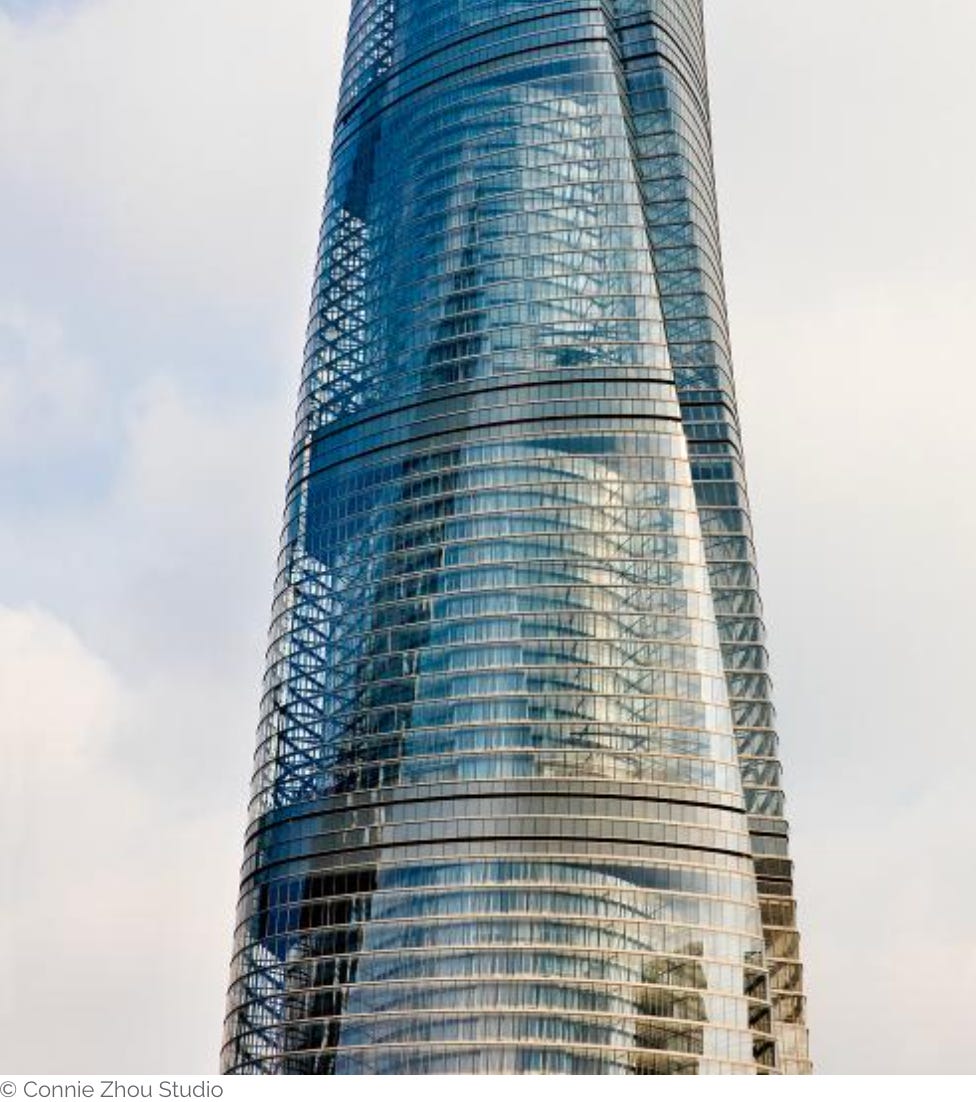
In Shanghai, one of the world’s tallest towers carries a façade that curves through 120 degrees from base to crown. The structural engineer of record said refining the form in a wind tunnel “reduced building wind loads by 24 percent, which resulted in a lighter structure and reduced material cost.” Not by resisting the wind. By letting it slide past.
And in May 2023, engineers put a full-scale ten-story mass timber building on a shake table at the University of California San Diego. They hit it with records from the 1994 Northridge and 1999 Chi-Chi earthquakes, the second a magnitude 7.7. The building “remained damage-free after two major design-level earthquakes back to back.” Peak interstory drift reached 2.33%, and the post-tensioned rocking walls returned the structure to plumb with negligible residual displacement.
That last result matters most, and it is routinely undersold as “it stayed standing.” A steel or concrete building of that height would be expected to survive. But wood? The timber building survived and re-centered, with damage confined to replaceable steel fuses—a low-carbon material performing like a high-performance one.
Which brings the tension into focus. The Mexico Beach house bought its survival with carbon-heavy concrete. It proved that resilience is a design choice, and it proved it using one of the most emissions-intensive materials available.
The quiet revolution is delivering that same multi-hazard survival at far lower carbon, and the reason structural materials are the battleground is calculable.
The Institution of Structural Engineers’ benchmarking data puts the superstructure at 40% to 47% of a building’s capital carbon and the substructure at a further 11% to 17%. Together, this typically accounts for over half and up to about two-thirds in heavy-frame buildings, though the share falls sharply for low-rise timber housing and fit-out-heavy refurbishments.
The market is moving. The Business Research Company, a private market-sizing firm, puts the global market for low-carbon construction materials at about $281.8 billion in 2025, rising toward $306.5 billion in 2026. The caution with these figures is that, as yet, “low-carbon construction material” has no agreed boundary.
Structural Forces
Three forces decide who wins, and the first one just reversed direction.
Force one: regulation pulls the material, and it does not pull steadily.
The United States is the example at the top of this brief, and what replaced the $2.15 billion program is nothing. Projects that had money obligated before the February 2025 freeze still have to meet the low-carbon material requirements. No new projects are being funded, and no successor program exists. The same July 2025 act also repealed the Environmental Protection Agency’s $250 million fund that helped manufacturers produce the environmental product declarations those requirements depend on.
In Europe, the Ecodesign for Sustainable Products Regulation, adopted in June 2024, is the horizontal framework for digital product passports, but it does not currently cover construction products. Its own text bars cement requirements before December 31, 2028, and the first working plan prioritizes textiles, furniture, tires, mattresses, iron and steel, and aluminum. The construction passport arrives instead through the recast Construction Products Regulation, in force since January 2025 and applicable from January 2026, delivered through delegated acts phased across 2026 to 2029.
Canada is often described as tying infrastructure funding to embodied-carbon audits. Its Treasury Board standard requires federal construction contracts of $10 million or more to disclose and cut the embodied carbon of ready-mix concrete by at least 10% against a baseline mix. One material, its own procurement, is in force since the end of 2022.
So the accurate picture is three jurisdictions moving at three speeds in two directions, and an assumption that synchronized regulatory pull will be wrong somewhere.
Force two: durability changes the lifecycle math. A material that survives the event and lasts longer produces lower insurance cost, lower replacement cost, and higher residual value. That is the adaptation-capex-as-asset argument pushed back up the supply chain to the factory.
McKinsey estimates that a set of ten themes and forty-nine named technologies represents “a $600 billion to $1 trillion addressable market by 2030,” which their authors define as forecast spending on equipment and infrastructure plus projected software and services revenue. That is a scoping decision, not a measured market. It is McKinsey’s estimate of an addressable market, not the size of an industry.
Force three: deliverability becomes a product feature. The events themselves, plus the tariffs and shipping constraints tracked all month, reward materials and supply chains that are regional, substitutable, and resilient. The next great building material may win less on raw performance than on whether it arrives on schedule when a canal is throttled or a tariff lands.
Running underneath all three is the digitization of the material itself. Mass timber arrives with a fabrication record. Low-carbon concrete arrives with a documented mix design and an environmental product declaration. That data layer lets a regulator, an underwriter, and a buyer read the same building from the same record, and documentation is exactly what a carrier needs before it will reward anything.
The Next Chapter
Over the next decade, building science becomes the competitive front in real estate, and the mechanism is exclusion rather than premium.
The supplier who controls a low-carbon, resilient, code-compliant material will not be selling a premium product. They will be selling the only compliant one. Conversely, the high-carbon or unrated product becomes stranded inventory, designed out of projects the way an uninsurable asset gets designed out of a portfolio.
For a century the cheapest-to-build material won, and durability and carbon were somebody else’s problem - the insurer’s, the next owner’s, or the planet’s. The revolution closes that gap only where carbon and performance are both measured, priced, and required. Take the requirement away, and the externality goes straight back out of the balance sheet.
So the firm that sees this early does not bet on regulation. It bets on the two forces that do not reverse. Physics does not reverse. A building that survives a 14.7-foot surge survives it under any administration. And insurance does not reverse. A carrier writing a coastal risk cares about the roof deck attachment, whatever the procurement rules say.
The question to leave with builders, suppliers, and the investors who back them is this. Are the materials sitting in your portfolio right now on the right side of the building-science revolution, or one code cycle away from obsolescence?
The revolution does not announce itself with a breakthrough or a ribbon-cutting. It shows up as the slow re-sorting of which materials, methods, and firms are still allowed in the building at all.
The house at Mexico Beach already told us the ending. Survival is a choice made at the spec stage. The only open questions are whether you will make it low-carbon, and whether you will make it before the market insists.
As always, KNOW YOUR SIGNALS and BE CLIMATE READY!
Jamie
Go Deeper
This is a Story & Future Thinking brief, so there is no companion workbook. The blank master CRDF Signal Tracker™ and Deal Stress Test™ are free and available at climatereadyre.com/tools.
Related briefs
Same signal (S9 Zoning, Codes & Land Use):
Brief 28 · Arizona Assured Water Supply Certificate: Subdivisions and a 4.86M Acre-Foot Gap
Brief 23 · EPC Improvement Capex Financing for UK Industrial: EPC B by 2031
Next in sequence:
Brief 34 · Real Estate Climate Risk: Acute vs. Chronic Threats - coming soon
Sources
Every figure above includes the data coverage date, the publication date, and the date I verified it.
Federal low-embodied-carbon procurement — $2.15 billion appropriated, with $2.003 billion assigned to 154 projects covering asphalt, concrete, glass, and steel; $767 million obligated by January 31, 2025; disbursements on hold from February 13, 2025; the authorizing section repealed and unobligated balances rescinded in July 2025
US Government Accountability Office, GAO-25-107349 and General Services Administration, low-embodied-carbon projects fact sheet · Data as of Jan 31, 2025 · Published Nov 3, 2023 and Apr 29, 2025 · Accessed Aug 2026
The Environmental Protection Agency’s $250 million environmental product declaration assistance fund was repealed in the same act. The technical material requirements still govern projects obligated before the freeze. The $2.15 billion is the Inflation Reduction Act appropriation to the General Services Administration to acquire and install low-embodied-carbon materials. The $1.38 billion is derived by subtracting the $767 million obligated by January 31, 2025, from that allocation; neither cited document states a rescinded amount directly.
Hurricane Michael — landfall October 10, 2018, at 140 knots and 919 millibars, upgraded to Category 5 in April 2019, the first Category 5 landfall in the United States since Andrew in 1992; storm surge at Mexico Beach of 14.7 feet above mean higher high water
NOAA National Hurricane Center, Tropical Cyclone Report AL142018 · Data as of Oct 2018 · Published May 17, 2019 · Accessed Aug 2026
Michael was rated Category 4 at the time of the storm and upgraded to Category 5 in post-analysis six months later.
The Mexico Beach house — reinforced concrete on 40-foot piles driven 28 feet deep, first floor about 15 feet above grade, built above Bay County code minimums at roughly double the cost per square foot, and it “lost only its stairs and breakaway walls, with some minor water damage”
Structural Extreme Events Reconnaissance, Hurricane Michael Preliminary Virtual Assessment Team report · Data as of Oct 2018 · Published Oct 2018 · Accessed Aug 2026
The 250-mile-per-hour figure often quoted for this house is the insulated concrete form manufacturer’s wall rating, not a whole-building design wind speed, and no engineer of record has certified the building to it. The 40-foot piles driven 28 feet and the 15-foot first-floor height are from trade and press accounts (ICF Builder Magazine, Sep 1, 2019), not from the StEER report.
Maasbommel amphibious housing — 32 amphibious houses built in 2005 that float up to 5.5 meters on steel guideposts; they floated for the first time in the 2011 Meuse flood with no problems detected.
European Environment Agency, Climate-ADAPT case study · Data as of 2011 · Published Jun 7, 2016 · Accessed Aug 2026
A further 14 permanently floating houses on the same site are a different typology and float regardless of river level.
Shanghai Tower — a façade curving 120 degrees, wind-tunnel refined, reducing building wind loads by 24 percent.
Thornton Tomasetti, structural engineer of record · Data as of 2015 · Published current · Accessed Aug 2026
A design claim by the engineer of record measured against its own earlier untwisted scheme, with no published wind-tunnel data. It is a design wind load, not a typhoon-specific measurement.
Ten-story mass timber shake table test — tested May 9, 2023 against records from the 1994 Northridge and 1999 magnitude 7.7 Chi-Chi earthquakes; the building remained damage-free after two back-to-back design-level events, with peak interstory drift of 2.33% and negligible residual displacement
University of California San Diego · Data as of May 2023 · Published May 11, 2023 · Accessed Aug 2026
UC San Diego describes its facility as one of the two largest shake tables in the world and the largest outdoor one. Damage across the wider test campaign was confined to replaceable steel fuses.
Embodied carbon in structure — superstructure typically 40% to 47% of capital carbon and substructure 11% to 17%
Institution of Structural Engineers, carbon footprint benchmarking data, The Structural Engineer · Data as of 2012 · Published Nov 2020 · Accessed Aug 2026
Heavily building-type dependent. The Institution’s own short guide gives a range as wide as 15% to 50% of embodied energy for the structure’s embodied energy.
Low-carbon construction materials market — about $281.8 billion in 2025 rising toward $306.5 billion in 2026
The Business Research Company, Low Carbon Construction Materials Global Market Report 2026 · Data as of 2025 · Published Jul 2026 · Accessed Aug 2026
A proprietary market-sizing estimate whose methodology and category boundary are not public. No public-institution figure exists for this category.
EU product passports — the Ecodesign for Sustainable Products Regulation was adopted June 13, 2024, and bars cement requirements before December 31, 2028; construction product passports arrive through the recast Construction Products Regulation, in force January 7, 2025, applicable January 8, 2026, phased through delegated acts to 2029
Regulation (EU) 2024/1781 and Regulation (EU) 2024/3110 · Data as of 2024 · Published Jun 28, 2024 and Nov 2024 · Accessed Aug 2026
Adopted law with a phased application timetable. Nothing is currently live for concrete or steel in construction.
Canada’s embodied carbon standard — federal construction contracts valued at $10 million or more must disclose and reduce the embodied carbon of ready-mix concrete by at least 10% against a baseline mix, in force since December 31, 2022
Treasury Board of Canada Secretariat, via the Government of Canada announcement · Data as of 2022 · Published Feb 2023 · Accessed Aug 2026
A procurement standard covering a single material in the federal government’s own contracts. It is not a condition on infrastructure transfer funding.
Climate resilience technology market — a $600 billion to $1 trillion addressable market by 2030 across ten themes and forty-nine named technologies
McKinsey and Company, Climate resilience technology · Data as of 2025 · Published Sep 29, 2025 · Accessed Aug 2026
Modeled. The authors define it as forecast addressable spending on equipment and infrastructure plus projected software and services revenue, across a scope McKinsey selected. It is not a market size.
Commentary and analysis only. Not investment, financial, legal, tax, or professional advice. CRDF tools are illustrative; examples are composites drawn from public data. Do your own due diligence and consult qualified professionals.
I run this analysis on specific deals. If your specification strategy is built on a procurement rule that may not survive the next appropriation, book 20 minutes.
Jamie Wolf, MBA — Founder & Publisher, Climate-Ready Real Estate Investing, © 2026, CR REI Holdings LLC