

Signals: S3 Capital Allocation Flows · S12 Resilience Economics & Retrofit · S6 Chronic Climate Stress
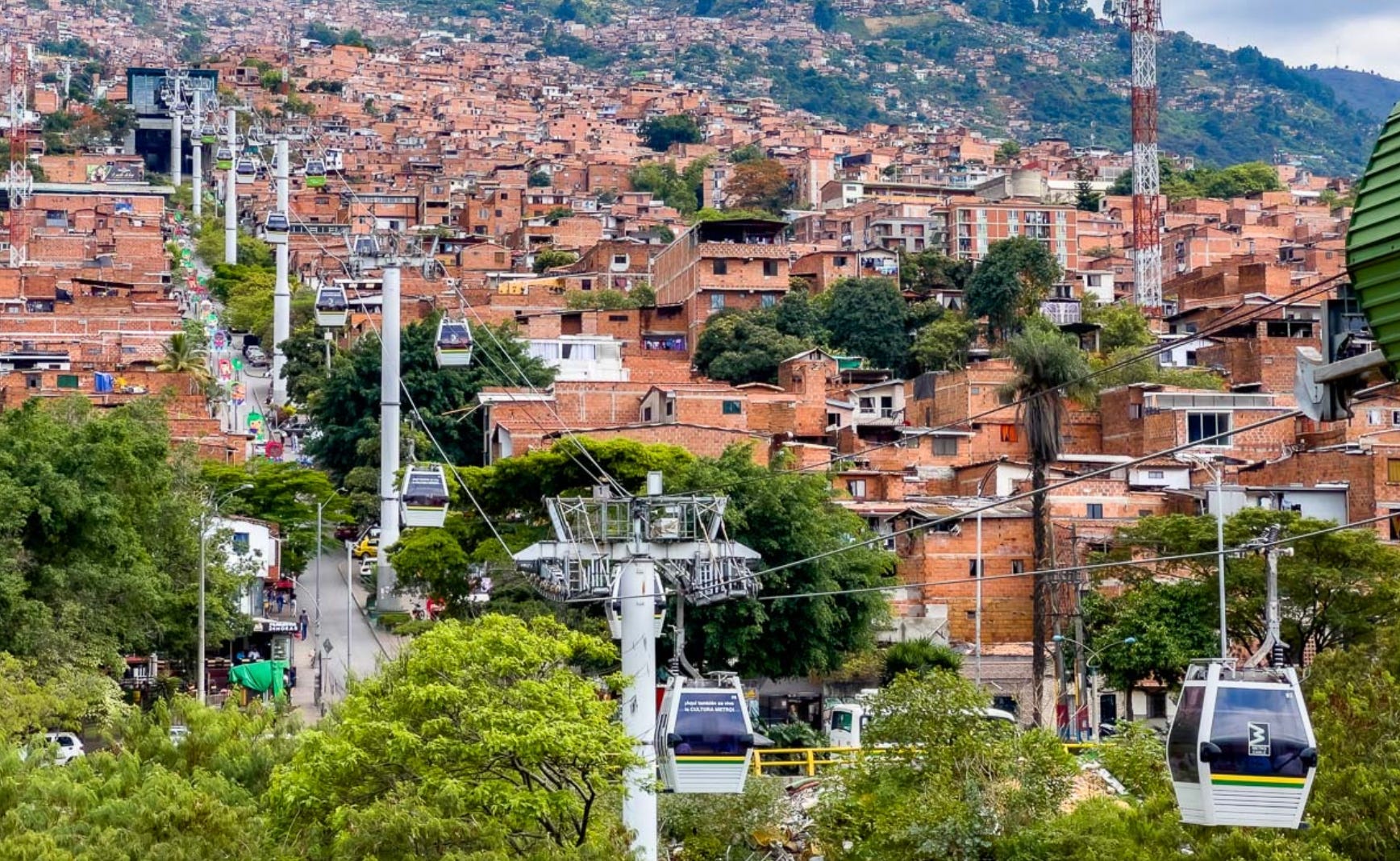
A difference-in-differences study of Medellín’s Metrocable Line H expansion estimated a reduction of up to 15 percentage points in informal housing in the neighborhoods it reached.
Not rents. Not prices. The share of housing that existed outside the formal market at all.
That is what a twenty-year public investment program actually produces, and it is the reason the returns went to the investors who were still there to collect them.
The Moment
There is a version of the patient capital argument that needs reframing.
One version says that large allocators have published a preference for longer real estate hold periods tied to climate resilience. However, no document from any of the institutions usually named states it in those terms.
In other briefs, I have mentioned Japan’s Government Pension Investment Fund. It is the largest in the world, and its alternatives allocation is 1.74% of the portfolio, with real estate within a combined infrastructure and real estate sleeve. Its real estate exposure is immaterial to its own balance sheet. So it doesn’t make sense to borrow its authority for a real estate hold-period argument.
Resilience investment produces a back-loaded return curve. Flood infrastructure protects value across an asset life, not a fund life. A certification program creates a compliance and maintenance advantage measured in the same units. Neither pays out fully within a five- to seven-year fund life.
A fund that must exit in year six sells the asset before the curve has resolved, pricing it at the level the market can see in year six. Whoever buys it collects the rest. This is what happens when the return duration and the vehicle duration do not match.
Medellín is simply where that mismatch has run long enough to observe.
The Story
Medellín is a Colombian city of roughly 2.4 million people at the 2018 census, sitting at about 1,500 meters in a valley in the Andes. In 2002, its homicide rate was over 170 per 100,000 residents, among the highest ever recorded in a major city.
The steep hillside settlements ringing the central bowl had been built without planning permission, without stormwater infrastructure, and on slopes with documented landslide exposure. There was no formal real estate market, no institutional capital, and no exit.
Over two decades ago, beginning in 2004 under Mayor Sergio Fajardo, and continued by successor administrations across party lines, the city began a program of targeted investment in the highest-risk informal settlements.
The Metrocable cable car system connected the hillside districts to the metro network for the first time. Line K opened in 2004, and Line J in 2008. A journey to the city center that had taken one to two hours on foot now took only minutes.
The Parques Biblioteca, library-and-park complexes, began opening at the end of 2006 in neighborhoods that had no public institutional infrastructure at all.
In Comuna 13, officially Comuna 13 San Javier, a district of roughly 140,000 people, the city installed outdoor public escalators. They opened on December 26, 2011, in six sections totaling about 384 meters, costing roughly 6.7 million US dollars, and free to use. A half-hour climb became a five-minute ride for about 12,000 residents.
What that infrastructure did to the housing market has been measured properly, once. Posada and García-Suaza, publishing in Transport Policy in 2022, used a difference-in-differences design on the Metrocable Line H expansion and estimated a reduction in informal housing of up to 15 percentage points in the affected areas, with the effect weakening by distance from the stations and the labor market acting as the mechanism. The 15-point figure is the upper bound of that estimate for Line H, not a flat observed result for the network as a whole.
That is a causal estimate with a control group. Access to work changed, and housing was formalized.
It is not a price series. Claims that property in the anchored zones appreciated by a specific percentage, or more than doubled in real terms, circulate widely but aren’t verifiable. A real-terms claim also requires a deflator, a base year, and a currency. Colombian consumer prices roughly doubled over the period in question. A nominal doubling and a real doubling are indistinguishable, so more hard data is needed to determine any impact on real estate pricing in that period.
So the defensible finding is the one that was measured. Formal housing markets emerged where none had existed. That is a larger claim than a price move, and it is better evidence for patience, because a market that does not yet exist cannot be bought into early by anyone unwilling to wait for it to form.
Plus, the reality is that the program’s flagship failed for eleven years.
Biblioteca España, the library park in Santo Domingo that became an international symbol of Medellín’s transformation, opened in 2007 and closed in 2015 because of serious structural problems. It then sat shut while successive municipal administrations failed to resolve it. The local press called it a white elephant.
It partially reopened on June 18, 2026, as Parque Biblioteca Santo Domingo Savio, after a recovery costing roughly 55 billion Colombian pesos. Eleven years closed, out of the roughly twenty the transformation is usually credited with.
The neighborhood formalized anyway. The Metrocable kept running, the escalators kept running, and the labor market access that drove the measured effect did not depend on the library.
Long-duration programs contain failures. Not every asset works. Long-duration investment requires enough of the system to keep working while failures are being resolved, and an investor who remains invested until they are resolved.
Structural Forces
Force 1: The duration mismatch is structural, not a preference. Resilience returns are back-loaded, and they do not resolve on a schedule a closed-end fund controls. Some adaptation spending pays back quickly; the protective value of hard infrastructure accrues over the asset’s operating life. Closed-end real estate funds resolve over five to seven years. A vehicle that must return capital before the curve completes will sell into a market that has not yet priced the completion. This is true regardless of what any allocator has or has not published, which is why the argument is stronger without the attribution.
Force 2: Formalization is the return, and it is invisible to comparables. In a market that did not previously exist, there is no prior transaction to compare against and no discount to observe. The Metrocable result is measured as a change in the share of informal housing precisely because pre-period price data are scarce. An investor waiting for comparable evidence of appreciation is waiting for what only exists after the opportunity has closed.
Force 3: Chronic drift takes years to reach prices, and that lag is the entry window. Signal 6 is the slow accumulation of climate stress across temperature, precipitation, sea level, and operating cost. Medellín’s landslide exposure, managed over fifteen years of slope stabilization and drainage work, is chronic drift running in slow motion with a public balance sheet against it. The investor who reads the trajectory before it is in the data pays for the trajectory. The one who waits for the data pays for the outcome.
Force 4: Public infrastructure sets the clock, and private capital arrives late. In Medellín, the public program began in 2004, and institutional real estate capital arrived roughly thirteen to fifteen years later. That lag is the observable variable. Cities where comparable public programs are now underway are the places where the same lag is running, and it is long enough to be tradable if the holding vehicle can survive it.
Next Chapter
Long-duration vehicles will appear because the mismatch is real, not because anyone announced them. A fund structure that matches a return curve longer than a closed-end fund life is a product waiting to be built. Watch for it in evergreen and open-ended structures rather than in a longer closed-end fund, because the problem is the terminal date, not the fund length.
The measurement gap will become the constraint. Medellín is the best-documented case in the world, yet it still has no publicly available, verifiable price series for the anchored zones. Until infrastructure-adjacent property values are measured with the same rigor as the Metrocable formalization effect, allocators will continue to underwrite these markets on narrative. The first credible price panel will move capital.
Resilience attribution will be separated from market beta in LP reporting. When a limited partner report distinguishes the portion of the return attributable to resilience investment from that attributable to the market, patient capital becomes benchmarkable. Until then, it is a story, and stories do not raise institutional funds twice.
The investor who wins this decade is not the fastest. It is the one whose vehicle is still open when the curve resolves, and who was willing to underwrite a market before there were comparables to underwrite it with.
Brief 21 found the same tension in institutional portfolios. What allocators are documented as doing is narrower than what they are described as doing, and the difference matters when you are pricing a deal against it.
As always, KNOW YOUR SIGNALS and BE CLIMATE READY!
Jamie
Go Deeper
This is a Story & Future Thinking brief, so there is no companion workbook. The blank master CRDF Signal Tracker™ and Deal Stress Test™ are free and available at climatereadyre.com/tools.
Related briefs
Same signal (S3 Capital Allocation Flows):
Brief 16 · Private Equity Real Estate Climate Strategy: Brookfield’s $23.5B Fund
Brief 7 · Sustainable Real Estate Fund Flows and the Green Premium: $84B Went Out
Next in sequence:
Brief 25 · Construction Material Cost Increase 2026: Tariffs Put Aluminum Up 33% - coming soon
Sources
Every figure above, with the date the data covers, the date it was published, and the date I verified it.
Metrocable and informal housing — a difference-in-differences study of the Line H expansion estimated a reduction in informal housing of up to 15 percentage points, with the effect weakening by distance from stations and labor market access as the mediating mechanism.
Transport Policy — Posada & García-Suaza, volume 128, pages 209–228 · Data as of period not stated · Published Nov 2022 · Accessed Sep 2026
Controlled. A difference-in-differences design with a comparison group. The 15-point figure is an upper bound for the Line H expansion, not a flat observed result for the whole network. The study measures housing formalization, not price appreciation.
Biblioteca España closure and reopening — opened 2007, closed 2015 with structural problems, reopened June 18, 2026 as Parque Biblioteca Santo Domingo Savio at a recovery cost of roughly 55 billion Colombian pesos.
El Colombiano — report on the reopening of Biblioteca España · Data as of 2007–2026 · Published Jun 18, 2026 · Accessed Aug 2026
The article puts the investment at $55.029 millones. Cajas 1 and 2 were handed over on that date, with the auditorium due in July 2026.
Comuna 13 San Javier escalators — inaugurated December 26, 2011; six sections, about 384 meters of total length, roughly 6.7 million US dollars, free to use, serving about 12,000 residents; a half-hour climb reduced to five minutes.
Elevator World — Medellín’s Outdoor Escalator · Data as of 2011 · Published date not stated · Accessed Sep 2026
Trade press. Project cost and specifications are worth confirming with the Alcaldía de Medellín before they carry weight on their own. Comuna 13’s population of 140,758 is the Alcaldía de Medellín’s 2020 figure from its Comuna 13 San Javier ficha informativa.
Medellín population and elevation — roughly 2.4 million residents at the 2018 census, at about 1,500 meters.
Encyclopedia Britannica — Medellín, Colombia · Data as of 2018 · Published Jul 8, 2026 · Accessed Sep 2026
City rather than metropolitan area. The Valle de Aburrá metropolitan area has a larger population. Colombia’s national statistics agency publishes the current projection.
GPIF alternatives allocation — 1.74% of the total portfolio, with real estate inside a combined infrastructure and real estate sleeve.
Government Pension Investment Fund — Annual Report FY2025 summary · Data as of Mar 31, 2026 · Published 2026 · Accessed Aug 2026
Commentary and analysis only. Not investment, financial, legal, tax, or professional advice. CRDF tools are illustrative; examples are composites drawn from public data. Do your own due diligence and consult qualified professionals.
I run this analysis on specific deals. If you are underwriting an asset whose thesis depends on infrastructure that has not finished arriving, book 20 minutes.
Jamie Wolf, MBA — Founder & Publisher, Climate-Ready Real Estate Investing, © 2026, CR REI Holdings LLC