

Signals: S9 Zoning, Codes & Land Use · S5 Acute Climate Hazard · S1 Insurance Repricing
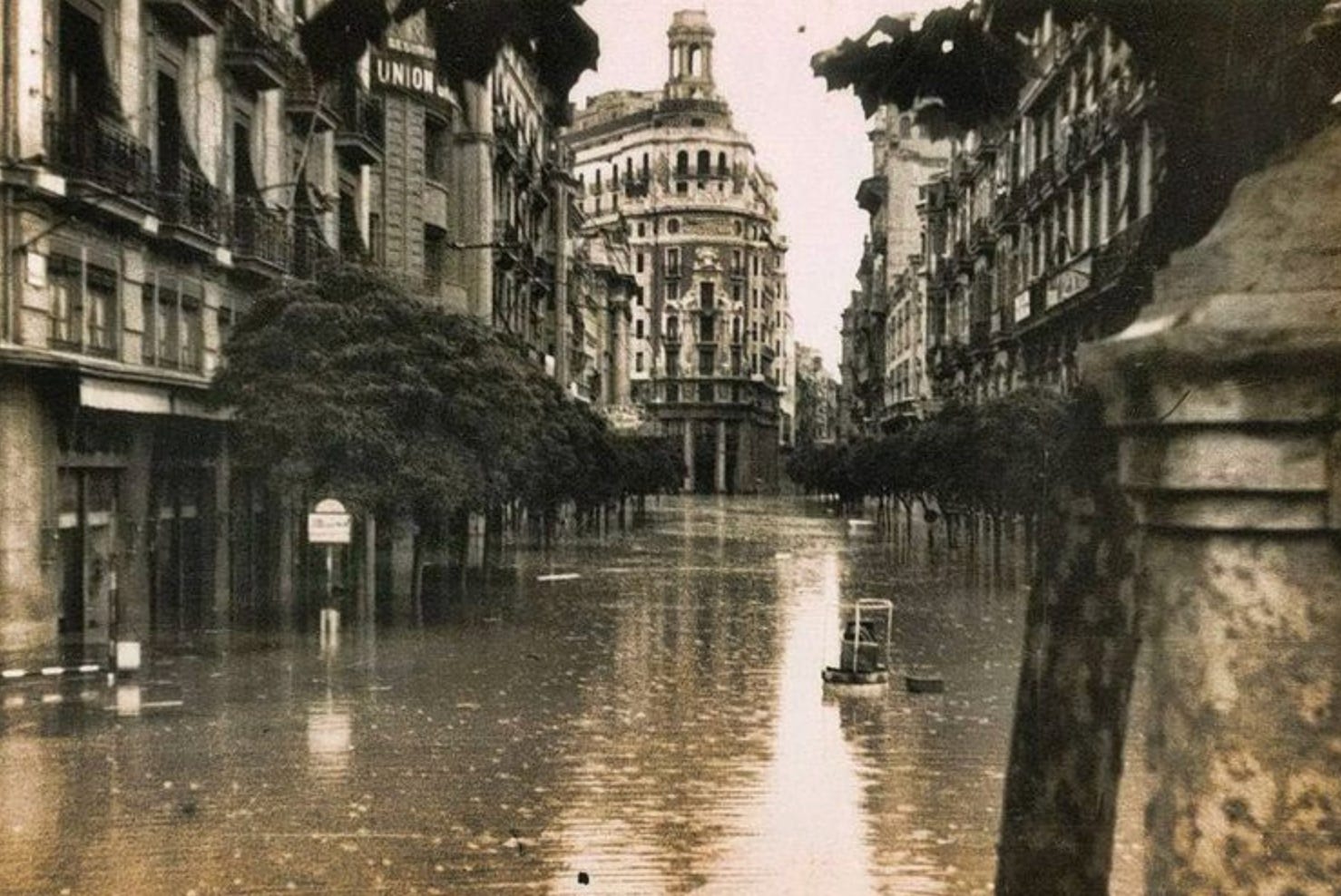
Photo credit: Great Flood of Valencia, 1957, Archivo Histórico Municipal de Valencia
Every home in Paiporta sits inside a mapped flood-risk zone. The map is public and has been for more than twenty years. The town of 25,000 was permitted, built, mortgaged, and insured on top of it anyway.
Across the Valencian Community, roughly 600,000 people - about 12% of the population - live in zones the regional flood plan already catalogs as flood-prone.
Brief 9 told the story of the water. This brief is about the paperwork, because the paperwork is where the next loss is already written down.
The Moment
On October 29, 2024, a stalled DANA dropped a year’s worth of rain on the Valencian interior in a single day, and the runoff tore through the southern municipalities of Paiporta, Catarroja, and Benetússer. The Spanish government’s count reached 238 dead, 230 of them in the Valencia region.
What the water found was permitted development. The Valencian flood plan, PATRICOVA, has mapped 278 risk zones covering about 145,000 hectares through successive versions since 2003. The towns that flooded were not built in ignorance of the map. They were built on it, through a permitting regime that treated a mapped floodway as a condition to be managed rather than a place not to build.
The peer-reviewed analyses read the event the same way. Unregulated construction in flood-prone areas, including the dry riverbeds known as ramblas, amplified the damage, and urban density concentrated the loss. That is a permitting finding, not a construction finding, and it is the one this brief follows.
The Story
Spain’s Consorcio de Compensación de Seguros, the national pool that covers extraordinary risks through a surcharge on every ordinary policy, had paid more than 4 billion euros on 210,106 claims by November 26, 2025, against 250,674 claims filed. Its estimated final cost is about € 4.8 billion. The Consorcio’s 2024 loss ratio was 445%, its combined ratio 450%, and it posted a loss of about 3.5 billion euros.
The reserve absorbed it. The Consorcio’s stabilization reserve for its general activity stood at about 10.3 billion euros at the end of 2023, fell to 7.13 billion at the end of 2024, and had rebuilt only to 7.52 billion by the end of 2025. Against 2025 surcharge revenue of about 1.2 billion euros, the DANA consumed roughly four years of income in one event, and the reserve is still 2.8 billion euros below where it started.
That is what a functioning backstop looks like. It paid, it paid fast, and in 2025 it collected more than it paid out. But a profitable year is not a refilled reserve. That surplus moved the general-activity reserve from 7.13 to 7.52 billion euros, which still leaves it 2.8 billion below its end-2023 level. In other words, a backstop can absorb one Valencia a decade, not one every few years, and the reserve it rebuilds comes from every policyholder in Spain, including those nowhere near a rambla.
The Consorcio’s 2025 solvency ratio recovered to 1.52 times the required capital from 1.29 times a year earlier. A second Valencia-scale event before the reserve is rebuilt would force one of three things. A higher surcharge on every policy in Spain, a transfer from the Treasury, or a narrower definition of what the pool covers where the land-use risk is structural.
It’s worth observing what the payout was used for and what it did and didn’t accomplish.
BBVA Research finds that by March 2025, about five months on, Valencia had not only recovered its employment but was posting a net increase, driven by reconstruction and aid, and that where insured payouts exceed roughly 40% of estimated damages, as they did here, they neutralize much of the hit to employment growth. That is a threshold an underwriter can use, and it is a strong argument for mandatory pooled insurance.
CaixaBank Research, looking at the same ground in April 2025, found the number of active business establishments in the worst-hit area was still 20% below the pre-flood level. Both findings are accurate. The payout restored the payroll faster than it restored the businesses, because reconstruction hires people while a destroyed shop stays destroyed. For anyone underwriting ground-floor retail in a flood zone, that is the distinction that matters.
The economic damage ran to roughly 0.65% of Spanish GDP. Spain committed 16.6 billion euros in aid and the EU about 1.6 billion. None of those figures includes the quiet markdown on the buildings that did not flood.
A home that stayed dry in Paiporta in 2024 is now, demonstrably, in a place that floods, and its insurance, its financing, and eventually its price will reflect it. That repricing is slow and invisible until a transaction forces it, which is why the people most exposed are usually the last to learn their asset has already changed value.
Structural Forces
The flood map is being redrawn, and the new one covers a much larger area.
In January 2026, the Generalitat began revising PATRICOVA. The current plan models flood hazard to a 500-year return period. The revision extends the analysis to 2,000 years, on the stated reasoning that rainfall above 500 millimeters is no longer exceptional. Preliminary modeling for the revision indicates that 500 liters per square meter in 24 hours now falls somewhere in the Valencian Community roughly every 15 years. The first phase covers 43 municipalities in the DANA zone, with formal public consultation opened in June 2026 and the rest of the region to follow. The expected result is more land classified as flood-prone, and therefore more land where building is restricted.
When a return-period standard moves from 500 to 2,000 years, parcels that were developable on Monday are not on Tuesday, and the ones already built on carry a designation their comps have never seen.
In case this sounds as counterintuitive to you as it did to me, here’s another way to understand it. The old rule said your house at the bottom of the hill might go underwater once every 500 years, so if you build at the top of the hill, you’re good. The new rule says we now believe the entire hill will go underwater in the once-in-2000-year event, so you can’t build anywhere near that hill. In other words, by demanding a higher level of protection (surviving a 2,000-year event), the government forces developers to build much further away from water and on much higher ground, rendering previously “safe” parcels legally undevelopable.
The rules on the land in the DANA zone changed three times in four months.
The Consell’s Decree-Law 20/2024, of December 30, 2024, did two things. It let owners of legally built, damaged buildings rebuild on a responsible declaration, a signed statement by the owner rather than a fresh permit, backdated to the day of the flood. And it stopped new planning on rural land mapped as flood-prone until the State produced a costed schedule of hydraulic works.
In February 2025, the Generalitat published the boundaries of where new planning on rural land was halted, naming the Turia and Magro rivers and the Poyo, Saleta and Picassent ravines, covering 18.57% of the affected municipalities’ land.
Then, on April 15, 2025, Law 2/2025 lifted it with a catch. Planning may proceed again in every flood category, but not freely. The conditions tighten as the mapped hazard rises.
Where the DANA cartography shows land flooded that PATRICOVA and the national flood atlas did not, a favorable flood-risk report comes first. The same law ordered the PATRICOVA revision within one year. That deadline was April 2026.
Where State hydraulic works are scheduled but unbuilt, the Conselleria may tie approval to those works. Notably, however, Amnesty International’s account of regional budget data shows investment in hydraulic infrastructure in Valencia province fell by 83% between 2006 and 2021, steadily and long before the October 2024 events in Valencia.
The final rules said existing buildings could be rebuilt where they stood. New development on open land was stopped for three and a half months and then allowed to proceed under conditions, ahead of the map that is supposed to govern it. The state chose to protect the capital already in place and to let new capital arrive with a report attached. That is a rational political decision and an uncomfortable underwriting one, because it means the next loss in Paiporta will hit the same buildings, and possibly a few new ones.
Ultimately, the floodway was mapped, the hydraulic defenses were not funded and therefore not built, and the permits kept coming.
The Next Chapter
The fork facing Valencia’s southern municipalities faces hundreds of exposed communities worldwide. Managed retreat and floodplain restoration, or rebuilding in place behind hard defenses. Each path reclassifies who can insure, finance, and hold.
Managed retreat protects people and strands capital. You cannot lend thirty years against a parcel slated to become a floodway.
Rebuilding in place protects capital and bets that the hydraulic defenses hold, and the insurance fund stays. Valencia has made that bet for the buildings already standing. But the defenses are hydraulic works that are scheduled, not built, based on an 83% cut in hydraulic investment over 15 years, and the insurance fund is still 2.8 billion euros short. It is not a bet on engineering. It is perhaps a misplaced bet on two ailing budgets.
Four things to watch.
The revised PATRICOVA map. When the 2,000-year hazard layer is published, count the hectares that move from developable to restricted, and look for the first transaction inside the new line. That’s when the designation hits a price.
The interim rules. Law 2/2025’s conditional regime runs until the revised PATRICOVA is approved, and the one-year deadline passed in April 2026 with the revision still at consultation. Every plan approved under the interim rules on land the DANA flooded is a parcel priced before the 2,000-year line is drawn, and a plan tied to State works that are scheduled but unbuilt is Valencia’s 1957 lesson repeating.
The Consorcio’s reserve and surcharge. The reserve is 2.8 billion euros below its 2023 level. If it is still there when the next event lands, the surcharge or the scope of cover moves, and either one changes what a Spanish flood-zone asset costs to hold.
The business base, not the payroll. A recovery measured in jobs and a recovery measured in reopened premises diverged by twenty points in six months. Ground-floor commercial in a flood zone is priced off the second number, not the first.
You do not have to go to Spain to find the pattern. Every market has its ramblas: the floodplain that got rezoned, the wildfire interface that kept issuing permits, the subsiding basin that kept approving subdivisions. The common thread is a gap between what the hazard map knows and what the permit allows, and that gap is an unpriced liability on someone’s balance sheet right now, waiting for the event or the repricing that finally names it.
The places that price the map before the flood will hold their value. The ones that wait will have it priced for them. That is not a forecast. In Valencia, it is a receipt, and the receipt is 4.8 billion euros.
Brief 9 asked what a risk map is for. Brief 28 follows the same administrative mechanism into Arizona, where a water model rather than a flood map decides what can be built.
As always, KNOW YOUR SIGNALS and BE CLIMATE READY!
Jamie
Go Deeper
This is a Story & Future Thinking brief, so there is no companion workbook. The blank master CRDF Signal Tracker™ and Deal Stress Test™ are free and available at climatereadyre.com/tools.
Related briefs
Same signal (S5 Acute Climate Hazard):
Same signal (S9 Zoning, Codes & Land Use):
Brief 30 · Rotterdam Flood Resilience Funding: The Delta Program Is EUR 9 Billion Short - coming soon
Brief 31 · FORTIFIED Roof Savings: How 73% Fewer Claims Cut Insurance Costs - coming soon
Next in sequence:
Brief 28 · Arizona Assured Water Supply Certificate: Subdivisions and a 4.86M Acre-Foot Gap - coming soon
Sources
Every figure above, with the date the data covers, the date it was published, and the date I verified it.
Population and housing inside mapped flood zones — about 600,000 people, roughly 12% of the Valencian Community’s population, live in zones cataloged by PATRICOVA; 278 risk zones covering about 145,000 hectares; all of Paiporta’s housing sits inside a risk zone, in a municipality of more than 25,000 residents; hydraulic infrastructure investment in Valencia province fell 83% between 2006 and 2021
Amnesty International Spain — Ten urgent questions on the DANA in the Comunitat Valenciana · Data as of 2025 · Published Nov 13, 2025 · Accessed Sep 2026
An advocacy organization’s compilation of official figures. The PATRICOVA totals are the regional plan’s own; the 83% investment figure is Amnesty’s reading of regional budgets and is carried as attributed rather than as a verified series. Amnesty’s death toll of 228 is superseded by the government’s January 2026 count below.
Valencia DANA confirmed toll — 238 dead, 230 of them in the Valencia region.
Spanish Government, La Moncloa — DANA follow-up data · Data as of Jan 12, 2026 · Published Jan 12, 2026 · Accessed Sep 2026
Floodplain urbanization amplified the damage — unregulated construction in flood-prone areas such as dry riverbeds amplified the loss; density concentrated it
Martin-Moreno and colleagues — Public Health Reviews 46:1608297 and Galvez-Hernandez and colleagues — International Journal for Equity in Health · Data as of 2024 to 2025 analysis · Published Apr 28, 2025 and Mar 5, 2025 · Accessed Sep 2026
Peer-reviewed. The Public Health Reviews paper carries a total-loss estimate of more than 50 billion euros on a different scope from the GDP figure below; the two are not comparable, le and only the GDP figure is used here.
Consorcio payout — more than 4 billion euros paid on 210,106 claims by November 26, 2025, of 250,674 filed; estimated final cost about 4.8 billion euros
La Moncloa — The Consorcio passes 4 billion euros in DANA payments and Consorseguros Digital — The 2024 Valencia floods · Data as of Nov 2025 · Published Nov 26, 2025 and autumn 2025 · Accessed Sep 2026
Consorcio 2024 accounts — loss ratio 445.3%, combined ratio 450.3%, resulting in a loss of about 3.5 billion euros; general-activity stabilization reserve 7.13 billion euros at the end of 2024, down from about 10.34 billion at the end of 2023; solvency capital ratio 1.29 times.
INESE — The CCS closes 2024 with more than 7 billion euros of stabilization reserves and Servimedia — The DANA took 3.2 billion from the Consorcio’s catastrophe reserve in 2024 · Data as of Dec 31, 2024 · Published Jul 10, 2025 and Oct 28, 2025 · Accessed Sep 2026
Trade and wire coverage of the Consorcio’s Informe Anual 2024 and Memoria de Responsabilidad Social 2024. The annual report itself sits on consorseguros.es and was not opened directly.
Consorcio 2025 accounts — surplus of 801.8 million euros; loss ratio 79.3%; premiums and surcharges 1,216.7 million euros, up 4%; general-activity stabilization reserve 7.518 billion euros, up 5.8%; solvency capital ratio 1.52 times
INESE — The CCS reverses its 2024 losses and Grupo Aseguranza — CCS reserves grow above 6% · Data as of Dec 31, 2025 · Published 2026 and Jul 13, 2026 · Accessed Sep 2026
Both cite the Consorcio’s Informe Anual 2025. The “four years of income” comparison is this brief’s arithmetic: 4.8 billion euros against 1.2 billion of annual surcharge revenue, and the reserve gap is 10.34 minus 7.52 billion.
Employment recovery and the payout threshold — by March 2025, Valencia had recovered and was posting a net increase in employment; where payouts exceed roughly 40% of estimated damages, they neutralize much of the negative effect on employment growth.h
BBVA Research — Economic Watch, assessing the economic impact of extreme climate events · Data as of Mar 2025 · Published May 9, 2025 · Accessed Sep 2026
Business base still below pre-flood level — in April 20,25 the number of active business establishments in the worst-hit area remained 20% below the pre-flood period.
CaixaBank Research — Economic situation in Valencia province six months after the floods · Data as of Apr 2025 · Published Jun 12, 2025 · Accessed Sep 2026
Bank research. It carries no employment series; the employment finding is BBVA’s.
Economic damage and public aid — roughly 0.65% of Spanish GDP; Spain:n 16.6 billion euros committed; EU: about 1.6 billion euros
BBVA Research — Working paper 25/13, La Moncloa — DANA follow-up data, and European Commission — Almost EUR 1.6 billion of EU funds will help Spain recover · Data as of Nov 2025 and Jan 2026 · Published Nov 13, 2025, Jan 12, 2026, and Oct 3, 2025 · Accessed Sep 2026
PATRICOVA revision — hazard analysis extended from a 500-year to a 2,000-year return period; preliminary modeling puts 500 liters per square meter in 24 hours somewhere in the region roughly every 15 years; first phase covers 43 municipalities in the DANA zone, with formal consultation opened in June 2026; hydrological work contracted to the Universitat Politècnica de València
Última Hora — The Generalitat will widen restrictions on building in flood zones in the PATRICOVA revision, elDiario.es — The Generalitat announces tighter urban restrictions in flood-prone areas, and Valencia News — The Generalitat begins the PATRICOVA revision · Data as of Jan to Jun 2026 · Published Jan 13, 2026, Jan 14, 2026, and Jun 19, 2026 · Accessed Sep 2026
Press coverage of the regional government’s announcements by Vice President Vicente Martínez Mus. An April 2026 approval was anticipated in late 2025 and did not happen; the revision was in public consultation as of June 2026.
Reconstruction law and planning rules — Decree-Law 20/2024 of December 30, 2024 (DOGV January 2, 2025; convalidated by Les Corts January 16, 2025): reconstruction of damaged legal buildings by responsible declaration with effect from October 29, 2024; planning procedures on flood-mapped rural land suspended until the State approved a costed schedule of hydraulic works. Law 2/2025 of April 15, 2025 (DOGV April 16, 2025; BOE May 17, 2025): the suspension was replaced by a four-category regime under which planning proceeds with conditions until the PATRICOVA revision is approved, and that revision ordered within one year. Decree-Law 14/2025 of December 26, 2025, and Law 3/2026 of June 29, 2026, formally repealed the decree-law.
Noticias Jurídicas — Decreto Ley 20/2024 and BOE — Ley 2/2025 de 15 de abril · Data as of Apr 2025 · Published Jan 2, 2025 and Apr 16, 2025 · Accessed Sep 2026
Primary texts, both open. The February 2025 delimitation (Turia, Magro, Poyo, Saleta, Picassent; 18.57% of municipal land) is from Valencia News, February 5, 2025, and describes the decree-law regime that Law 2/2025 replaced. The law applies to the municipalities listed in Real Decreto-ley 6/2024.
Commentary and analysis only. Not investment, financial, legal, tax, or professional advice. CRDF tools are illustrative; examples are composites drawn from public data. Do your own due diligence and consult qualified professionals.
I run this analysis on specific deals. If you are underwriting in a market where the hazard map and the permit map disagree, book 20 minutes.
Jamie Wolf, MBA — Founder & Publisher, Climate-Ready Real Estate Investing, © 2026, CR REI Holdings LLC