

Signals: S3 Capital Allocation Flows · S1 Insurance Repricing · S5 Acute Climate Hazard
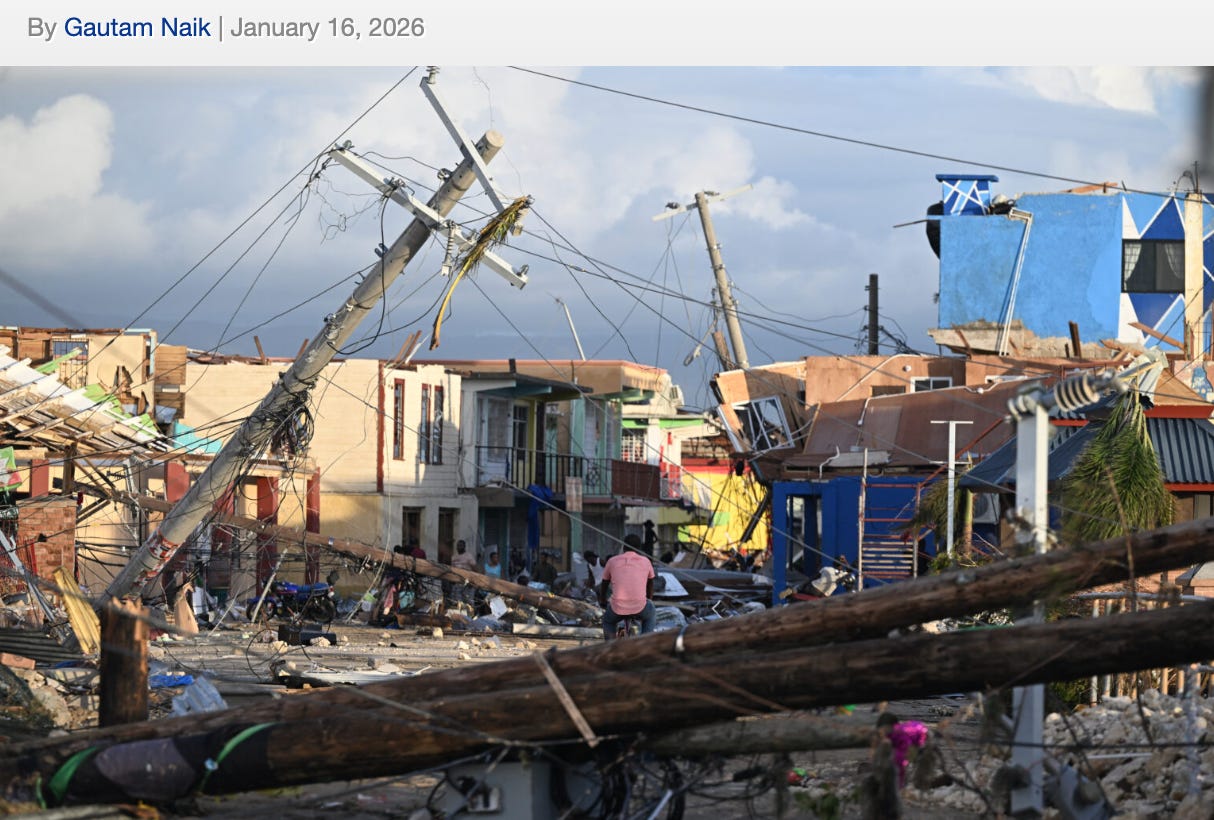
On Wednesday, we looked at New Zealand’s new national rule for building in areas with natural hazards. Today we go to the other end of that question. Once the building is up, who carries the catastrophe, and what do they charge for it?
More and more, the answer is a bond market most property owners have never used.
The Moment
On July 28, 2026, Wrigley Re, Series 2023-1, reached its scheduled redemption date. It was a $250 million catastrophe bond sponsored through a captive insurer (an insurer owned by the business it insures) covering real estate funds managed by Blackstone affiliates. Very few property owners have ever issued one.
The sponsor sets up a stand-alone legal entity between itself and the investors, called a Special Purpose Vehicle (SPV), that holds their investment in trust as collateral and pays regular interest payments (premiums) to investors. These interest payments are called ‘the spread’. When a qualifying catastrophe occurs (like a specific-magnitude earthquake or a hurricane causing a certain level of industry damage), the collateral pays the sponsor’s claims, and investors may lose some or all of their principal. If not, they get it back at maturity.
The trigger decides what counts as a qualifying catastrophe.
An indemnity trigger pays on the sponsor’s actual losses.
A parametric trigger pays on a measured feature of the event, such as an earthquake’s magnitude.
Catastrophe bonds are the best-known insurance-linked securities (ILS), investments whose returns depend on insured losses rather than on markets.
According to Artemis, a specialist news and data site for this market, outstanding catastrophe bonds totaled $65.6 billion as of June 30, 2026. Artemis tracks every Rule 144A deal (bonds sold privately to large institutions without public registration) and the private deals in its own directory. Aon Securities, the investment banking arm of the broker Aon, puts it at $63.4 billion, and Swiss Re’s count sits between the two.
The first half of 2026 set records on every count. Artemis counts $17.98 billion of new issuance across 83 transactions, with 12 first-time sponsors. May alone brought $6.93 billion, the biggest month on record.
Swiss Re names two ILS funds, two national governments, a German insurer, United States primary insurers, and two Lloyd’s syndicates, the underwriting groups inside the Lloyd’s of London market.
Not one is a property owner.
The Story
Blackstone came in small. In June 2021, its captive, Gryphon Mutual, sought $50 million of notes covering the California earthquake on a parametric basis. Price guidance, the spread range floated before pricing, was 2.75 percent to 3.25 percent, against a modeled expected loss of 0.99 percent. Expected loss is the average share of principal the risk model says investors will lose per year.
Two years later, it came back bigger. Swiss Re, which structured the $250 million Wrigley Re 2023-1, called it two ‘market firsts’. It was the first corporate catastrophe bond to cover named storms (hurricanes and tropical storms) on an indemnity basis, meaning that the bond’s payout is triggered and calculated directly by the actual, incurred losses experienced by the bond’s issuer. It was also the first to cover more than one country.
Class A was $100 million, covering the United States and Canada, named storms, and earthquakes in every state except California. It attached at $350 million of losses and ran out at $650 million. The modeled chance of touching that layer in a given year was 0.95 percent, and the modeled expected loss was 0.56 percent. It priced at 6.5 percent, the bottom of its guidance, meaning investors accepted the lowest possible interest rate, of 6.5 percent to 7 percent.
Class B was $150 million of California earthquake, attaching at $750 million and running to $900 million. It priced at 7.0 percent on a modeled expected loss of 1.03 percent. Both classes priced at the bottom of guidance in July 2023, the hardest point of the pricing cycle.
In October 2024, Prologis’s captive, the other real estate sponsor, renewed a $95 million earthquake bond, Logistics Re 2024-1. It attaches its stack of coverage layers at $400 million in losses to the Prologis insurance tower. It covers losses up to $550 million, with a modeled expected loss of 2.6 percent. Against guidance of 6.75 percent to 7.25 percent, it priced at 6.0 percent, 75 basis points below the range. California contributes as much as 95 percent of the expected loss.
A catastrophe bond doesn’t insure a portfolio. It insures a concentration. That bond runs to mid-December 2027.
Each has a captive that can pass risk on. Each portfolio is deep enough, and insured deeply enough, that losses of $350 million to $400 million come before the bond pays a cent. And each sits high enough that traditional insurers price it thinly and capital markets price it competitively.
Structural Forces
Force one: the price of catastrophe risk is falling. Artemis puts the average catastrophe bond spread at 6.63 percent in the second quarter of 2026, down from 7.12 percent in the first quarter and 7.23 percent in the same quarter last year. The average price multiple, spread divided by modeled expected loss, fell from 3.14 to 2.29 over the same period. The average spread above expected loss was 3.74 percent, the lowest since the first quarter of 2023 (3.19 percent). The spread fell 8.3 percent, and the multiple fell 27.1 percent. In other words, investors now accept more modeled risk for each dollar of spread.
Based on Artemis’ numbers, Class A is priced at about 11.6 times its modeled expected loss. Besides the 2.29 market average, it looks as if Blackstone overpaid by five times. It didn’t. That average spans every expected loss in the market, and Class A sat far out in the tail, where investors charge a minimum premium, however remote the risk.
Class B at 1.03 percent priced at 6.8 times. Prologis at 2.6 percent priced at 2.3 times. In every deal we looked at, the multiple falls as modeled risk rises.
Force two: the money keeps arriving. Aon Securities puts total alternative reinsurance capital (capital markets money rather than reinsurers’ own balance sheets) at $144.5 billion as of June 30, 2026. Catastrophe bonds account for $63.4 billion of that, up 17 percent year on year. Twelve-month issuance hit a record $24.9 billion, beating $21.8 billion.
What draws the investment is returns. The Swiss Re Global Cat Bond Total Return Index returned 11.4 percent in 2025, which Artemis calls the third double-digit year in a row, and Swiss Re reports 4.12 percent for the first half of 2026.
Force three: some of that capital reaches ordinary owners, but only indirectly. The broker Marsh reports United States property insurance rates down 13 percent in the second quarter of 2026, the eighth quarterly decline in a row. Catastrophe-exposed programs with premiums above $1 million fell 20 percent. That index reflects one broker’s book, and Marsh names four drivers: strong insurer profits, surplus capital, cheaper reinsurance, and higher investment returns. Catastrophe bond capacity feeds the reinsurance price, which is only one of the four.
Florida is the one place the link is direct and measured. At the June 1 renewals, reinsurance broker Guy Carpenter reported risk-adjusted property catastrophe reinsurance pricing down 15 to 20 percent across many layers, with $3.2 billion of Florida catastrophe bond cover placed for 12 sponsors this year.
Force four: the loss trend hasn’t moved. At September’s annual reinsurance meeting in Monte Carlo, Swiss Re said insured natural catastrophe losses continue to grow 5% to 7% per year. It modeled a 2026 peak-loss scenario of around $320 billion. The calm is real, but narrow. Swiss Re counted $42 billion in insured catastrophe losses in the first half of 2026, 16 percent below the ten-year average and the lowest first half since 2020, even as severe storm activity in the US ran above average. Urs Baertschi, who runs property and casualty reinsurance at Swiss Re, told Insurance Business that 2026’s calm is the luck of the draw.
Soft pricing is a cycle. The loss trend is not.
The Next Chapter
The entry ticket is a balance sheet. Blackstone’s two classes carried $17.00 million per year of spread on $250 million of cover, a blended 6.8 percent. Prologis pays $5.70 million per year on $95 million. Those are spread costs only. Unpublished structuring, modeling, legal, and fronting costs come on top. (Fronting means a licensed insurer issues the policy and passes the risk on.)
The bonds also don’t fill their layers. Class A’s $100 million covered 33.3 percent of a $300 million layer. Logistics Re filled 63.3 percent of its layer. A catastrophe bond is a slice of a tower, not the tower. That structure explains why a year full of disasters can look calm to bond investors. Artemis reports that 78 percent of cat bond limits issued in 2026 use indemnity triggers, a record, and 63.9 percent of outstanding risk is now per-occurrence, meaning it pays only when a single event is large enough, rather than adding up many smaller losses over the year. In 2025, the Los Angeles wildfires caused about $40 billion in insured losses, the largest wildfire loss on Swiss Re’s record, yet cat bond prices fell by only about $200 million. In other words, a year of fires, floods, and tornadoes can leave most cat bond investors untouched.
So the market is dominated by risk it already knows. Swiss Re says more than half of first-half 2026 issuance drew more than 90 percent of its modeled expected loss from United States wind. Insurers and state plans are passing that wind risk on. This suggests a wind-exposed United States property portfolio is the natural next sponsor. For now, most owners buy this capacity secondhand, through their insurer.
The Swiss Re Institute estimates that about 40 percent of United States data center capacity may sit in zones with significant to very high numbers of tornado days. It projects global data center insurance premiums rising from $10.6 billion now to $24.2 billion by 2030, about 2.28 times in four years.
Gianfranco Lot, Swiss Re’s chief underwriting officer for property and casualty reinsurance, told Artemis that infrastructure catastrophe bonds are a very interesting tool the market hasn’t yet seen much of. He added that the economics have to work, and he estimates 80 percent to 85 percent of large hyperscale projects (the giant campuses of major cloud companies) are already reinsured.
Over the next 12 to 24 months, I expect the soft price to attract more non-insurance sponsors, led by infrastructure owners with one huge concentrated exposure rather than diversified real estate funds. Blackstone’s next move will be the most-watched real estate decision here. The price should stay soft only as long as the big single losses stay away from the layers these bonds cover.
The Strategic Question
With capital markets pricing wind risk at the thinnest spread over expected loss since early 2023, are you buying that capacity directly, or secondhand through your insurer?
The following are worth evaluating:
First, the retention. Both real estate bonds paid nothing until an event had cost $350 million to $400 million. Could your balance sheet, captive, and other cover carry that much first, and can your captive send the risk above it somewhere?
Second, the pass-through. Ask your broker how much of this year’s softer reinsurance pricing reached your program, and on which layers. In Florida, risk-adjusted pricing fell 15% to 20% across many layers. If your renewal didn’t move, find out why.
Third, the concentration. Prologis told the market that California carried as much as 95 percent of its bond’s expected loss. Which single region drives your own modeled loss, and would a lender or insurer read that number the way you do?
Blackstone’s bond was scheduled to run off in July, and nothing has publicly replaced it. If you’re in that position, the market has never been more open to you, or more crowded with sponsors who already know how to use it.
As always, KNOW YOUR SIGNALS and BE CLIMATE READY!
Jamie
Go Deeper
This is a Story & Future Thinking brief, so there is no companion workbook. The blank master CRDF Signal Tracker™ and Deal Stress Test™ are free and available at climatereadyre.com/tools.
Related briefs
Same signal (S3 Capital Allocation Flows):
Next in sequence:
Brief 46 · NNN Lease Grocery Cooling: Who Keeps the PG&E Savings? - coming soon
Sources
Every figure above includes the data coverage date, the publication date, and the date I verified it.
The market size — catastrophe bonds outstanding reached $65.6 billion as of June 30, 2026, by Artemis’s count; $17.98 billion of first-half issuance across 83 transactions, with 12 first-time sponsors.
Artemis.bm (Steve Evans) - Catastrophe bond market records that were broken in H1 2026 · Data as of Jun 30, 2026 · Published Jul 6, 2026 · Accessed Sep 2026
Artemis’s own compilation of every Rule 144A deal and the private deals in its directory. Outstanding notional, not issuance, and unaudited.
The record month — $6.93 billion of issuance in May 2026, the biggest month on record.
Artemis.bm (Steve Evans) - Catastrophe bond market records that were set in Q2 2026 · Data as of Q2 2026 · Published Jul 14, 2026 · Accessed Sep 2026
A record on Artemis’s own historical series, the only continuous one published.
The lower count and the capital pool — $144.5 billion of alternative reinsurance capital; $63.4 billion of catastrophe bonds, up 17 percent; twelve-month issuance of $24.9 billion against a previous record of $21.8 billion.
Aon - ILS Becomes ‘Foundational Reinsurance Capital’ as Sector Reaches New Heights (Aon Securities ILS Annual Report, 20th edition; Richard Pennay, CEO of Insurance-Linked Securities) · Data as of Jun 30, 2026 · Published Aug 28, 2026 · Accessed Sep 2026
Aon Securities was joint bookrunner on Wrigley Re 2023-1, so it reports on a market it takes part in.
The middle count — $64.8 billion outstanding at June 30, 2026, on Swiss Re Capital Markets’ own deal database.
Swiss Re Capital Markets - Insurance-Linked Securities Market Insights, Edition XL, July 2026 (report PDF) · Data as of Jun 30, 2026 · Published Jul 2026 · Accessed Sep 2026
Swiss Re counts 64 deals where Artemis counts 83, because Artemis includes private catastrophe bonds.
The new sponsors and the wind share — Swiss Re named the 12 first-time sponsors of the first half of 2026; more than half of first-half issuance drew more than 90 percent of its modeled expected loss from United States wind.
Swiss Re Capital Markets - Insurance-Linked Securities Market Insights, Edition XL, July 2026 (report PDF) · Data as of H1 2026 · Published Jul 2026 · Accessed Sep 2026
The list is Swiss Re’s. The reading that none of the 12 are property owners is CRREI’s interpretation of that list. The wind share is modeled.
The 2023 baseline — the catastrophe bond market at $45 billion in 2023.
Congressional Budget Office - Climate Change, Disaster Risk, and Homeowner’s Insurance · Data as of 2023 · Published Aug 2024 · Accessed Sep 2026
A market aside in a report about homeowners insurance, not its subject.
Blackstone’s first bond — $50 million of notes for Gryphon Mutual, parametric California earthquake; guidance of 2.75 percent to 3.25 percent; modeled expected loss of 0.99 percent.
Artemis.bm (Steve Evans) - Blackstone captive seeks $50m parametric quake cat bond Wrigley Re · Data as of Jun 2021 · Published Jun 7, 2021 · Accessed Sep 2026
Terms at launch. No final 2021 spread is stated in this brief.
The two market firsts — the first corporate catastrophe bond to cover named storms on an indemnity basis, and the first to cover more than one country.
Swiss Re - press release: Swiss Re structures Blackstone’s first indemnity catastrophe bond · Data as of Jul 2023 · Published Jul 20, 2023 · Accessed Sep 2026
The structuring bank’s own announcement of its own deal.
Monnier on the deal — Jean-Louis Monnier, head of ILS at Swiss Re, said the deal expanded the boundaries of the ILS market.
Artemis.bm (Steve Evans) - Blackstone indemnity cat bond an ILS market milestone: Monnier, Swiss Re (quoting Jean-Louis Monnier, Head of ILS, Swiss Re) · Data as of Jul 2023 · Published Jul 20, 2023 · Accessed Sep 2026
The quotation is from Artemis, not from the Swiss Re press release.
The Wrigley Re 2023-1 layers — $250 million; Class A attaching at $350 million and running to $650 million; Class B from $750 million to $900 million; attachment probability 0.95 percent and expected loss 0.56 percent on Class A; redemption July 28, 2026.
Artemis.bm - Wrigley Re Ltd. (Series 2023-1) deal directory entry · Data as of Jul 2023 · Published read Sep 23, 2026 · Accessed Sep 2026
Every expected loss and attachment probability is a catastrophe model output at issuance.
The Wrigley Re 2023-1 pricing — Class A priced at 6.5 percent on guidance of 6.5 percent to 7 percent; Class B priced at 7.0 percent on a modeled expected loss of 1.03 percent.
Artemis.bm (Steve Evans) - Blackstone targets low-end of guidance pricing for $250m Wrigley Re cat bond · Data as of Jul 2023 · Published Jul 14, 2023 · Accessed Sep 2026
Both classes priced at the bottom of guidance. Expected losses are modeled.
The Prologis bond — $95 million of earthquake cover attaching at $400 million and covering losses up to $550 million; modeled expected loss of 2.6 percent; guidance of 6.75 percent to 7.25 percent; as much as 95 percent of the expected loss in California; runs to mid-December 2027.
Artemis.bm (Steve Evans) - Prologis seeks $95m renewal of Logistics Re US earthquake catastrophe bond · Data as of Sep 2024 · Published Sep 30, 2024 · Accessed Sep 2026
Terms at launch. The model includes expected loss and the California share.
The Prologis pricing — priced at 6.0 percent, 75 basis points below the bottom of initial guidance.
Artemis.bm (Steve Evans) - Prologis gets new $95m Logistics Re cat bond at low-end of twice reduced price guidance · Data as of Oct 2024 · Published Oct 22, 2024 · Accessed Sep 2026
Priced after two reductions in guidance.
The price of catastrophe risk — average spread of 6.63 percent in the second quarter of 2026, against 7.12 percent and 7.23 percent; average multiple from 3.14 to 2.29; spread above expected loss of 3.74 percent, the lowest since 3.19 percent in the first quarter of 2023.
Artemis.bm - Q2 2026 Catastrophe Bond & ILS Market Report (PDF) · Data as of Q2 2026 · Published Jul 2026 · Accessed Sep 2026
Market averages across all sponsors, perils, and expected losses. Not a comparator for any single tranche.
The multiples, spread costs, and layer shares — Class A at about 11.6 times expected loss, Class B at 6.8 times, and Logistics Re at 2.3 times; $17.00 million per year of spread for Blackstone and $5.70 million per year for Prologis; 33.3 percent and 63.3 percent of each layer filled.
CRREI modeled scenario · Method: CRREI arithmetic on the sourced deal terms. The multiple is the spread divided by modeled expected loss at issuance; spread cost is spread times principal; and layer share is principal divided by the width from attachment to exhaustion. · Modeled — not a specific asset
Spread cost excludes structuring, modeling, legal, and fronting costs, which no source publishes, so it is a floor.
The 2025 return — the Swiss Re Global Cat Bond Total Return Index returned 11.4 percent in 2025, the third double-digit year in a row.
Artemis.bm (Steve Evans), reporting the Swiss Re Global Cat Bond Total Return Index · Data as of 2025 · Published Jan 12, 2026 · Accessed Sep 2026
Artemis describes the run of double-digit years.
The first-half return — 4.12 percent for the Swiss Re Global Cat Bond Total Return Index in the first half of 2026.
Swiss Re Capital Markets - Insurance-Linked Securities Market Insights, Edition XL, July 2026 (report PDF) · Data as of H1 2026 · Published Jul 2026 · Accessed Sep 2026
A half-year return on indicative pricing, not a like-for-like comparison with the full-year 2025 figure.
Pension money — insurance-linked holdings at CalPERS of almost $2.46 billion at mid-2026, up from $1.451 billion at the end of 2025.
Artemis.bm (Steve Evans), from CalPERS documents seen by Artemis · Data as of Jun 30, 2026 · Published Sep 14, 2026 · Accessed Sep 2026
From CalPERS documents seen by Artemis. The underlying filing is not public.
Retail money — UCITS catastrophe bond funds grew almost 40 percent in 2025 to $19 billion.
Insurance Journal (Gautam Naik) - Ex-PIMCO executive scores milestone on cat bond ETF · Data as of 2025 · Published Jan 16, 2026 · Accessed Sep 2026
Trade press relaying Bloomberg. No compiler is named behind the $19 billion.
United States property rates — US property down 13 percent in the second quarter of 2026, the eighth quarterly decline in a row; four named drivers.
Marsh - Global Insurance Market Index, Q2 2026 (John Donnelly, President, Global Placement, Marsh Risk) · Data as of Q2 2026 · Published Jul 23, 2026 · Accessed Sep 2026
Built from one broker’s placements. Cheaper reinsurance is one of four drivers Marsh names.
Catastrophe-exposed programs — rates on catastrophe-exposed programs above $1 million of premium fell 20 percent in the second quarter of 2026.
Artemis.bm (Jack Willard) - Global property insurance rates fall 12% in Q2 2026 as soft market broadens: Marsh · Data as of Q2 2026 · Published Jul 24, 2026 · Accessed Sep 2026
Artemis relaying Marsh.
The Florida renewal — risk-adjusted property catastrophe reinsurance pricing down 15 to 20 percent across many layers at June 1; $3.2 billion of Florida catastrophe bond cover for 12 sponsors this year.
Guy Carpenter (Randy Fuller, Florida Segment Leader), reported by Artemis.bm (Steve Evans) · Data as of Jun 1, 2026 renewal · Published May 28, 2026 · Accessed Sep 2026
One state. The broker puts legal reform and building resilience ahead of capital.
The loss trend — insured natural catastrophe losses growing 5 to 7 percent per year; a 2026 peak-loss scenario of around $320 billion.
Swiss Re (Urs Baertschi, CEO Property & Casualty Reinsurance; Gianfranco Lot, Chief Underwriting Officer P&C Reinsurance) at the 68th Monte Carlo reinsurance meeting, reported by Artemis.bm (Jack Willard) · Data as of Sep 2026 · Published Sep 14, 2026 · Accessed Sep 2026
The $320 billion is a modeled scenario, not an observed year.
The first-half calm — $42 billion of insured catastrophe losses in the first half of 2026, 16 percent below the ten-year average and the lowest first half since 2020, with US severe storm activity above average.
Artemis.bm, reporting Swiss Re Institute - Global insured cat losses reach $42bn in H1 2026, lowest first-half since 2020 · Data as of H1 2026 · Published Aug 11, 2026 · Accessed Sep 2026
A Swiss Re Institute estimate relayed by Artemis. First half only. Second-half losses are not yet tallied.
The luck of the draw — Urs Baertschi of Swiss Re called 2026’s calm the luck of the draw.
Insurance Business (Josh Recamara), quoting Urs Baertschi, CEO Property & Casualty Reinsurance, Swiss Re · Data as of Sep 2026 · Published Sep 9, 2026 · Accessed Sep 2026
A quotation, attributed and not asserted.
Indemnity and per-occurrence — 78 percent of catastrophe bond limit issued in 2026 uses indemnity triggers, a record; 63.9 percent of outstanding risk is per-occurrence.
Artemis.bm - Catastrophe bond market shifts further towards indemnity triggers and per-occurrence coverage · Data as of 2026 to Sep 10 · Published Sep 10, 2026 · Accessed Sep 2026
The article provides no pricing data, so it doesn’t explain spreads.
The Los Angeles wildfires — about $40 billion of insured losses, the largest wildfire loss on Swiss Re’s records.
Swiss Re Institute press release - Wildfires, storms, floods contribute to record 92% of global insured losses in 2025 · Data as of 2025 · Published Mar 19, 2026 · Accessed Sep 2026
The issuer’s own estimate of a 2025 event.
The bond markdown — catastrophe bond prices marked down by about $200 million on the Los Angeles wildfires.
Artemis.bm - Catastrophe bond prices move again on LA wildfires, ~$200m write-down so far · Data as of early 2025 · Published Jan 2025 · Accessed Sep 2026
Mark-to-market, not settled losses. Claims were still being filed.
Data centers — about 40 percent of United States data center capacity in zones with significant to very high numbers of tornado days; global data center premiums from $10.6 billion now to $24.2 billion by 2030.
Swiss Re Institute - sigma insights 07/2026, Insuring AI: data center risks (James Finucane, Head L&H Economic Research) · Data as of Mar 2026 · Published Mar 27, 2026 · Accessed Sep 2026
The tornado share is modeled. The 2.28 times is CRREI arithmetic on the two premium figures.
Infrastructure bonds — Gianfranco Lot of Swiss Re on infrastructure catastrophe bonds; 80 to 85 percent of large hyperscale projects already reinsured.
Gianfranco Lot, Chief Underwriting Officer, Property & Casualty Reinsurance, Swiss Re, reported by Artemis.bm (Steve Evans) · Data as of Sep 2026 · Published Sep 9, 2026 · Accessed Sep 2026
The 80 to 85 percent is Lot’s estimate, not a published series.
No public replacement — no publicly reported replacement for Wrigley Re 2023-1 after its July 28, 2026 redemption.
Artemis.bm - Wrigley Re Ltd. topic page and deal directory · Data as of Sep 23, 2026 · Published read Sep 23, 2026 · Accessed Sep 2026
A negative finding. We would not report a private placement, a reinsurance renewal, or a decision to retain.
Commentary and analysis only. Not investment, financial, legal, tax, or professional advice. CRDF tools are illustrative; examples are composites drawn from public data. Do your own due diligence and consult qualified professionals.
I run this analysis on specific deals. If you hold a wind-exposed United States property portfolio and your renewal didn’t move, book 20 minutes.
Jamie Wolf, MBA — Founder & Publisher, Climate-Ready Real Estate Investing, © 2026, CR REI Holdings LLC