

Signals: S11 Public Finance & Infrastructure Capacity · S12 Resilience Economics & Retrofit · S1 Insurance Repricing
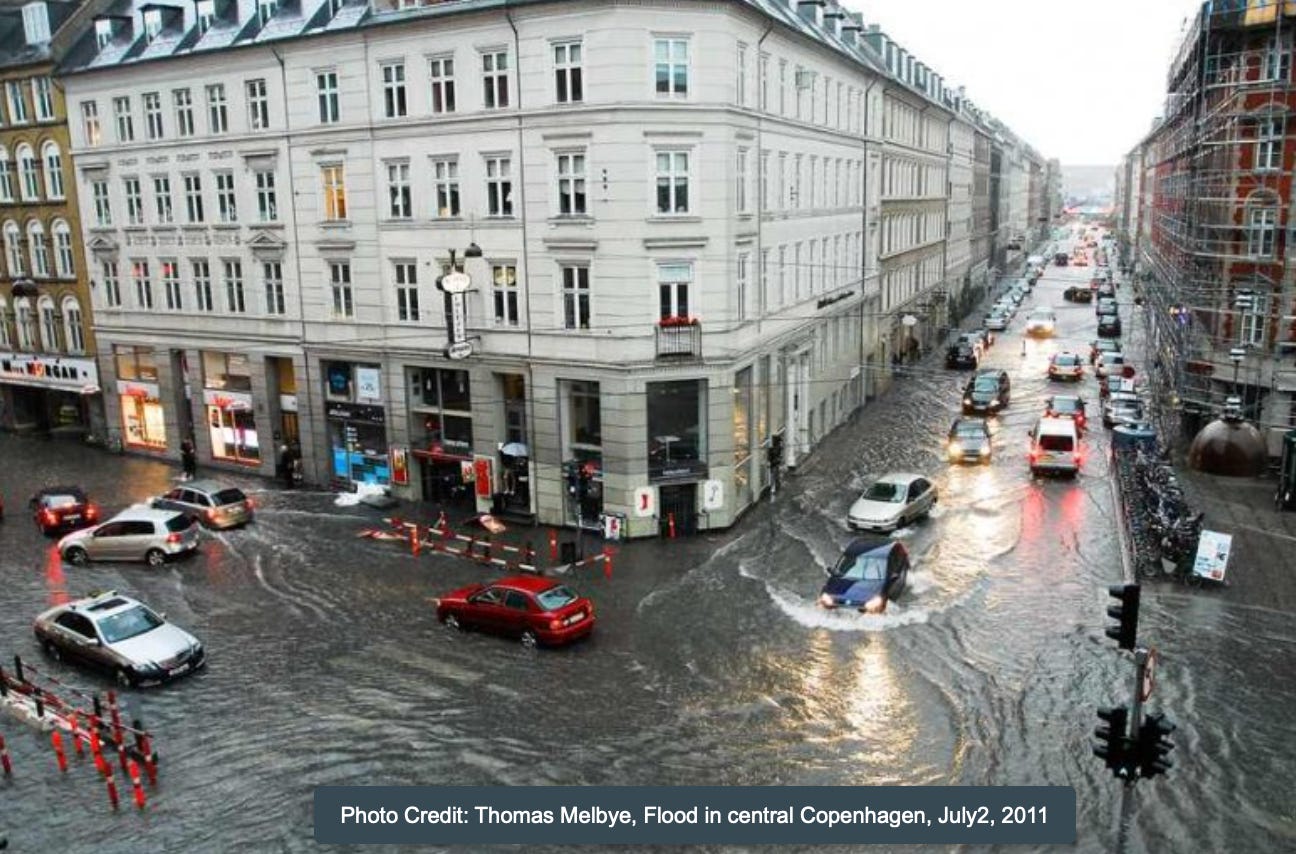
In Wednesday’s Brief 50, the protective feature was Japan’s local construction workforce, the crews who strengthen buildings before an earthquake and repair them after one, except that workforce is shrinking. Today, the economic moat is the flood protection Copenhagen residents agreed to pay for through their wastewater bills.
Copenhagen’s cloudburst plan has been cut, but not in the way the word suggests. The budget wasn’t cut. It rose, and the plan now costs DKK 15 billion. (DKK is the Danish krone.) What was cut is the protection standard that water bills cover. For future work funded by water tariffs, it dropped from a 100-year storm to a 10-year storm. Projects already underway keep the 100-year standard.
Here’s what that means in practice. The protection standard was the biggest storm the system is built to handle without flooding.
A 100-year standard sizes pipes, tunnels, and green streets to handle a 100-year cloudburst. That includes every 10-year rain event, since those are smaller.
A 10-year standard sizes them to carry only rain up to the 10-year level. Any storm bigger than that overflows onto streets and into basements, whether it’s a 20-, 50-, or 100-year storm.
The result is that protection shrinks. The old standard, designed to handle huge water volumes, already covered small, frequent storms by default. The loss is protection for the big, rare ones, which do most of the damage.
A 100-year rain, or cloudburst, implies a severe flood in water volume, and it has about a 1 percent chance of falling in any given year. A 10-year rain is less significant but has about a 10 percent chance of occurring in any given year. The U.S. Geological Survey points out that 100-year floods can happen two years in a row.
So if the model city for self-funded flood defense can scale back its defenses, who’s safe?
The Moment
On August 25, 2026, Copenhagen’s Finance Committee recommended long-term loans of DKK 82.9 million to pay off six climate adaptation projects already finished and running.
In public finance, cities often pay for a project with short-term money while it’s being built. Once it’s finished and the final cost is known, the city borrows new money to move that cost into a long-term loan of up to 25 years. The city passes the interest and repayments on to HOFOR, the utility whose wastewater tariffs fund the plan, so the city incurs no borrowing costs.
Three weeks after recommending loans to pay off those six completed projects, the City Council, the Borgerrepræsentationen, approved five new projects worth DKK 74.9 million in 2027 prices on September 17, 2026, also financed through HOFOR’s wastewater tariffs. However, the minutes state that the service level for tariff-financed climate adaptation has now changed from a 100-year event to a 10-year event. The vote was 43 for, with 12 abstaining.
Under the original plan, no more than 10 centimeters of water could stand at the boundary between public and private space during a 100-year rain.
The Story
Why did Copenhagen set the bar so high in the first place? On July 2, 2011, a cloudburst hit the city. A year later, Forsikring & Pension, the Danish insurers’ association, revised its tally of insured damages from an initial estimate of DKK 3 billion to about DKK 6 billion. The revised figure covered 90,644 claims, with 20,564 commercial claims accounting for roughly half the cost.
A Nordic insurance trade journal reported in 2011 that, after that event, some insurers told flooded customers such damage wouldn’t be covered in the future, and some customers had their policies canceled. At the same time, other insurers raised prices or deductibles. In other words, Copenhagen has already repriced once.
The community responded by paying for its own protection.
On November 26, 2015, the City Council adopted a 20-year cloudburst plan. HOFOR financed its above-ground surface projects through wastewater tariffs. The plan’s investment framework totaled DKK 11 billion in 2015 prices and also included private money, such as what landowners pay to disconnect their buildings’ rainwater from the sewer. The city originally planned about 300 surface projects. By 2023, it had reduced that to 242 because some weren’t needed and others were moved underground into pipes.
Then the national rules changed. In May 2020, politicians agreed on how wastewater utilities would pay for climate adaptation. The Folketing, the Danish parliament, passed the law in December 2020, and it took effect on January 1, 2021, after Climate, Energy and Utilities Minister Dan Jørgensen signed it. Under the new rules, a project paid for by water tariffs must be cost-effective and, under certain conditions, set at a socio-economically appropriate level.
Vandsektortilsynet, Denmark’s water sector regulator, says the purpose was to help protect consumers against unnecessarily high water prices. That was a cost decision. It wasn’t a finding about how often floods happen.
For Copenhagen, the city says water bills can now pay for physical construction to protect against a storm with about a 10% chance of hitting in any given year. In the inner city, it expects to protect against heavier, rarer storms, with about a 3% to 5% chance in a given year. Under the old standard, the system was built for a storm so severe it had only a 1% chance of occurring in a given year. The old rules still apply only to projects that began construction before January 1, 2027.
On December 12, 2024, the city formally dropped 179 planned projects at the planning stage, most because they could not start before the national deadline. The City Council approved that without a vote. Seven parties added a joint remark to the record, saying they agreed with great regret to annul 179 cloudburst projects, and that most were annulled because new legislation no longer lets the city protect to the level it expected.
In September 2024, Line Barfod of Enhedslisten, the city’s Mayor for Technical and Environmental Affairs, told the Danish news site Altinget the downgrade was completely absurd.
A draft status report from November 2025 says that before the law took effect, about 240 surface projects were planned to the 100-year standard. About 58 will be built to it, and 23 are in operation; six opened in 2024 and 2025. Of the DKK 4.6 billion frame for surface projects, DKK 1.7 billion (37%) had been committed in 2025 prices.
The word ‘cuts’ is what misleads most about the budget. The frame rose from DKK 11 billion in 2015 prices to DKK 15 billion in 2025 prices. The city’s own report says DKK 2.4 billion of that rise is simply an adjustment for higher prices. About DKK 1.6 billion of the rise is real, mostly because the tunnels cost more than assumed and some surface projects are being built as pipes instead.
The tunnels are the plan's backbone, and they come late. The Kalvebod Brygge tunnel is expected in 2027 and will drain about 200 hectares from Frederiksberg Øst and Vesterbro. The Valby tunnel is expected in 2028, and the Svanemøllen tunnel in 2033.
The CIP Foundation, in a June 2026 report on climate adaptation in Denmark, says Copenhagen’s cloudburst tunnels have been in the pipeline for 15 to 20 years, not because construction takes so long. The delay is in the decision-making, not the engineering.
Structural Forces
What holds a community’s flood defense up, and what pulls it down? I see four forces.
Force one: the community’s balance sheet works. The August 2026 loans weren’t the first. In June 2025, the city’s Technical and Environmental Committee approved DKK 82.6 million of long-term loans for three finished projects, at interest rates from 2.41% to 2.62% and terms of up to 25 years. HOFOR pays the costs through the wastewater tariffs, and the loans don’t count against the city’s available borrowing frame. In other words, residents’ water bills carry the debt, not the city budget.
Force two: the nation sets the ceiling. Across Denmark, utilities commissioned 104 climate adaptation projects from 2021 to 2025 for about DKK 2.1 billion, and 85% of that investment was in the Copenhagen area or Aarhus, according to Vandsektortilsynet. Water consumers cover those costs overwhelmingly through their tariffs. And in 2025, 57% of the capital investment was built to protect only against storms that have about a 20% chance of hitting in any given year. The community still pays, but the rule decides how much protection that buys.
Force three: the storms haven’t stopped. The CIP Foundation, relaying an estimate by DTU, the Technical University of Denmark, puts Denmark’s flood damage today at about DKK 9 billion per year, mostly from heavy rain. It says cloudbursts are now the largest annual cause of flood damage. DTU’s model expects about DKK 400 billion of flood damage across Denmark over the next 100 years, in fixed 2024 prices. Those are modeled national figures for every source of flooding, not Copenhagen alone. The 2021 rule was about what consumers pay. It didn’t make the rain any less dangerous.
Force four: insurers carry what the defenses don’t. In Denmark, ordinary home and contents insurance covers cloudburst damage. Storm surge from the sea is different, and owners can be covered through Naturskaderådet, the state’s natural damage council. Private insurers price cloudburst risk. Forsikring & Pension says Denmark saw almost 23,000 cloudburst claims in 2023, the highest number since the Copenhagen storm of 2011.
Back in September 2024, Pia Holm Steffensen, the association’s deputy director, told Altinget that insurance prices would, all else being equal, rise, and that the industry’s worst case would be homeowners who could no longer buy cloudburst coverage. Then in January 2025 she told Bolius, a Danish homeowner information service, that insurers differed on whether to raise premiums for everyone or price each property separately. The one bright side was that the cancellations after 2011 hadn’t returned as a trend.
As of 2026, the CIP Foundation expects premiums for cloudburst coverage to rise in the most exposed areas, and it warns that some areas and properties may no longer be insurable in the long term.
The Next Chapter
The next date that matters is January 1, 2027.
I suspect that after January 1, 2027, Copenhagen will appear as two cities on a flood map. Some catchments, meaning the areas that drain into the same set of pipes and surface projects, keep protection built to the old 100-year standard. Others will meet the new 10-year protection standard. I expect the first market sign in the downgraded catchments to come as cloudburst deductibles or exclusions at insurance renewal, not a headline premium change. That’s our forecast, not a sourced fact.
In Copenhagen, after a major cloudburst event in 2011, residents agreed to pay for their own protection through their wastewater bills. A national rule in force since 2021 made that protection shallower for future work. The moat isn’t gone, but it’s shallower and less effective than the community planned. But in the short term it kept their utility bills from increasing…
The Strategic Question
If the model city for self-funded flood defense scales back its protection, whose defenses remain safe?
I suggest you evaluate the following:
First, for each Copenhagen asset, determine which side of the 2027 line its catchment falls on. Is it served by one of the 23 projects in operation, by a project started before the deadline, or by a tunnel due in 2027, 2028, or 2033? Or was its project dropped?
Second, at the next insurance renewal, read the cloudburst deductible and the exclusions, not just the premium.
Third, look beyond Copenhagen. Wherever your assets rely on flood protection that residents or ratepayers fund, ask who sets the ceiling on what they may spend, and when that rule last changed.
The lesson isn’t that community defense fails. A community can agree to the protection, yet someone else may still choose short-term protection (capped water prices) over longer-term protection (preparation for the 100-year water).
As always, KNOW YOUR SIGNALS and BE CLIMATE READY!
Jamie
Go Deeper
This is a Story & Future Thinking brief, so there is no companion workbook. The blank master CRDF Signal Tracker™ and Deal Stress Test™ are free and available at climatereadyre.com/tools.
Related briefs
Same signal (S11 Public Finance & Infrastructure Capacity):
Next in sequence:
Brief 52 · Maui STR Phase-Out: 6,200 Condos Face Zoning Deadlines - coming soon
Sources
Every figure above includes the data coverage date, the publication date, and the date I verified it.
The plan’s cost—the cloudburst plan’s investment frame — rose from DKK 11 billion in 2015 prices to DKK 15 billion in 2025 prices; DKK 2.4 billion of the rise is price adjustment, and about DKK 1.6 billion is real, mostly due to more expensive tunnels and surface projects built as pipes.
City of Copenhagen, Technical and Environmental Administration, Klimatilpasningsredegørelsen 2025 (climate adaptation status report, draft) · Data as of 2025 prices · Published Nov 5, 2025 · Accessed Oct 2026
The city’s own frame, which includes landowners’ disconnection costs. It is not the utility’s wider figure, and the two are different scopes.
The new standard — tariff-funded work now protects against a 10-year rain, with 20- to 30-year protection expected in the inner city, for every project not physically started before January 1, 2027.
City of Copenhagen, Technical and Environmental Administration, Klimatilpasningsredegørelsen 2025 (climate adaptation status report, draft) · Data as of 2025 · Published Nov 5, 2025 · Accessed Oct 2026
The city’s reading of what the national rule means for Copenhagen. The rule itself is adopted law.
What a 100-year rain means — a 1 percent chance in any given year, and a 10-year event a 10 percent chance; 100-year floods can happen two years in a row.
U.S. Geological Survey, Water Science School, The 100-Year Flood · Data as of Definition · Published date not stated · Accessed Oct 2026
A definition only. Copenhagen’s standard is a rain event, not a river flood, but the probability meaning is the same.
The loans for finished projects — long-term loans of DKK 82.9 million for six completed climate adaptation projects, re-invoiced to HOFOR, so the city bears no borrowing cost.
City of Copenhagen, Finance Committee minutes, loans for six climate adaptation projects · Data as of Aug 25, 2026 · Published Aug 25, 2026 · Accessed Oct 2026
A committee recommended the projects to the City Council. The council did not open its final vote.
The new projects are at a lower standard—five new projects worth DKK 74.9 million in 2027 prices, with the service level changed from a 100-year event to a 10-year event; 43 for, 12 abstaining.
City of Copenhagen, City Council (Borgerrepræsentationen) minutes, climate adaptation project package 2026 · Data as of Sep 17, 2026 · Published Sep 17, 2026 · Accessed Oct 2026
The newest primary in this brief. It confirms the 10-year standard applies.
The 2011 cloudburst — insured damages revised from an initial DKK 3 billion to about DKK 6 billion, across 90,644 claims, with 20,564 commercial claims at about DKK 3.2 billion.
Altinget, relaying Forsikring & Pension · Data as of Jul 2, 2011 event · Published Aug 18, 2012 · Accessed Oct 2026
The insurers’ association revised its estimate, according to a news site. The association put the total at about DKK 6 billion.
How insurers reacted in 2011 — some insurers excluded future cover or canceled policies after the storm; others raised prices or deductibles.
Nordisk Försäkringstidskrift 3/2011 · Data as of 2011 · Published 2011 · Accessed Oct 2026
A trade journal’s account at the time, with no author named. Context for the first repricing, not a measure of it.
The original plan — a 20-year cloudburst plan adopted November 26, 2015; about 300 surface projects planned, reduced to 242 by 2023; at most 10 centimeters of water at the public-private boundary in a 100-year rain.
City of Copenhagen, Technical and Environmental Administration, Klimatilpasningsredegørelsen 2025 (climate adaptation status report, draft) · Data as of 2015 plan; 2023 count · Published Nov 5, 2025 · Accessed Oct 2026
The count fell before the 2021 law for other reasons, because some projects weren’t needed and others moved underground.
The national rule—Act no. 2210 of December 29, 2020, passed by the Folketing in December 2020 and in force January 1, 2021 —requires tariff-funded projects to be cost-effective and, under certain conditions, set at a socio-economically appropriate level. Old rules end for projects not started before January 1, 2027.
Retsinformation: Lov nr. 2210 af 29/12/2020 (Act no. 2210) · Data as of Dec 29, 2020 · Published Dec 29, 2020 · Accessed Oct 2026
Adopted and in force; the 2027 deadline was unchanged in the June and September 2026 primaries. The regulator says the purpose was to protect consumers from unnecessarily high water prices.
The 179 dropped projects — on December 12, 2024, the City Council annulled 179 planned cloudburst projects, most at the pre-analysis stage and most because they could not start before the national deadline; seven parties recorded their regret.
City of Copenhagen, City Council (Borgerrepræsentationen) minutes · Data as of Dec 12, 2024 · Published Dec 12, 2024 · Accessed Oct 2026
Approved without a vote. The parties’ remark says most projects, not all.
Where the plan stands — about 240 surface projects planned to the 100-year standard before the law, about 58 still to be built to it, 23 in operation; DKK 1.7 billion (37%) of the DKK 4.6 billion surface frame committed.
City of Copenhagen, Technical and Environmental Administration, Klimatilpasningsredegørelsen 2025 (climate adaptation status report, draft) · Data as of 2025 · Published Nov 5, 2025 · Accessed Oct 2026
A draft report. The 58 are projects at the old standard, not every project the city will build.
The tunnels — Kalvebod Brygge expected in 2027, draining about 200 hectares from Frederiksberg Øst and Vesterbro; Valby in 2028; Svanemøllen in 2033.
City of Copenhagen, Technical and Environmental Administration, Klimatilpasningsredegørelsen 2025 (climate adaptation status report, draft) · Data as of 2025 · Published Nov 5, 2025 · Accessed Oct 2026
Expected dates, not completions. Frederiksberg is a separate municipality.
Why the tunnels are slow — Copenhagen’s cloudburst tunnels have been in the pipeline for 15 to 20 years, and not because construction takes so long.
CIP Foundation, Climate adaptation in Denmark: how can we accelerate progress? (main report) · Data as of Jun 2026 · Published Jun 2026 · Accessed Oct 2026
A foundation’s characterization with no start year given. The link goes to the foundation’s homepage.
The balance sheet — DKK 82.6 million of long-term loans for three finished projects at 2.41% to 2.62% for up to 25 years, paid by HOFOR through wastewater tariffs and outside the city’s borrowing frame.
City of Copenhagen, Teknik- og Miljøudvalget (Technical and Environmental Committee), loans for three cloudburst projects · Data as of Jun 16, 2025 · Published Jun 16, 2025 · Accessed Oct 2026
The maximum term is 25 years, not the term of every loan.
The national picture — 104 utility climate adaptation projects commissioned in 2021 to 2025 for about DKK 2.1 billion, 85% of it in the Copenhagen area or Aarhus; in 2025, 57% of capital investment was built to a five-year level.
Vandsektortilsynet (Danish water sector regulator), Spildevandsselskabernes klimatilpasning i nøgletal 2026 · Data as of 2021-2025 · Published Jun 2026 · Accessed Oct 2026
National, all utilities. Not a Copenhagen figure.
The damage outlook — about DKK 9 billion of flood damage per year today, mostly from heavy rain, and about DKK 400 billion over the next 100 years in fixed 2024 prices.
CIP Foundation, Climate adaptation in Denmark: how can we accelerate progress? (main report), relaying DTU · Data as of 2024-2124, fixed 2024 prices · Published Jun 2026 · Accessed Oct 2026
A modeled national estimate for every source of flooding, relayed by a foundation; not Copenhagen alone. DTU’s own study was not opened.
The claims count — almost 23,000 cloudburst claims in Denmark in 2023, the highest since 2011.
Forsikring & Pension press release, via Ritzau · Data as of 2023 · Published Jun 29, 2026 · Accessed Oct 2026
The insurers’ association’s own national count. Not a Copenhagen figure.
The 2024 warning — insurance prices would, all else equal, rise, and the worst case would be homeowners who can no longer buy cloudburst cover.
Altinget, quoting Forsikring & Pension and Line Barfod · Data as of Sep 2024 · Published Sep 4, 2024 · Accessed Oct 2026
A warning, not a measured price change. The same article quotes the city’s mayor calling the downgrade completely absurd.
The insurers’ view — insurers differ on whether to raise premiums for everyone or price each property, and cancellations after 2011 have not returned as a trend.
Bolius (Realdania), quoting Forsikring & Pension · Data as of 2023-2025 · Published Jan 16, 2025 · Accessed Oct 2026
A description of practice, not a measured price change. No current measure of cloudburst repricing was found.
The forward view on premiums — premiums for cloudburst cover expected to rise in the most exposed areas, and some areas and properties may no longer be insurable in the long term.
CIP Foundation, Climate adaptation in Denmark: how can we accelerate progress? (main report) · Data as of Jun 2026 · Published Jun 2026 · Accessed Oct 2026
A forward view, not a measurement.
Commentary and analysis only. Not investment, financial, legal, tax, or professional advice. CRDF tools are illustrative; examples are composites drawn from public data. Do your own due diligence and consult qualified professionals.
I run this analysis on specific deals. If you own or lend against property that depends on flood defenses someone else funds, book 20 minutes.
Jamie Wolf, MBA — Founder & Publisher, Climate-Ready Real Estate Investing, © 2026, CR REI Holdings LLC