
FORTIFIED Roof Claims Data: 73% Fewer Claims and What Carriers Now Reward
Insurance-Grade Construction — Brief 31 · Market Intelligence

For years, “build it stronger” was a values argument. It has become an underwriting one — and the carrier is writing the spec sheet.
Insurers have stopped only pricing damage after the fact and started rewarding resilience before it. In a $393 trillion global real estate market, that single shift flips the incentive running through the entire supply chain. What a carrier will insure, and on what terms, increasingly dictates what a developer specifies, what a builder builds, and what a manufacturer makes.
Read through Signal 1 (insurance repricing and availability), Signal 9 (codes, zoning and land use), and Signal 12 (resilience economics).
Market Signal
This is not a soft, values-driven trend.
Boards now treat insurability as a business-continuity input — a precondition for operating rather than a back-office line item. The World Economic Forum documented that board-level shift at the end of 2025, and Chubb frames climate resilience as core risk management rather than corporate citizenship.
The supply-side question underneath all three signals is simple: when the carrier writes the spec sheet, are you building to it?
Case Study
Start with the proof the spec works, because that is what lets a carrier underwrite it.
After Hurricane Sally came ashore on the Alabama coast in 2020, a peer-reviewed study from the University of Alabama’s Center for Risk and Insurance Research examined more than 40,000 insured properties. Homes built to the FORTIFIED standard — stronger roof, sealed deck, rated openings, continuous load path — took 63% less roof damage than standard homes.
But the number that should get a builder’s attention is not the damage figure. It is the claims data. FORTIFIED Roof homes filed 73% fewer insurance claims and posted 72% lower total losses. Build to the higher FORTIFIED Gold tier, and it was 76% fewer claims and 67% lower losses.
That is not a brochure promise or a modeled projection. It is observed claims experience across 40,000 real policies — exactly the kind of evidence a carrier can put into a rate filing and reward with a discount, or with the simple decision to keep writing the policy at all.
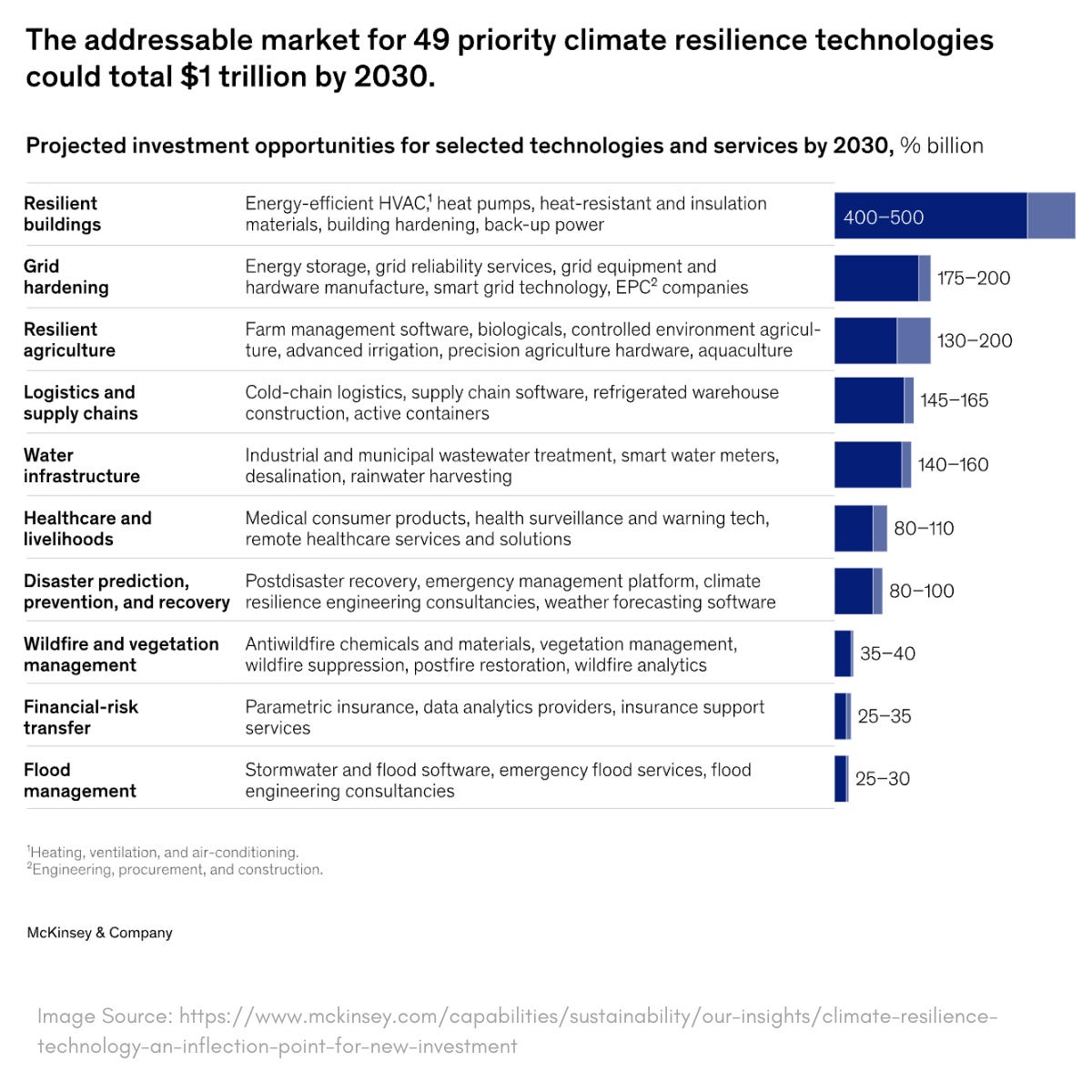
Now follow the capital, because it is moving toward that evidence. McKinsey estimates climate resilience and adaptation technologies represent an addressable market of roughly $600 billion to $1 trillion by 2030, growing 7–11% a year. Those are precisely the products the supply side makes.
So here is the opportunity and the threat in one sentence: the builder or manufacturer whose product earns a carrier credit — or simply keeps the asset insurable — wins the bid, and the one whose product cannot be insured is quietly designed out of the project.
For a manufacturer, “earning a carrier credit” is becoming concrete and testable rather than a marketing claim. It means a listed assembly, an impact or wind rating, tested fire performance, an environmental product declaration — documentation an underwriter’s model can actually ingest. The FORTIFIED data is the template: when performance is measured on real claims and published, the carrier can price it, the lender can rely on it, and the developer can specify it with confidence.
Strategic Implications
Three forces are reshaping the supply chain around this signal, and they are arriving together.
Insurability is the new procurement filter (Signal 1). Where coverage is scarce or repricing fast, the insurable product wins by default. The developer specifies whatever keeps the asset insurable and financeable, and the product that cannot be covered is removed from the catalog. That is not a future state — carriers and boards already treat coverage as continuity risk, which means the procurement decision is increasingly made by the underwriter, one step before the architect.
The code is catching up to the carrier (Signal 9). Building codes and public-procurement rules are steadily mandating what carriers already reward. The supply side faces the same specification from two directions at once: the insurer who prices it today, and the code that will require it tomorrow. Building to the carrier’s standard is increasingly the same thing as building to the next code cycle — which makes the carrier’s reward an early-warning system for where the code is going.
Tariffs and shipping set the cost of compliance (Signal 12). None of this happens in a frictionless market. Under Section 232, the United States now carries 50% tariffs on imported steel and aluminum, and the pass-through is showing in the indexes: the producer price index for steel mill products up around 13%, iron and steel roughly 10% year over year, aluminum shapes by as much as a third. Cushman & Wakefield estimates overall construction-material costs are up about 6% against the 2024 baseline, pushing total project costs up around 3%.
The geography of that cost is the real story. Domestic US hot-rolled steel coil has traded above $1,200 a metric ton — more than double the roughly $570 in Southeast Asia. That gap is a map of risk and opportunity at once. The supplier who can deliver compliant, resilient product reliably at a predictable landed cost captures a premium; the one exposed to a tariff line or a throttled shipping lane watches the insurance-grade spec become unaffordable to hit.
Put the three together, and the playbook writes itself. Certify to the standard the carrier already rewards. Watch the code, because it is following the carrier. Engineer the supply chain so you can deliver compliant product at a knowable cost even when a tariff lands. Miss one and you are exposed: a great product you cannot deliver on time, a cheap product the carrier will not reward, or a compliant product priced out by a supply shock.
Future Signal
The shift to watch next: resilience stops being a discount and becomes the price of admission.
Today, building to the insurance-grade spec earns a credit on the wind or fire portion of a premium. As parametric and mitigation-linked products mature, “insurance-grade” will increasingly be the minimum required to get a quote at all in exposed markets — and the supply side that has already certified will be the only one left in the room when the quote is written.
Expect three things now moving separately to converge into one specification: the carrier’s underwriting standard, the building code, and the public-procurement floor. When they line up — and they are lining up — there will be effectively one global resilience spec a manufacturer designs to once and sells everywhere. That is a forward-looking call, so treat it as directional. But the direction is not subtle.
The takeaway: build to what the carrier rewards, because it is becoming what the market requires. Insurability is migrating from a cost you pay to a spec you sell against. Specify, certify and lock your supply chain to that standard before the code and the carrier make it mandatory — not after.
Log the signals in your own markets. The CRDF Signal Tracker™ is built on these exact observations — free, no signup: CRDF Signal TrackerTM Brief 31
New to the framework? The blank master workbooks are at climatereadyre.com/tools.
Sources
Every figure above, with the period it covers, when it was published, and when it was verified.
FORTIFIED roofs took less damage in Hurricane Sally — 63% less roof damage
IBHS · Data as of 2020 · Published 2025 · Accessed Jul 2026 · High confidence
Peer-reviewed FORTIFIED claims and loss outcomes — Roof: 73% fewer claims, 72% lower losses; Gold: 76% / 67%
CRIR, University of Alabama Culverhouse · Data as of 2020 · Published 2025 · Accessed Jul 2026 · High confidence
Climate-resilience technology addressable market — $600B–$1T by 2030; 7–11% CAGR
McKinsey · Data as of 2025 · Published 2025 · Accessed Jul 2026 · Medium confidence
Boards treat insurability as a business-continuity input — Insurance products tied to board resilience
World Economic Forum · Data as of 2025 · Published 2025 · Accessed Jul 2026 · Medium confidence
Climate resilience as core risk management (carrier-side) — Resilience as continuity risk
Chubb · Data as of 2025 · Published 2025 · Accessed Jul 2026 · Medium confidence
Section 232 steel/aluminium tariffs raise construction costs — 50% tariffs; pass-through to inputs
Construction Dive · Data as of 2025 · Published 2025 · Accessed Jul 2026 · High confidence
Tariff drag on construction and project costs — Materials +6% vs 2024; project costs +~3%
Cushman & Wakefield · Data as of 2026 · Published 2026 · Accessed Jul 2026 · Medium confidence
Steel-price divergence — US hot-rolled coil ~$1,201.50/mt vs ~$571/mt SE Asia; PPI steel products +13.3%, iron & steel +10.4%; aluminium +~33%
S&P Global / GMK Center · Data as of 2026 · Published 2026 · Accessed Jul 2026 · Medium confidence
Supply-chain resilience in the climate era — Resilient sourcing as strategic input
MIT Sloan · Data as of 2024 · Published 2024 · Accessed Jul 2026 · Medium confidence
Commentary and analysis only — not investment, financial, legal, tax, or professional advice. CRDF tools are illustrative; examples are composites drawn from public data. Do your own due diligence and consult qualified professionals.
I run this analysis on specific deals. If you are underwriting an asset in an exposed market and need the insurance and exit assumptions pressure-tested before you sign, book 20 minutes.
Jamie Wolf, MBA — Founder & Publisher, Climate-Ready Real Estate Investing